
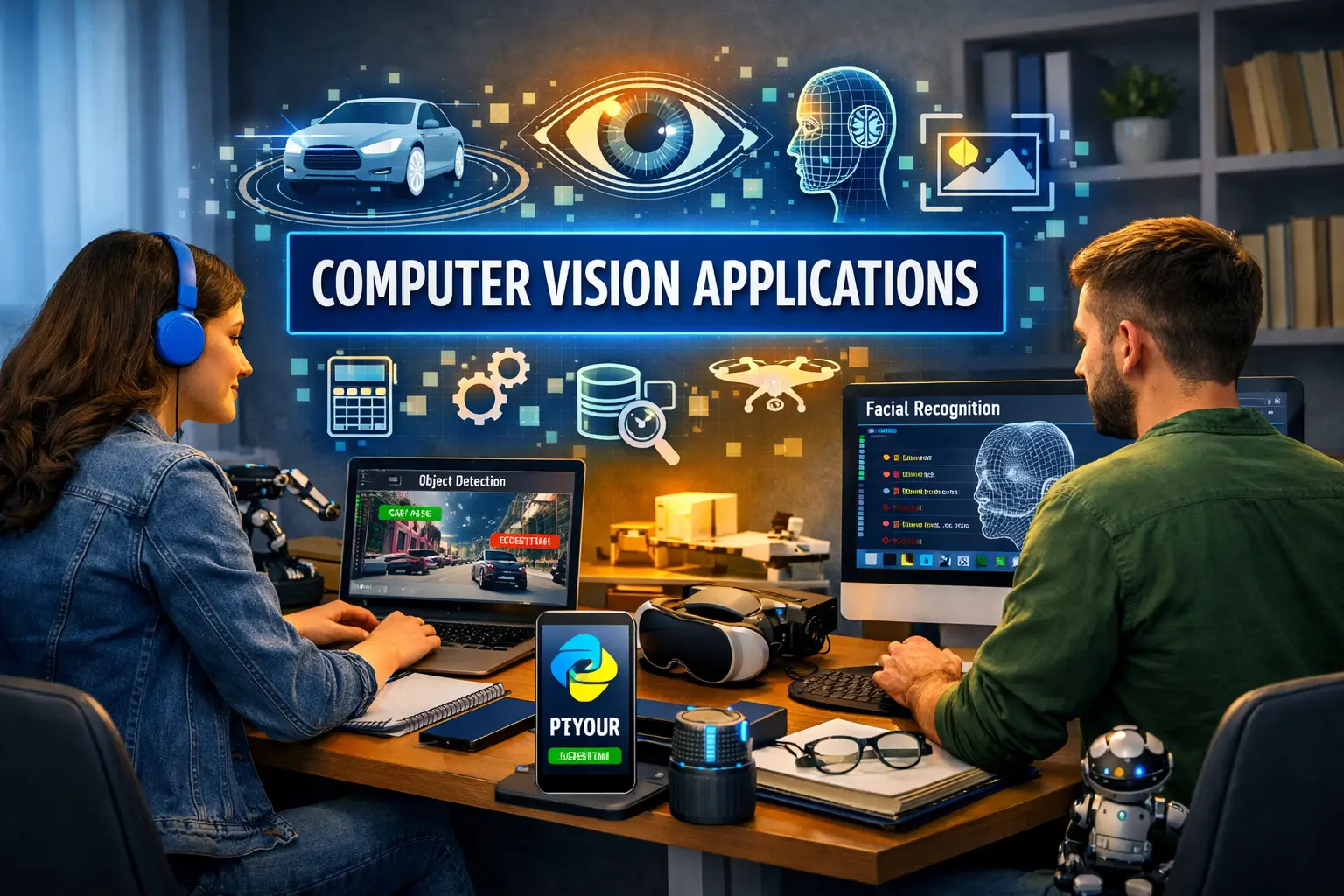
Unlock the potential of artificial intelligence with our Computer Vision Applications course, designed to provide learners with the knowledge and skills to develop systems that interpret and analyze visual data. Computer vision is one of the fastest‑growing fields in AI, enabling machines to “see” and make decisions based on images and videos. This course offers a structured foundation in computer vision techniques, equipping participants with practical strategies to succeed in both academic and professional environments.
Learners will explore the fundamentals of image processing, feature extraction, and object detection. The curriculum emphasizes convolutional neural networks (CNNs), deep learning frameworks, and advanced techniques such as semantic segmentation and facial recognition. Participants will gain insights into how computer vision integrates with industries like healthcare, automotive, retail, and security.
A major focus of the course is on practical application. Students will learn how to build vision models using Python libraries such as OpenCV, TensorFlow, and PyTorch. Real‑world case studies highlight how computer vision powers applications like medical imaging, autonomous vehicles, surveillance systems, and augmented reality.
The course also introduces learners to modern developments in computer vision, including edge AI, generative vision models, and multimodal systems that combine vision with natural language processing. By understanding how innovation and ethics shape computer vision, participants will be prepared to adapt to evolving AI landscapes.
Whether you are a student, developer, or researcher, this course equips you with actionable knowledge and confidence. By the end of the program, learners will be able to design, train, and deploy computer vision applications that solve real‑world problems.
Key Benefits:
- Understand image processing, feature extraction, and object detection
- Learn CNNs, deep learning, and semantic segmentation
- Explore applications in healthcare, automotive, retail, and security
- Gain skills in OpenCV, TensorFlow, and PyTorch
- Prepare for modern trends like edge AI and multimodal vision systems
FAQ SECTION
1. What is computer vision?
Computer vision is a branch of artificial intelligence that enables computers to analyze and interpret images and videos.
2. Is this Computer Vision Applications Course suitable for beginners?
Yes, the course introduces computer vision concepts in a beginner-friendly manner.
3. What skills will I learn?
You will learn image processing, object detection, facial recognition, visual analysis, and AI-powered vision technologies.
4. Do I need programming experience?
Basic technical knowledge is helpful, but prior programming experience is not mandatory.
5. What industries use computer vision?
Healthcare, automotive, manufacturing, retail, agriculture, robotics, and security industries widely use computer vision technologies.
6. Does the course cover AI concepts?
Yes, artificial intelligence and machine learning concepts are integrated throughout the curriculum.
7. Will I receive a certificate?
Yes, learners receive a course completion certificate.
8. What is object detection?
Object detection is the process of identifying and locating objects within images or video streams.
9. Can computer vision improve career opportunities?
Yes, computer vision skills are highly valued in AI, automation, and technology sectors.
10. What should I study after this course?
Advanced machine learning, deep learning, AI engineering, and image processing courses are recommended.





Reviews
There are no reviews yet.