
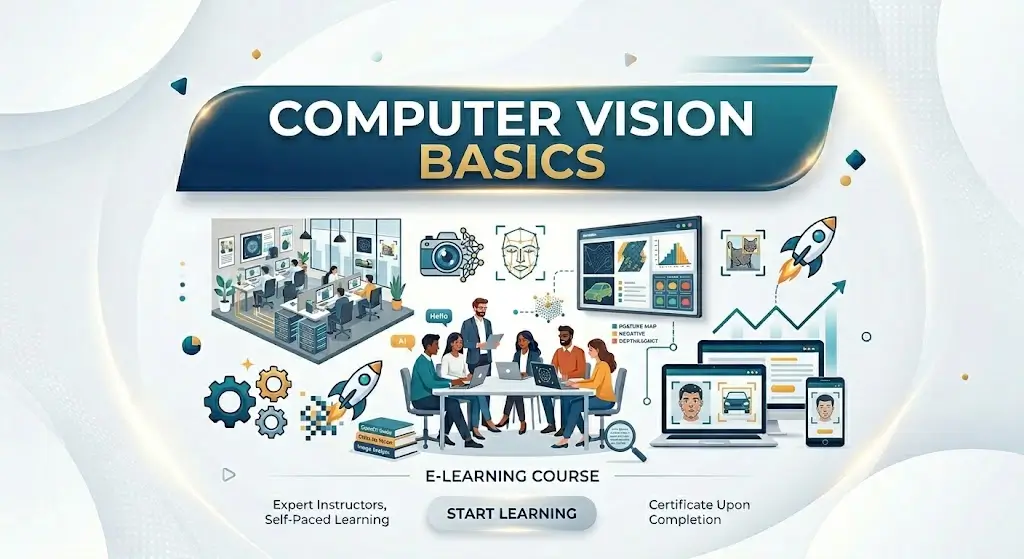
Introduction to the Computer Vision Basics Course
The Computer Vision Basics Course is a beginner-friendly program designed to help learners understand how computers analyze and interpret images and videos. Computer Vision is one of the fastest-growing areas of Artificial Intelligence (AI), enabling machines to recognize objects, identify patterns, and make decisions based on visual information.
Today, Computer Vision is used in healthcare, manufacturing, retail, transportation, agriculture, robotics, and security systems. As a result, professionals with Computer Vision knowledge are becoming increasingly valuable across industries. This course provides a strong foundation for students, technology enthusiasts, and professionals who want to explore visual AI technologies.
What is Computer Vision?
Computer Vision is a branch of Artificial Intelligence that allows computers to understand visual information from images and videos. Unlike humans, computers do not naturally recognize objects or environments. Instead, they analyze pixels and use algorithms to identify patterns and extract useful information.
For example, Computer Vision systems can recognize faces, detect vehicles, classify products, and analyze medical scans. Therefore, Computer Vision plays a critical role in modern AI applications.
Why Choose the Computer Vision Basics Course?
The Computer Vision Basics Course helps learners understand how visual AI technologies work in real-world environments. Additionally, it introduces key concepts that support further learning in Artificial Intelligence, Machine Learning, and Data Science.
Benefits of this course include:
- Understanding Computer Vision fundamentals
- Learning image processing concepts
- Exploring AI-powered visual systems
- Developing analytical thinking skills
- Preparing for advanced technology courses
- Building industry-relevant knowledge
Consequently, learners gain practical awareness of technologies shaping the future.
Image Processing Fundamentals
Image processing is an essential part of Computer Vision. Before analyzing images, systems often improve image quality through various processing techniques.
Common image processing methods include:
- Noise reduction
- Image resizing
- Brightness adjustment
- Contrast enhancement
- Edge detection
- Color correction
Furthermore, these techniques help improve the accuracy of image analysis and object recognition systems.
Object Detection and Image Recognition
Object detection allows computers to identify and locate objects within images or videos. For example, systems can detect people, vehicles, animals, products, or machinery.
Similarly, image recognition enables computers to classify images into categories. These technologies are widely used in retail, transportation, healthcare, and security applications.
As a result, organizations can automate processes that traditionally required human observation.
Facial Recognition and Pattern Recognition
Facial recognition is one of the most popular applications of Computer Vision. It analyzes facial features and compares them with stored information to verify identities.
Likewise, pattern recognition helps systems identify recurring shapes, textures, and visual structures. Consequently, businesses can improve security, quality control, and operational efficiency.
Moreover, pattern recognition supports applications in healthcare diagnostics, manufacturing inspection, and scientific research.
Machine Learning and Computer Vision
Machine Learning plays a major role in modern Computer Vision systems. Instead of relying only on manually programmed rules, Machine Learning enables computers to learn from large datasets.
Additionally, Machine Learning improves the accuracy of object detection, image classification, and visual analysis systems. Therefore, it has become a core component of Computer Vision technology.
As organizations generate more visual data, Machine Learning continues to enhance the capabilities of AI-powered systems.
Applications of the Computer Vision Basics Course
The knowledge gained from the Computer Vision Basics Course can be applied across multiple industries.
Healthcare
Computer Vision supports medical image analysis, disease detection, and diagnostic assistance.
Manufacturing
Organizations use visual inspection systems to identify product defects and improve quality control.
Retail
Retailers utilize Computer Vision for inventory management, customer behavior analysis, and automated checkout systems.
Agriculture
Farmers use visual analytics to monitor crops, detect diseases, and improve productivity.
Transportation
Autonomous vehicles and traffic management systems rely heavily on Computer Vision technologies.
Consequently, Computer Vision has become a valuable tool for innovation and automation.
Skills Learned in the Computer Vision Basics Course
After completing the Computer Vision Basics Course, learners will develop:
- Computer Vision fundamentals
- Image processing knowledge
- Object detection awareness
- Image recognition concepts
- Pattern recognition understanding
- Machine Learning foundations
- Visual analytics skills
- AI technology awareness
- Problem-solving abilities
- Analytical thinking skills
Furthermore, these competencies provide a strong base for future AI and technology studies.
Career Opportunities After Computer Vision Basics Course
The demand for Computer Vision professionals continues to grow. As businesses adopt Artificial Intelligence solutions, new career opportunities are emerging across industries.
Potential career paths include:
- Computer Vision Analyst
- AI Support Specialist
- Visual Analytics Assistant
- Image Processing Associate
- Data Annotation Specialist
- AI Operations Executive
- Technology Research Assistant
Therefore, learning Computer Vision fundamentals can support long-term career development.
Future of Computer Vision
The future of Computer Vision is highly promising. For example, autonomous vehicles are becoming more advanced through improved visual recognition capabilities. Similarly, healthcare organizations are adopting AI-powered diagnostic imaging systems.
In addition, smart cities are using visual analytics for traffic monitoring and public safety. Meanwhile, robotics companies continue integrating Computer Vision into intelligent automation systems.
As a result, Computer Vision technologies will continue expanding across industries and daily life.
Conclusion
The Computer Vision Basics Course provides a practical introduction to visual AI technologies. Through topics such as image processing, object detection, image recognition, pattern recognition, and Machine Learning, learners gain valuable knowledge that can be applied across numerous industries.
Moreover, the Computer Vision Basics Course helps build a strong foundation for future learning in Artificial Intelligence, Machine Learning, Data Science, and Robotics. Therefore, it serves as an excellent starting point for anyone interested in modern technology and innovation.
FAQ SECTION
1. What is the Computer Vision Basics Course?
It is a beginner-level course that teaches how computers analyze and understand images and videos.
2. Who should take this course?
Students, AI enthusiasts, technology learners, and professionals interested in Artificial Intelligence.
3. Do I need coding experience?
No, the course is designed for beginners.
4. What skills will I learn?
You will learn image processing, object detection, image recognition, and Computer Vision fundamentals.
5. Is Computer Vision part of AI?
Yes, Computer Vision is one of the most important branches of Artificial Intelligence.
6. Is Computer Vision in demand?
Yes, Computer Vision skills are increasingly valuable across healthcare, manufacturing, retail, and technology industries.
7. Will I receive a certificate?
Yes, a certificate is awarded after successful course completion.
8. Is this course useful for future AI learning?
Absolutely. The Computer Vision Basics Course provides a strong foundation for advanced AI and Machine Learning studies.
9. Is this useful for future AI learning?
Absolutely. Computer Vision provides a strong foundation for advanced AI, Machine Learning, and Deep Learning studies.
10. What skills will I gain?
You will gain knowledge of image analysis, visual AI systems, computer vision concepts, machine learning foundations, and analytical thinking skills.




Reviews
There are no reviews yet.