
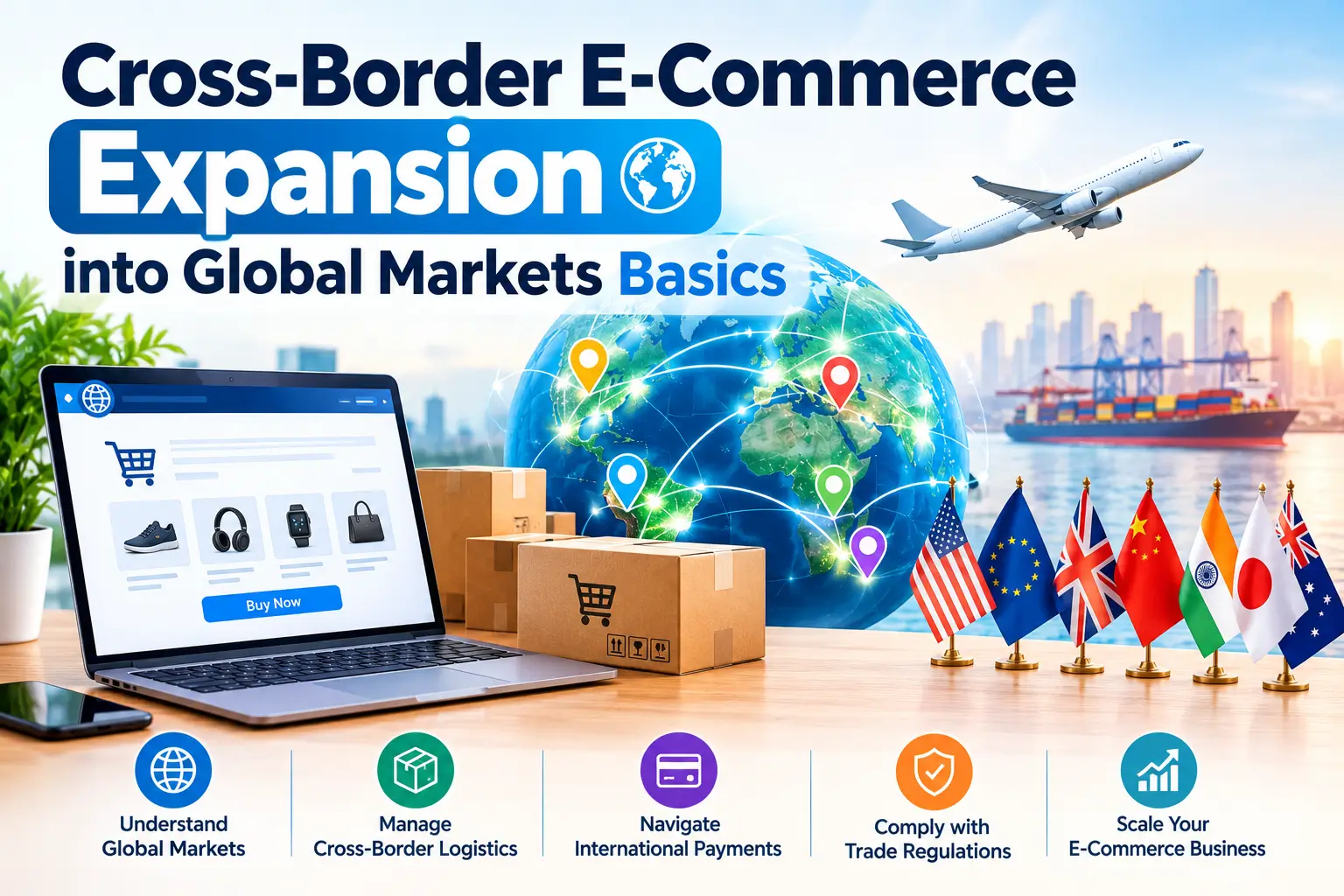
Cross-Border E-Commerce Expansion into Global Markets Basics
Learn the Fundamentals of Global E-Commerce Expansion
The growth of digital commerce has created opportunities for businesses to reach customers beyond their domestic markets. However, entering international markets involves more than simply making a website available in another country.
Cross-Border E-Commerce requires businesses to consider market demand, customer expectations, pricing, payments, logistics, localization, regulations, taxation, customer service, and returns.
This course provides a beginner-friendly introduction to the key concepts involved in expanding an e-commerce business into global markets.
What You Will Learn
Throughout the course, learners will explore:
- Fundamentals of cross-border e-commerce
- International e-commerce opportunities
- Global market research
- Market selection and evaluation
- International customer behavior
- Market-entry strategies
- E-commerce localization
- International pricing considerations
- Currency and payment considerations
- Cross-border shipping and logistics
- Customs and import/export considerations
- Tax and regulatory considerations
- International customer service
- Returns and refunds
- Risk considerations
- Global e-commerce strategy fundamentals
Understanding Cross-Border E-Commerce
Cross-border e-commerce involves online transactions where buyers and sellers are located in different countries.
For businesses, this can create opportunities to reach new customer groups, diversify markets, and expand their online presence.
At the same time, international expansion can introduce additional operational and commercial considerations.
This course helps learners understand these considerations through a structured framework.
Identifying Global Market Opportunities
Successful international expansion begins with selecting the right markets.
You will learn the basic factors businesses can consider when evaluating potential markets, including:
- Market demand
- Customer demographics
- Competition
- Purchasing behavior
- Market size
- Product-market fit
- Local preferences
- Digital commerce maturity
- Operational feasibility
Rather than expanding everywhere at once, businesses can use structured market evaluation to prioritize markets that align with their products, capabilities, and objectives.
International Customer and Market Research
Customers in different markets may have different expectations regarding products, pricing, communication, payment methods, delivery, and customer support.
The course introduces basic approaches for researching international customers and understanding market-specific requirements.
Learners will explore how customer insights can influence:
Product → Pricing → Messaging → Website Experience → Payment → Delivery → Customer Support
E-Commerce Localization
Entering a global market often requires adapting the customer experience to local expectations.
Topics include:
- Language localization
- Localized product information
- Currency presentation
- Local payment preferences
- Market-specific messaging
- Customer support expectations
- Local delivery information
- Cultural considerations
The objective is to create an online shopping experience that is easier for international customers to understand and use.
International Payments and Currency
Payment preferences can vary between markets.
Learners will explore the basic considerations involved in accepting international payments, including:
- Payment methods
- Currency conversion
- Pricing in local currencies
- Transaction considerations
- Payment security
- Customer trust
Understanding payment expectations is an important part of planning a cross-border e-commerce operation.
Cross-Border Logistics and Shipping
International delivery introduces additional operational considerations.
The course introduces:
- International shipping
- Delivery timelines
- Shipping costs
- Fulfillment options
- Customs processes
- Import considerations
- Tracking
- Returns logistics
Learners will understand why logistics planning should be considered before launching into a new international market.
Customs, Taxes and Compliance
Cross-border transactions can involve country-specific customs, tax, and regulatory requirements.
This course introduces these areas at a foundational level so learners understand why compliance research is an essential part of international expansion.
Requirements can differ significantly by country, product category, transaction structure, and business model, so businesses should verify applicable requirements before entering a specific market.
Global Market Entry Strategy
Learners will explore basic approaches for entering international markets.
A simple framework is:
Market Research → Market Selection → Localization → Pricing → Payments → Logistics → Launch → Measurement → Optimization
This framework can help businesses organize the major decisions involved in international e-commerce expansion.
Measuring International E-Commerce Performance
After entering a new market, businesses need to evaluate performance.
You will explore basic international e-commerce metrics such as:
- Traffic
- Conversion rate
- Average order value
- Customer acquisition cost
- Revenue
- Repeat purchases
- Return rate
- Delivery performance
- Market-level profitability
These indicators can help businesses identify which markets and strategies are performing effectively.
Who Should Take This Course?
This course is suitable for:
- E-commerce beginners
- Business owners
- Entrepreneurs
- Digital marketers
- E-commerce professionals
- International business students
- Marketing professionals
- Export-oriented businesses
- Online retailers
- Startup teams
- Business development professionals
It is particularly useful for learners who want to understand the fundamentals before developing a more advanced international e-commerce strategy.
Learning Outcomes
After completing this course, learners should be able to:
- Explain the fundamentals of cross-border e-commerce
- Identify key factors in global market selection
- Understand basic international customer considerations
- Recognize localization requirements
- Understand international payment considerations
- Identify key cross-border logistics challenges
- Recognize customs, tax, and regulatory considerations
- Develop a basic global market-entry framework
- Identify important international e-commerce performance metrics
- Understand the major components of a cross-border expansion strategy
Why Learn Cross-Border E-Commerce?
Global e-commerce can provide businesses with access to customers outside their domestic markets, but international growth requires careful planning.
Learning the fundamentals of Cross-Border E-Commerce can help professionals and business owners better understand the decisions involved in evaluating and entering global markets.
This course provides a foundation that learners can use before progressing into advanced international e-commerce, global marketing, export strategy, or cross-border business topics.
Start learning the fundamentals of Cross-Border E-Commerce and build a stronger foundation for expanding online into global markets.
Frequently Asked Questions
1. What is cross-border e-commerce?
Cross-border e-commerce refers to online buying and selling between customers and businesses located in different countries.
2. What will I learn in this Cross-Border E-Commerce course?
You will learn the basics of global market selection, international customers, localization, pricing, payments, logistics, customs, compliance, customer service, and market-entry strategy.
3. Is this Cross-Border E-Commerce course suitable for beginners?
Yes. This is a fundamentals-level course designed to introduce learners to the key concepts involved in international online business expansion.
4. Why do businesses expand into international e-commerce markets?
Businesses may expand internationally to reach new customers, explore additional market opportunities, diversify revenue sources, and grow beyond their domestic market.
5. What should a business consider before entering a global market?
Important considerations can include market demand, competition, customer behavior, localization, pricing, payments, logistics, regulations, taxes, and operational capabilities.
6. What is e-commerce localization?
E-commerce localization involves adapting an online shopping experience to the language, currency, preferences, expectations, and other market-specific requirements of customers in a particular country or region.
7. Does cross-border e-commerce involve international shipping?
It can. Depending on the business model and fulfillment structure, international orders may require cross-border shipping, customs processing, tracking, and international returns management.
8. What are the challenges of cross-border e-commerce?
Common challenges can include logistics, delivery costs, customs, regulatory requirements, taxes, currency differences, payment preferences, localization, customer support, and returns.
9. Who should learn cross-border e-commerce?
Entrepreneurs, e-commerce professionals, digital marketers, online retailers, business owners, students, and professionals interested in international market expansion can benefit from learning the fundamentals.
10. Can this course help me plan international market expansion?
Yes. The course provides a foundational framework for evaluating international opportunities and understanding the major areas involved in developing a cross-border e-commerce expansion strategy.



Reviews
There are no reviews yet.