
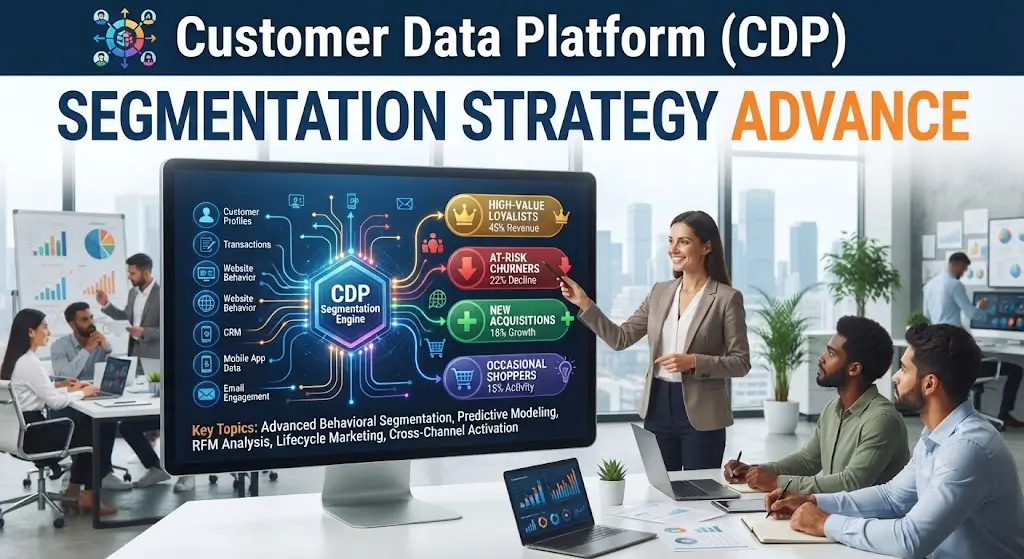
Customer Data Platform (CDP) Segmentation Strategy Advance
Introduction
The Customer Data Platform (CDP) Segmentation Strategy Advance course is an advanced training program designed for professionals who want to develop stronger customer segmentation and audience targeting skills.
Modern businesses collect customer information from many touchpoints. Websites, mobile applications, CRM systems, ecommerce platforms, email campaigns, social media, and customer service channels can all generate valuable data.
However, collecting data is only the first step. Marketing teams need to organize and interpret that information to create useful customer segments.
A Customer Data Platform can connect customer information across multiple sources. It can also support unified profiles, behavioral analysis, audience creation, and campaign activation.
This advanced course focuses on applying those capabilities strategically. Learners will explore advanced segmentation models, behavioral signals, lifecycle stages, customer value, predictive insights, personalization, audience activation, testing, and performance optimization.
The course is designed to move beyond basic segmentation. Instead, it focuses on how businesses can create more precise, actionable, and measurable audience strategies.
Understanding Advanced CDP Segmentation
Advanced CDP segmentation uses multiple customer data points to create more meaningful audiences.
Basic segmentation may group customers by age, location, or purchase history. Advanced segmentation can combine several signals at once.
These signals may include:
- Purchase behavior
- Website activity
- Product interests
- Email engagement
- Customer value
- Lifecycle stage
- Channel preferences
- Content interactions
- Frequency of activity
- Recency of purchases
By combining these signals, marketers can create more specific audience definitions.
For example, a business could identify customers who recently purchased a product, frequently visit related pages, and show high engagement with email content.
As a result, the business can design a campaign that directly matches the audience’s current behavior.
Building Advanced Customer Profiles
A unified customer profile provides a foundation for advanced segmentation.
Customer profiles may combine information from:
- CRM systems
- Ecommerce platforms
- Websites
- Mobile applications
- Email platforms
- Customer service systems
- Loyalty programs
- Advertising channels
When these data points are connected, marketers can understand customer interactions across different channels.
Furthermore, unified profiles can reduce fragmented customer information.
A more complete profile allows marketing teams to analyze both historical and recent customer activity.
Advanced Customer Data Analysis
Advanced segmentation requires more than collecting customer information.
Marketing teams should examine patterns within the data.
Important questions may include:
- Which products interest customers?
- How frequently do customers purchase?
- Which channels generate engagement?
- Which customers are becoming inactive?
- Which customers have high value?
- Which audiences respond to specific campaigns?
These questions help marketers identify useful segmentation opportunities.
Therefore, customer data analysis should remain connected to specific business goals.
Behavioral Segmentation
Behavioral segmentation is a major part of advanced audience strategy.
Instead of focusing only on customer characteristics, behavioral segmentation examines customer actions.
Signals may include:
- Product views
- Website visits
- Search activity
- Purchases
- Cart activity
- Email clicks
- Content downloads
- App sessions
- Customer service interactions
These behaviors can reveal customer intent.
For instance, customers who repeatedly view a product may show stronger purchase intent than customers who have never interacted with it.
Consequently, behavioral segments can support more relevant campaign strategies.
Predictive Segmentation
Predictive segmentation uses available customer data to identify likely future behaviors.
Businesses may analyze signals related to:
- Purchase likelihood
- Churn risk
- Customer value
- Engagement probability
- Product interest
- Repeat purchase potential
Predictive insights can help marketing teams prioritize audiences.
For example, customers with a high likelihood of purchasing may receive product-focused campaigns. Meanwhile, customers with increasing churn risk may receive retention communication.
As a result, marketers can move from reactive targeting toward more proactive strategies.
Lifecycle Segmentation
Customers move through different stages during their relationship with a business.
Common lifecycle stages include:
- Prospect
- New customer
- Active customer
- Repeat customer
- Loyal customer
- At-risk customer
- Inactive customer
Each stage can require a different marketing approach.
For example, new customers may need onboarding content. Loyal customers may respond better to loyalty offers.
Meanwhile, at-risk customers may need targeted retention campaigns.
Therefore, lifecycle segmentation can help marketers align communication with customer needs.
Customer Value Segmentation
Customer value provides another advanced segmentation dimension.
Businesses can evaluate customers using factors such as:
- Total spending
- Purchase frequency
- Average order value
- Customer lifetime value
- Profitability
- Recency
High-value customers may require different engagement strategies from low-frequency customers.
For example, a company could create a high-value customer segment for exclusive offers and loyalty programs.
This approach can help businesses allocate marketing resources more effectively.
RFM Segmentation
RFM analysis evaluates customers based on:
- Recency
- Frequency
- Monetary value
Recency shows how recently a customer purchased.
Frequency measures how often the customer purchases.
Monetary value reflects how much the customer spends.
Together, these factors can create useful customer groups.
For example, customers with strong scores across all three areas may represent highly valuable audiences.
Meanwhile, customers with low recency but strong historical value may be suitable for reactivation campaigns.
Combining Multiple Segmentation Variables
Advanced segmentation often combines several conditions.
For example, marketers can combine:
- Customer location
- Product interest
- Purchase frequency
- Engagement level
- Customer value
- Lifecycle stage
A segment could include high-value customers in a specific region who recently purchased a particular product and remain highly engaged.
Such segments can provide more precise targeting.
However, marketers should avoid unnecessary complexity.
Dynamic Segmentation
Customer behavior changes continuously.
A customer may become active after receiving a campaign. Another customer may become inactive after several months without interaction.
Dynamic segments can update as customer data changes.
For example, a customer can automatically move from an active segment to an at-risk segment when engagement declines.
Therefore, dynamic segmentation can help marketers maintain current audiences.
Micro-Segmentation
Micro-segmentation divides broader audiences into smaller groups with highly specific characteristics.
For example, a general segment might include repeat customers.
A micro-segment could focus on repeat customers who:
- Purchased within the last 30 days
- Show interest in a specific product
- Open marketing emails frequently
- Have a high customer value
Micro-segments can support highly relevant campaigns.
However, they should remain large enough to produce meaningful results.
Predictive Audience Targeting
Predictive targeting can help identify customers who are likely to respond to particular campaigns.
Potential predictive signals include:
- Previous purchases
- Engagement trends
- Browsing activity
- Product interest
- Customer value
- Response to previous campaigns
These signals can help marketing teams prioritize audiences.
As a result, campaign resources can be focused on customers with stronger potential.
Intent-Based Segmentation
Customer intent can provide valuable targeting information.
Intent signals may include:
- Repeated product searches
- Frequent product page visits
- Comparison activity
- Pricing page visits
- Content downloads
- Cart activity
High-intent customers may require different communication from customers who are only exploring.
Therefore, intent-based segments can support more timely marketing actions.
Engagement Scoring
Engagement scoring assigns values to customer interactions.
For example, marketers can evaluate:
- Email opens
- Email clicks
- Website visits
- Content downloads
- Product views
- Purchases
Higher engagement scores can indicate stronger customer interest.
These scores can then support audience segmentation.
For instance, highly engaged customers can receive advanced product content, while low-engagement customers can enter re-engagement campaigns.
Personalization Strategy
Advanced segmentation creates a strong foundation for personalization.
Marketing teams can customize:
- Email messages
- Product recommendations
- Website content
- Promotional offers
- Advertising
- Mobile experiences
- Customer communications
Personalization should be relevant to customer behavior.
For example, customers who show interest in a specific category can receive content related to that category.
Consequently, personalized communication can become more useful and timely.
Cross-Channel Audience Strategy
Customers interact with businesses across many channels.
A CDP can help marketers understand these interactions within a broader customer profile.
Cross-channel segmentation can support:
- Website
- Mobile
- Advertising
- Social media
- SMS
- Customer service
For example, a customer who engages with an email and later visits a product page may qualify for a different audience.
Therefore, cross-channel signals can improve campaign coordination.
Audience Activation
Creating segments is not enough.
Marketing teams must also activate those audiences.
Audience activation may involve sending segments to:
- Email platforms
- Advertising platforms
- CRM systems
- Marketing automation tools
- Personalization systems
- Customer engagement platforms
The goal is to connect segmentation with real marketing actions.
As a result, customer data can support measurable campaign activity.
Segment Overlap Management
Customers may belong to several segments at the same time.
For example, one customer could qualify as:
- High-value
- Highly engaged
- Recent purchaser
- Product-interest audience
Without proper management, the customer may receive conflicting messages.
Therefore, marketers should establish segment priorities and communication rules.
These rules can help determine which campaign should take precedence.
Frequency and Contact Management
Advanced segmentation should consider how often customers receive communication.
Too many messages can create fatigue.
Marketing teams can manage contact frequency by defining rules for:
- Maximum campaign exposure
- Channel frequency
- Promotional messages
- Transactional communication
- Retention campaigns
Consequently, segmentation can support both targeting and customer experience.
Audience Suppression
Not every customer should receive every campaign.
Suppression segments can exclude customers who:
- Recently purchased
- Already converted
- Requested no promotional communication
- Are outside the target market
- Have already received a similar offer
This approach can reduce unnecessary communication.
It can also improve campaign efficiency.
Campaign Personalization
Advanced segments can support campaign-specific personalization.
For example, an ecommerce campaign could create separate audiences for:
- New customers
- Repeat customers
- High-value customers
- Product-interest customers
- Inactive customers
Each audience can receive a different message.
Therefore, campaign personalization becomes more strategic.
Testing Segmentation Strategies
Segmentation should be tested before being considered final.
Marketing teams can compare different audience definitions.
Testing may include:
- Broad vs narrow segments
- Behavioral vs demographic criteria
- Single-variable vs multi-variable segments
- Static vs dynamic audiences
- Personalized vs general campaigns
A/B testing can reveal which approach generates better outcomes.
As a result, marketers can improve their segmentation strategy using actual performance data.
Measuring Segment Performance
Every important segment should have measurable outcomes.
Useful metrics include:
- Conversion rate
- Revenue
- Engagement rate
- Click-through rate
- Purchase frequency
- Retention rate
- Churn rate
- Customer lifetime value
- Campaign response
- Return on marketing investment
These metrics help determine whether a segment is useful.
Furthermore, performance measurement allows teams to identify segments that require adjustment.
Segment Optimization
Customer segments should not remain unchanged forever.
Business objectives and customer behavior can change over time.
Marketing teams should regularly review:
- Segment size
- Segment performance
- Data quality
- Customer movement
- Campaign response
- Conversion trends
Poor-performing segments may need new criteria.
Meanwhile, successful segments can be expanded or used for additional campaigns.
Data Quality for Advanced Segmentation
Accurate segmentation depends on reliable data.
Common data quality problems include:
- Duplicate customer records
- Missing information
- Incorrect values
- Outdated profiles
- Conflicting customer identifiers
- Inconsistent data formats
These issues can affect targeting accuracy.
Therefore, marketing teams should monitor data quality as part of their segmentation process.
Privacy and Responsible Customer Data Use
Advanced segmentation requires responsible data practices.
Marketing teams should consider:
- Customer consent
- Data usage permissions
- Access controls
- Communication preferences
- Data security
- Retention requirements
Customer data should be used according to applicable laws and organizational policies.
Furthermore, personalization should not compromise customer trust.
Common Advanced Segmentation Challenges
Organizations may experience several challenges.
These include:
- Fragmented customer data
- Poor data quality
- Complex segmentation rules
- Small audience sizes
- Overlapping segments
- Weak campaign integration
- Limited data literacy
- Inconsistent customer identifiers
Each challenge can affect campaign performance.
A practical approach is to start with clear objectives and build segmentation complexity gradually.
Advanced CDP Segmentation Best Practices
Define Clear Business Objectives
Every segment should support a specific marketing or customer goal.
Use Multiple Relevant Signals
Combine meaningful data points without creating unnecessary complexity.
Keep Segments Actionable
A segment should lead to a clear marketing action.
Use Dynamic Segmentation
Allow audiences to change as customer behavior changes.
Monitor Segment Overlap
Create rules to manage customers who qualify for multiple campaigns.
Maintain Data Quality
Reliable customer information improves targeting accuracy.
Test Audience Definitions
Compare different segmentation approaches before scaling them.
Measure Performance
Use meaningful metrics to evaluate segment effectiveness.
Review Segments Regularly
Customer behavior and business goals can change.
Protect Customer Data
Apply appropriate privacy, security, and governance practices.
What You Will Learn
By completing the Customer Data Platform (CDP) Segmentation Strategy Advance course, learners will be able to:
- Understand advanced CDP segmentation
- Build unified customer profiles
- Analyze customer behavior
- Apply behavioral segmentation
- Develop predictive segments
- Create lifecycle audiences
- Apply customer value segmentation
- Use RFM segmentation
- Combine multiple segmentation variables
- Build dynamic segments
- Apply micro-segmentation
- Identify customer intent
- Develop engagement scores
- Create personalized audiences
- Support cross-channel targeting
- Activate customer segments
- Manage segment overlap
- Control communication frequency
- Build suppression audiences
- Test segmentation strategies
- Measure segment performance
- Optimize customer segments
- Improve data quality
- Apply responsible data practices
Skills You Will Gain
Learners will develop advanced skills in:
- CDP segmentation
- Customer data analysis
- Advanced audience targeting
- Behavioral analysis
- Predictive segmentation
- Lifecycle marketing
- Customer value analysis
- RFM analysis
- Micro-segmentation
- Customer profiling
- Audience activation
- Marketing personalization
- Cross-channel targeting
- Engagement scoring
- Segment optimization
- Campaign targeting
- Customer retention
- Re-engagement strategy
- Marketing analytics
- Customer data management
- Data-driven marketing
- Audience strategy
Benefits of This Course
Advanced Segmentation Skills
Learners develop practical skills for creating more precise customer audiences.
Better Audience Targeting
Advanced segmentation can help marketing teams reach customers with more relevant messages.
Improved Personalization
Customer behavior and preferences can support more meaningful marketing experiences.
Stronger Campaign Performance
Well-defined audiences can improve campaign relevance and measurement.
Better Customer Retention
Lifecycle and predictive segments can help identify customers who may require additional engagement.
Improved Customer Insights
Combining different data sources can provide a broader view of customer behavior.
More Efficient Marketing
Targeted audiences can help teams focus resources on relevant customer groups.
Better Data Utilization
Learners can understand how customer data can support strategic marketing decisions.
Who Should Enroll?
The Customer Data Platform (CDP) Segmentation Strategy Advance course is suitable for:
- Marketing Managers
- Digital Marketing Professionals
- CRM Managers
- CRM Specialists
- Customer Data Analysts
- Customer Insights Professionals
- Marketing Operations Specialists
- Marketing Technology Professionals
- Growth Marketing Professionals
- Lifecycle Marketing Specialists
- Customer Experience Professionals
- Ecommerce Professionals
- Email Marketing Specialists
- Audience Strategy Professionals
- Product Marketing Professionals
- Data-Driven Marketing Teams
- Business Owners
- Entrepreneurs
The course is particularly useful for professionals who already understand basic customer data or segmentation concepts and want to develop more advanced skills.
Career Opportunities
Advanced CDP segmentation knowledge can support career development across marketing, customer data, and customer experience functions.
Potential career paths include:
- Customer Data Analyst
- Senior CRM Specialist
- CRM Manager
- Customer Insights Analyst
- Marketing Data Analyst
- Marketing Operations Manager
- Marketing Technology Specialist
- Audience Strategy Manager
- Lifecycle Marketing Manager
- Growth Marketing Manager
- Customer Experience Manager
- Digital Marketing Manager
- Customer Engagement Manager
- Personalization Specialist
- Marketing Analytics Specialist
- Customer Segmentation Specialist
These skills can be applied across ecommerce, retail, technology, finance, healthcare, travel, education, media, telecommunications, and professional services.
Practical Applications
The concepts from this course can be applied to real marketing situations.
An ecommerce company can identify high-value customers who frequently browse a specific product category. It can then create personalized campaigns for that audience.
A subscription business can use engagement and lifecycle signals to identify customers at risk of cancellation.
Similarly, a retailer can combine purchase history, location, product interest, and customer value to create localized campaigns.
Email marketing teams can use engagement scores to separate active subscribers from inactive audiences.
Meanwhile, product marketers can identify customers with strong purchase intent based on browsing and content activity.
Advertising teams can use audience activation to deliver targeted campaigns to relevant customer groups.
As a result, advanced CDP segmentation can connect customer data with practical marketing actions.
Certification
Upon successful completion of the Customer Data Platform (CDP) Segmentation Strategy Advance course, learners receive a professional course completion certificate recognizing their knowledge of advanced customer segmentation, CDP strategy, behavioral analysis, predictive segmentation, lifecycle marketing, customer value analysis, audience activation, personalization, segment optimization, and data-driven marketing.
The certificate can strengthen a professional profile and demonstrate advanced knowledge relevant to CRM, digital marketing, customer data, marketing operations, customer experience, and audience strategy.
Conclusion
The Customer Data Platform (CDP) Segmentation Strategy Advance course provides advanced knowledge for professionals who want to use customer data more strategically.
Modern marketing requires more than broad audience targeting. Customers interact with brands across multiple channels, and their behavior can change quickly.
A well-structured CDP can help connect these interactions and create unified customer profiles.
From there, marketers can apply behavioral, predictive, lifecycle, value-based, RFM, intent-based, and micro-segmentation strategies.
Furthermore, advanced segmentation can support personalization, audience activation, retention, re-engagement, and cross-channel marketing.
The course also emphasizes testing, performance measurement, data quality, and responsible customer data use.
By applying these practices, marketing professionals can create more actionable audiences and make better use of customer information.
Whether your goal is to advance your career in CRM, customer data, digital marketing, marketing operations, personalization, customer experience, or audience strategy, this course provides practical knowledge for developing advanced CDP segmentation capabilities.
Frequently Asked Questions
1. What is the Customer Data Platform (CDP) Segmentation Strategy Advance course?
It is an advanced course focused on customer segmentation, behavioral analysis, predictive audiences, lifecycle strategies, personalization, audience activation, and segment optimization.
2. Who should take this advanced CDP course?
The course is suitable for marketing professionals, CRM specialists, customer data analysts, marketing operations teams, and customer experience professionals who want to improve their segmentation skills.
3. Do I need basic CDP knowledge?
Basic knowledge can be helpful. However, the course explains key concepts while focusing on more advanced segmentation applications.
4. What is advanced customer segmentation?
Advanced segmentation combines multiple customer data signals to create more precise and actionable audience groups.
5. What is predictive segmentation?
Predictive segmentation uses available customer information to identify audiences based on likely future behaviors, such as purchasing, engagement, or churn.
6. How does behavioral segmentation work?
Behavioral segmentation groups customers based on actions such as purchases, website activity, product views, email engagement, and content interactions.
7. What is RFM segmentation?
RFM segmentation evaluates customers using recency, frequency, and monetary value. It can help identify valuable and strategically important customer groups.
8. Can CDP segmentation support personalization?
Yes. Customer segments can help marketers create more relevant messages, offers, recommendations, and experiences.
9. How can segmentation improve customer retention?
Marketers can identify at-risk or inactive customers and create targeted campaigns designed to improve engagement and encourage continued relationships.
10. Will I receive a certificate after completing the course?
Yes. Learners receive a professional course completion certificate after successfully completing the Customer Data Platform (CDP) Segmentation Strategy Advance course.



Reviews
There are no reviews yet.