
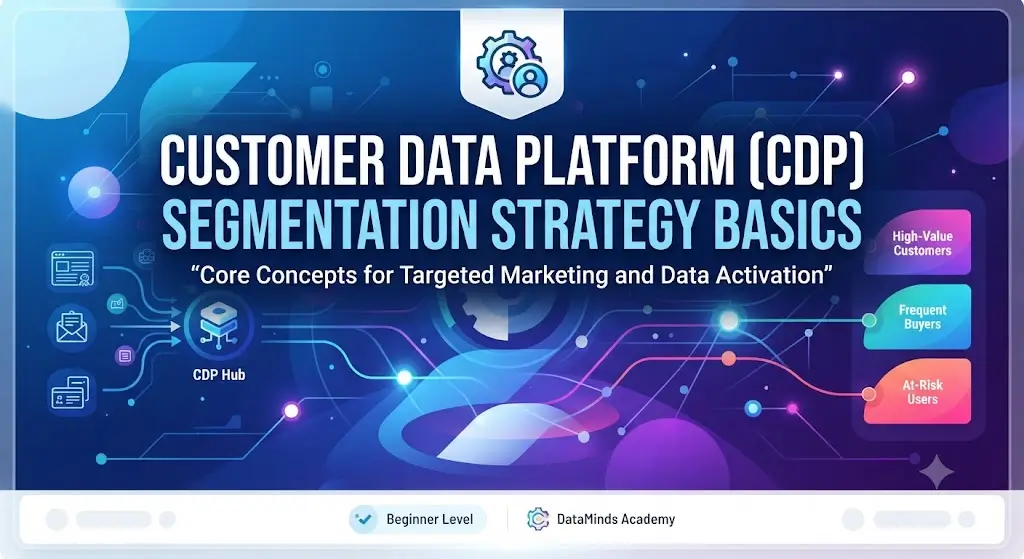
Customer Data Platform (CDP) Segmentation Strategy Basics
Introduction
The Customer Data Platform (CDP) Segmentation Strategy Basics course is a practical training program designed to help learners understand how customer data can be organized, analyzed, and used for effective audience segmentation.
Modern businesses collect customer information from many sources. These sources may include websites, mobile applications, email campaigns, social media, ecommerce platforms, CRM systems, and customer service interactions. As a result, marketing teams often have large amounts of customer data to manage.
A Customer Data Platform can bring this information together into unified customer profiles. Once data is organized, businesses can create meaningful audience segments based on customer characteristics, behaviors, interests, and engagement patterns.
This course introduces the fundamentals of CDP segmentation and explains how segmentation can support targeted marketing, customer engagement, personalization, and campaign planning.
Learners will explore customer data types, profile creation, segmentation criteria, behavioral analysis, audience targeting, personalization, campaign activation, and segmentation best practices.
Understanding Customer Data Platforms
A Customer Data Platform is designed to collect and organize customer information from multiple sources.
A CDP can help businesses create more complete customer profiles by bringing together data from different interactions.
Common data sources include:
- Websites
- Mobile applications
- CRM platforms
- Ecommerce systems
- Email marketing tools
- Social media channels
- Customer service systems
- Loyalty programs
- Advertising platforms
Instead of viewing each interaction separately, businesses can connect customer information across these sources.
Therefore, marketers can gain a broader understanding of customer behavior and preferences.
What Is Customer Segmentation?
Customer segmentation involves dividing a larger customer population into smaller groups with shared characteristics.
Segments can be created using different criteria.
For example, businesses may group customers according to:
- Age
- Location
- Purchase history
- Product interests
- Website behavior
- Engagement level
- Customer value
- Purchase frequency
- Communication preferences
Effective segmentation makes marketing communication more relevant.
Furthermore, businesses can create different messages for different customer groups instead of sending identical content to everyone.
Why CDP Segmentation Matters
Customer data becomes more useful when it can support specific marketing decisions.
CDP segmentation can help businesses:
- Improve audience targeting
- Create personalized campaigns
- Understand customer behavior
- Improve customer engagement
- Support retention strategies
- Identify high-value customers
- Improve campaign relevance
- Reduce irrelevant communication
For example, a business can create a segment of customers who recently purchased a product. It can then develop a follow-up campaign that matches their purchase behavior.
As a result, marketing teams can make better use of customer information.
Types of Customer Data
Understanding different types of customer data is important for effective segmentation.
Demographic Data
Demographic data may include:
- Age
- Gender
- Location
- Occupation
- Household information
This data can help marketers understand broad customer characteristics.
Behavioral Data
Behavioral data focuses on customer actions.
Examples include:
- Website visits
- Product views
- Purchases
- Email clicks
- Content downloads
- App activity
- Search behavior
Behavioral information can reveal what customers actually do.
Transactional Data
Transactional data includes information about purchases and orders.
It may cover:
- Purchase frequency
- Order value
- Product categories
- Purchase dates
- Discounts used
- Repeat purchases
Consequently, businesses can identify valuable customer patterns.
Engagement Data
Engagement data shows how customers interact with marketing content.
Examples include:
- Email opens
- Email clicks
- Website activity
- Social interactions
- Content engagement
- Campaign responses
This information can help marketers identify highly engaged and less engaged audiences.
Building Unified Customer Profiles
A key CDP function is creating unified customer profiles.
A customer may interact with a business through several channels. For instance, the same person may visit a website, download content, receive an email, and later make a purchase.
If these interactions remain separate, the customer journey can be difficult to understand.
A unified profile connects relevant information.
Therefore, marketers can gain a more complete view of customer activity.
Identifying Segmentation Criteria
Good segmentation begins with clear criteria.
Marketing teams should first define what they want to achieve.
Possible objectives include:
- Increasing purchases
- Improving retention
- Re-engaging inactive customers
- Promoting new products
- Increasing loyalty
- Improving email engagement
The objective should guide the segmentation criteria.
For example, a retention campaign may focus on customers whose purchase frequency has recently declined.
Demographic Segmentation
Demographic segmentation divides customers according to personal or household characteristics.
Common categories include:
- Age groups
- Geographic areas
- Occupations
- Household types
- Income ranges
This approach can be useful when customer needs vary across demographic groups.
However, demographic data should not be used in isolation.
Behavioral and transactional information can provide additional context.
Geographic Segmentation
Geographic segmentation groups customers according to location.
Businesses may segment audiences by:
- Country
- State
- City
- Region
- Market
- Climate zone
For example, a retailer can promote region-specific products based on customer location.
Similarly, global businesses can create localized campaigns for different markets.
Behavioral Segmentation
Behavioral segmentation focuses on actions rather than basic customer characteristics.
Marketers can create segments based on:
- Website activity
- Purchase behavior
- Product interest
- Email engagement
- Content interaction
- App usage
- Browsing patterns
This type of segmentation can be especially useful for campaign personalization.
For instance, customers who repeatedly view a product but have not purchased it may respond to a different message than customers who have already bought the product.
Purchase-Based Segmentation
Purchase behavior provides valuable information for segmentation.
Customers can be grouped by:
- Purchase frequency
- Average order value
- Recent purchases
- Product categories
- Total spending
- Repeat purchase behavior
These segments can help marketers develop more relevant offers.
For example, frequent customers may receive loyalty-focused communication. Meanwhile, occasional customers may receive campaigns designed to encourage repeat purchases.
Engagement-Based Segmentation
Engagement segmentation groups customers based on their level of interaction.
Possible groups include:
- Highly engaged customers
- Moderately engaged customers
- Low-engagement customers
- Inactive customers
Each group may require a different strategy.
Highly engaged customers may respond well to new product announcements. In contrast, inactive customers may need re-engagement campaigns.
Customer Lifecycle Segmentation
Customer lifecycle segmentation considers where customers are in their relationship with a business.
Common stages include:
- Prospect
- New customer
- Active customer
- Repeat customer
- Loyal customer
- At-risk customer
- Inactive customer
Each stage can require different communication.
Therefore, lifecycle segmentation can help marketers align campaigns with customer needs.
Value-Based Segmentation
Not every customer contributes the same level of business value.
Value-based segmentation can consider:
- Total spending
- Average order value
- Purchase frequency
- Customer lifetime value
- Profitability
High-value customers may require retention and loyalty strategies.
Meanwhile, lower-value or new customers may receive campaigns designed to encourage greater engagement.
Creating Audience Segments
Creating a segment involves selecting criteria and defining clear conditions.
For example, a marketing team might create a segment for:
- Customers who purchased within the last 90 days
- Customers who viewed a product multiple times
- Customers who opened recent emails
- Customers who have not purchased recently
- Customers with high purchase value
The criteria should be specific enough to produce a useful audience.
At the same time, segments should remain large enough to support meaningful campaigns.
Combining Multiple Segmentation Criteria
Single criteria can provide useful information. However, combining multiple conditions can create more precise segments.
For example, marketers can combine:
- Location
- Purchase history
- Product interest
- Engagement
- Customer value
A retailer could create a segment of customers in a specific region who purchased a particular product and have remained highly engaged.
Consequently, campaign messaging can become more relevant.
Creating Dynamic Segments
Customer behavior changes over time.
A customer who was highly engaged last month may become inactive later.
Dynamic segments can update automatically as customer information changes.
For example, a customer can move from an active segment to an at-risk segment after a period of inactivity.
Therefore, dynamic segmentation can help marketing teams maintain current audiences.
Static vs Dynamic Segmentation
Static segments remain relatively fixed after they are created.
Dynamic segments change as customer data changes.
Static Segments
Static segmentation can be useful for:
- One-time campaigns
- Event lists
- Specific promotions
- Fixed customer groups
Dynamic Segments
Dynamic segmentation is useful for:
- Ongoing campaigns
- Lifecycle marketing
- Behavioral targeting
- Retention programs
- Personalization
Choosing the right approach depends on campaign objectives and data requirements.
Personalization Through Segmentation
Segmentation creates a foundation for personalized marketing.
Instead of sending the same message to every customer, businesses can tailor content according to segment characteristics.
Personalization may include:
- Product recommendations
- Email content
- Promotional offers
- Website experiences
- Advertising messages
- Loyalty communication
For example, customers interested in a particular product category can receive content related to that category.
As a result, marketing communication can become more relevant.
Using CDP Segmentation for Email Marketing
Email campaigns can benefit greatly from customer segmentation.
Marketers can create segments based on:
- Email engagement
- Purchase history
- Customer lifecycle
- Product interests
- Location
- Customer value
Different segments can receive different messages.
For instance, inactive subscribers may receive a re-engagement campaign, while active customers may receive product recommendations.
Using Segmentation for Campaign Targeting
Segmentation can improve campaign targeting across multiple channels.
Target audiences may include:
- New customers
- Repeat customers
- High-value customers
- Inactive customers
- Product-interest groups
- Highly engaged users
Once the audience is defined, marketers can select suitable messages and channels.
Therefore, segmentation can make campaign planning more structured.
Supporting Customer Retention
Retention is another important application of segmentation.
Businesses can identify customers who show signs of reduced engagement.
Potential indicators include:
- Declining purchase frequency
- Lower website activity
- Reduced email engagement
- Long periods without purchases
These customers can be placed into an at-risk segment.
Marketing teams can then create targeted retention campaigns.
Re-Engagement Segmentation
Inactive customers may still have potential value.
A re-engagement segment can identify customers who have stopped interacting with the business.
Marketers can then test:
- Special offers
- Reminder campaigns
- New product messages
- Personalized recommendations
- Content-based communication
Different approaches can be tested to determine what encourages customers to return.
Product Interest Segmentation
Product interest can be identified through customer behavior.
Useful signals include:
- Product page visits
- Search activity
- Product clicks
- Wishlist activity
- Content engagement
- Purchase history
These signals can help marketers understand customer interests.
Consequently, product-focused segments can support more relevant recommendations and campaigns.
Measuring Segment Performance
Creating a segment is only the beginning.
Marketing teams should measure how each audience performs.
Useful metrics include:
- Conversion rate
- Click-through rate
- Open rate
- Purchase rate
- Revenue
- Engagement rate
- Retention rate
- Customer lifetime value
These metrics can reveal which segments are responding effectively.
Furthermore, performance data can help marketers refine future segmentation strategies.
Testing Customer Segments
Segmentation should be treated as an ongoing process.
Teams can test different criteria to understand which combinations produce better results.
For example, marketers can compare:
- Broad vs narrow segments
- Behavioral vs demographic segments
- High-value vs general audiences
- Engaged vs inactive customers
Testing can reveal which audiences are most responsive.
As a result, segmentation can become more data-driven over time.
Avoiding Over-Segmentation
More segments do not always mean better marketing.
Creating too many small segments can make campaign management complicated.
Over-segmentation may also produce audiences that are too small for meaningful analysis.
Therefore, teams should focus on segments that have clear business value.
A useful segment should be:
- Relevant
- Measurable
- Reachable
- Large enough
- Actionable
Maintaining Data Quality
Segmentation depends on reliable customer data.
Incorrect or outdated information can produce inaccurate segments.
Marketing teams should monitor:
- Duplicate profiles
- Missing information
- Incorrect values
- Outdated records
- Inconsistent identifiers
Data quality processes can improve segmentation accuracy.
Moreover, regular data reviews can help maintain reliable customer profiles.
Data Privacy and Responsible Segmentation
Customer data should be handled responsibly.
Marketing teams should understand relevant privacy requirements and organizational policies when using customer information.
Important considerations may include:
- Consent
- Data access
- Data usage
- Customer preferences
- Security
- Retention
Segmentation strategies should support responsible data practices.
Therefore, marketers should balance personalization with appropriate data governance.
Common CDP Segmentation Challenges
Organizations may face several segmentation challenges.
These include:
- Incomplete customer data
- Duplicate profiles
- Poor data quality
- Unclear segmentation goals
- Too many segments
- Weak behavioral data
- Limited user adoption
- Inconsistent definitions
Each challenge requires a practical response.
For example, unclear goals can be addressed by defining campaign objectives before creating segments.
CDP Segmentation Best Practices
Define a Clear Objective
Start with the marketing outcome you want to achieve.
Use Relevant Data
Select data that directly supports the segmentation goal.
Keep Segments Actionable
Each segment should support a clear marketing action.
Combine Data Sources Carefully
Connected customer data can provide a broader view of customer behavior.
Maintain Data Quality
Clean and accurate data improves segmentation reliability.
Review Segments Regularly
Customer behavior changes, so segments should also evolve.
Avoid Unnecessary Complexity
Simple and useful segments are often easier to activate and measure.
Test and Improve
Use campaign performance data to refine segmentation rules.
Respect Customer Preferences
Segmentation should support responsible and transparent customer data use.
What You Will Learn
By completing the Customer Data Platform (CDP) Segmentation Strategy Basics course, learners will be able to:
- Understand Customer Data Platform fundamentals
- Explain customer segmentation principles
- Identify different types of customer data
- Build unified customer profiles
- Define segmentation objectives
- Create demographic segments
- Develop geographic segments
- Apply behavioral segmentation
- Use purchase-based segmentation
- Create engagement segments
- Apply lifecycle segmentation
- Develop value-based segments
- Combine multiple segmentation criteria
- Create dynamic audiences
- Compare static and dynamic segments
- Support personalized marketing
- Apply segmentation to email campaigns
- Improve campaign targeting
- Support customer retention
- Build re-engagement audiences
- Create product-interest segments
- Measure segment performance
- Test segmentation strategies
- Maintain customer data quality
- Apply responsible data practices
Skills You Will Gain
Learners will develop practical skills in:
- Customer segmentation
- CDP fundamentals
- Customer data analysis
- Audience targeting
- Behavioral analysis
- Customer profiling
- Data-driven marketing
- Lifecycle segmentation
- Purchase analysis
- Engagement analysis
- Customer personalization
- Campaign targeting
- Audience development
- Segment performance measurement
- Data quality management
- Customer retention
- Re-engagement strategy
- Marketing data management
- CDP segmentation strategy
Benefits of This Course
Better Customer Understanding
Learners can use customer data to identify meaningful patterns and audience characteristics.
More Relevant Marketing
Segmentation can help businesses deliver content and offers that match customer interests.
Improved Campaign Targeting
Well-defined audiences can make campaign planning more focused.
Stronger Personalization
Customer segments provide a foundation for more relevant communication.
Better Retention Opportunities
At-risk and inactive customer segments can support targeted retention campaigns.
Improved Data Utilization
Learners can understand how different customer data sources contribute to segmentation.
More Efficient Marketing
Clear segments can reduce unnecessary broad targeting and improve campaign focus.
Data-Driven Decision Making
Segment performance metrics can help marketers make better campaign decisions.
Who Should Enroll?
The Customer Data Platform (CDP) Segmentation Strategy Basics course is suitable for:
- Marketing Professionals
- Digital Marketing Specialists
- Marketing Managers
- CRM Professionals
- Customer Experience Professionals
- Customer Data Analysts
- Marketing Operations Specialists
- Email Marketing Professionals
- Growth Marketing Professionals
- Ecommerce Professionals
- Customer Success Teams
- Product Marketing Professionals
- Business Owners
- Entrepreneurs
- Marketing Technology Professionals
The course is also useful for professionals who work with customer data, audience targeting, personalization, CRM, or marketing campaigns.
Career Opportunities
Knowledge of CDP segmentation can support career development across marketing and customer data functions.
Potential career paths include:
- Customer Data Analyst
- CRM Specialist
- CRM Manager
- Digital Marketing Specialist
- Marketing Operations Specialist
- Customer Insights Analyst
- Audience Strategy Specialist
- Growth Marketing Specialist
- Marketing Data Analyst
- Customer Experience Specialist
- Lifecycle Marketing Specialist
- Email Marketing Specialist
- Marketing Technology Specialist
- Customer Engagement Manager
- Digital Marketing Manager
These skills can be applied across ecommerce, retail, technology, financial services, healthcare, education, media, travel, and many other industries.
Practical Applications
The concepts from this course can be applied to real marketing activities.
An ecommerce business can create segments based on purchase history and product interests. Meanwhile, a subscription business can identify customers who show declining engagement.
A retail company can create geographic segments for localized campaigns. Similarly, a B2B organization can group contacts based on engagement and account characteristics.
Email marketing teams can create audiences based on engagement levels. Product marketers can use behavioral data to identify customers interested in specific product categories.
Furthermore, customer service and loyalty teams can use customer profiles to understand different lifecycle stages.
As a result, CDP segmentation can support a wide range of marketing and customer engagement activities.
Certification
Upon successful completion of the Customer Data Platform (CDP) Segmentation Strategy Basics course, learners receive a professional course completion certificate recognizing their knowledge of customer data platforms, segmentation principles, audience targeting, customer profiling, behavioral analysis, lifecycle segmentation, personalization, campaign targeting, data quality, and segment performance measurement.
The certificate can strengthen a professional profile and demonstrate practical knowledge relevant to digital marketing, CRM, customer data, marketing operations, customer experience, and audience strategy.
Conclusion
The Customer Data Platform (CDP) Segmentation Strategy Basics course provides practical knowledge for professionals who want to understand how customer data can support more targeted and relevant marketing.
Modern organizations collect information from many customer touchpoints. Without proper organization, however, this information can be difficult to use effectively.
A CDP can help connect customer information and create unified profiles. From there, marketers can build segments based on demographics, behavior, purchases, engagement, lifecycle stage, and customer value.
Furthermore, effective segmentation can support personalization, campaign targeting, retention, re-engagement, and customer experience strategies.
The course also highlights the importance of data quality and responsible customer data practices. Good segmentation depends on reliable information and clear business objectives.
By applying the concepts covered in this course, learners can create more useful audience segments, improve marketing relevance, and make better use of customer data.
Whether your goal is to develop skills in customer data, CRM, digital marketing, marketing operations, customer experience, or audience strategy, this course provides a practical foundation for applying CDP segmentation principles.
Frequently Asked Questions
1. What is the Customer Data Platform (CDP) Segmentation Strategy Basics course?
It is a practical course that introduces customer data platforms, audience segmentation, customer profiling, behavioral analysis, targeting, personalization, and segment performance.
2. Who should take this course?
Marketing professionals, CRM specialists, customer data analysts, digital marketers, marketing operations teams, and customer experience professionals can benefit from the course.
3. Do I need previous CDP experience?
No. The course covers the fundamental concepts needed to understand and apply CDP segmentation strategies.
4. What types of customer data are used for segmentation?
Businesses can use demographic, geographic, behavioral, transactional, engagement, lifecycle, and customer value data.
5. How does a CDP support customer segmentation?
A CDP can connect customer information from different sources and create unified profiles. These profiles can then support more targeted audience segments.
6. What is behavioral segmentation?
Behavioral segmentation groups customers based on actions such as purchases, website visits, product views, email engagement, and app activity.
7. Can segmentation improve personalization?
Yes. Segmentation helps marketers create more relevant messages, offers, recommendations, and experiences for different customer groups.
8. How can segmentation support customer retention?
Marketers can identify inactive or at-risk customers and create targeted campaigns designed to increase engagement and encourage repeat purchases.
9. Why is data quality important for segmentation?
Accurate data helps marketers create reliable customer profiles and meaningful segments. Poor data can lead to incorrect targeting.
10. Will I receive a certificate after completing the course?
Yes. Learners receive a professional course completion certificate after successfully completing the Customer Data Platform (CDP) Segmentation Strategy Basics course.



Reviews
There are no reviews yet.