
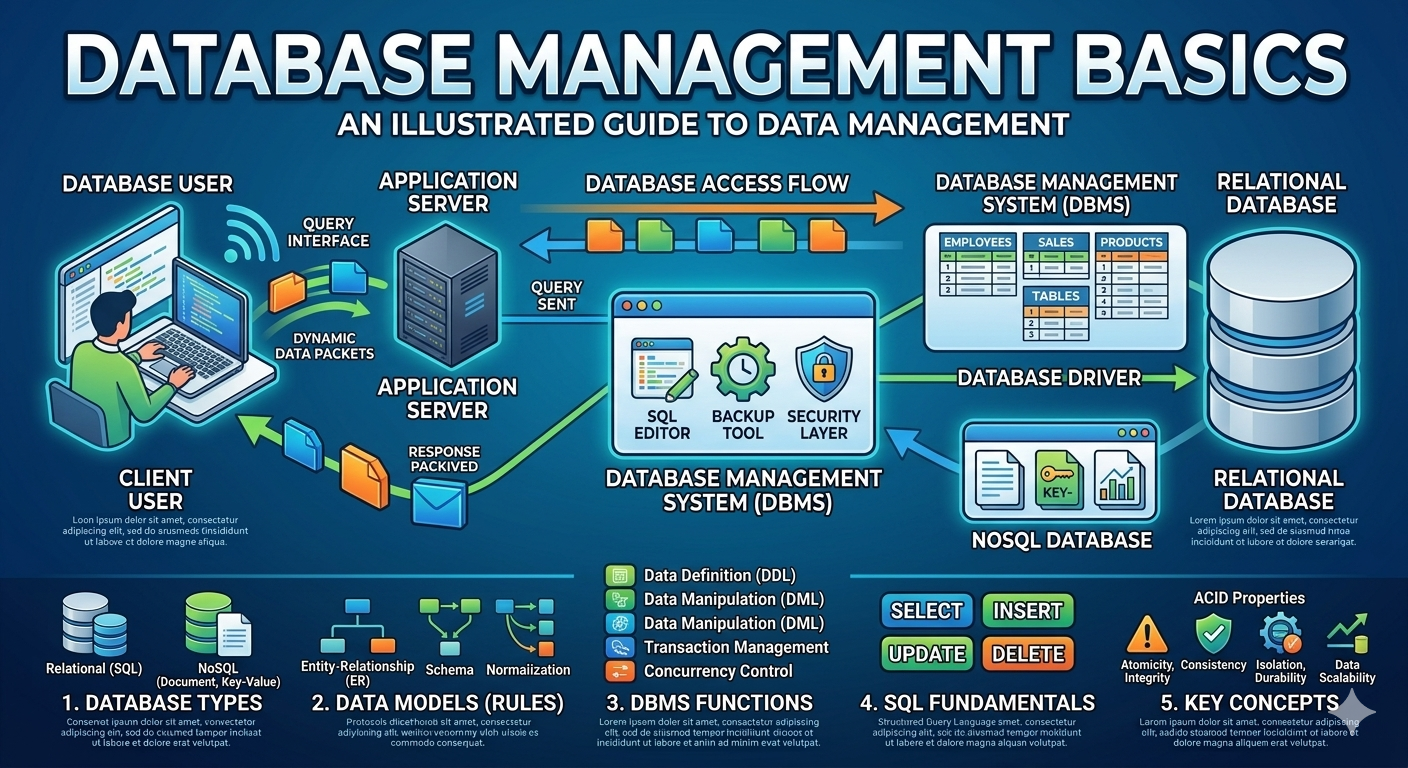
Database Management is the backbone of modern information systems, enabling organizations to store, organize, and retrieve data efficiently. This comprehensive course introduces learners to the fundamentals of database systems, covering essential concepts such as relational models, SQL queries, normalization, indexing, and transaction management.
Students will gain hands-on experience in designing and implementing databases, learning how to optimize performance and ensure data integrity. The course also explores advanced topics like distributed databases, cloud-based storage solutions, and database security practices, preparing learners for real-world applications in business, IT, and research.
By the end of this course, participants will be able to:
- Understand the principles of relational and non-relational databases.
- Write and optimize SQL queries for data manipulation and retrieval.
- Design efficient database schemas using normalization techniques.
- Implement indexing and transaction management for performance and reliability.
- Apply best practices in database security and backup strategies.
- Explore modern trends such as NoSQL, Big Data, and cloud database management.
This course is ideal for students, IT professionals, and entrepreneurs who want to master the art of managing data effectively. With practical examples, case studies, and project-based learning, you’ll be equipped with the skills to handle complex data challenges in today’s digital economy.
Keywords: Database Management Course, SQL Training, Relational Databases, Cloud Database, Data Security, NoSQL, Big Data, Database Design.
FAQ SECTION
1. What is a Database Management Course?
A Database Management Course teaches database concepts, SQL, database design, administration, and data management techniques.
2. Who should enroll in this course?
Students, software developers, IT professionals, data analysts, and aspiring database administrators can benefit from this course.
3. Is this course suitable for beginners?
Yes, the course starts with database fundamentals and is suitable for beginners.
4. What skills will I learn?
SQL querying, database design, data organization, database security, and administration basics.
5. Will I receive a certificate?
Yes, participants receive a course completion certificate.
6. Is SQL included in the course?
Yes, SQL fundamentals and practical query writing are major components of the course.
7. What are databases used for?
Databases store, organize, manage, and retrieve information efficiently for organizations.
8. Does the course include practical projects?
Yes, learners complete database-related exercises and hands-on projects.
9. Is the course available online?
Yes, learners can complete the course online.
10. What career opportunities are available after this course?
Database Administrator, SQL Developer, Database Developer, Data Analyst, and Software Developer.




Reviews
There are no reviews yet.