
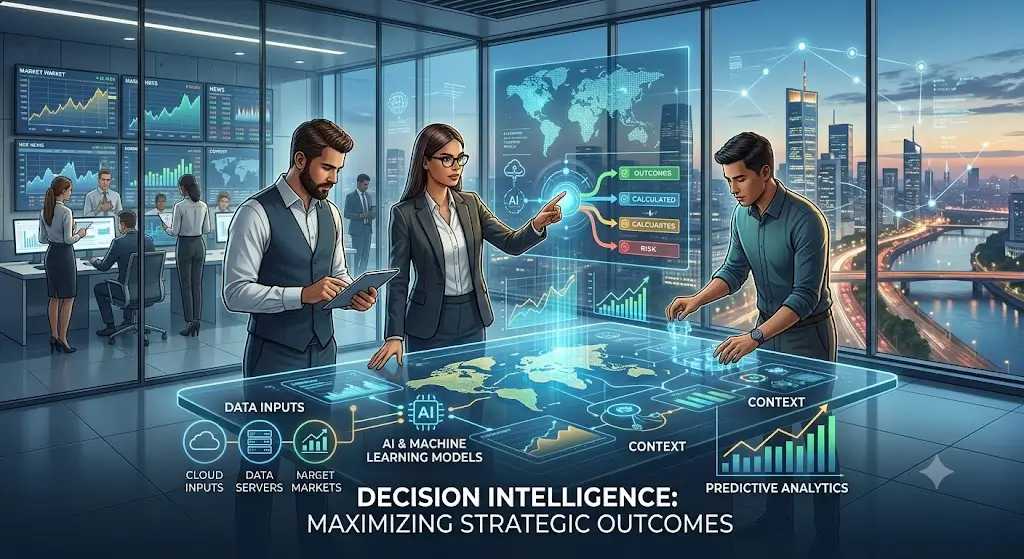
Introduction to Decision Intelligence
In an increasingly complex business landscape, organizations must make decisions faster and more accurately than ever before. Traditional decision-making methods often rely on intuition or incomplete information. Decision Intelligence provides a modern approach by combining data analytics, business intelligence, artificial intelligence, and decision science to improve the quality of decisions.
The Decision Intelligence Course is designed to help learners understand how organizations use data and technology to support strategic and operational decision-making. This course introduces the frameworks, tools, and methodologies used to transform data into actionable insights that drive business success.
As companies continue to embrace digital transformation, Decision Intelligence has become a critical capability for leaders and professionals across industries.
Why Decision Intelligence Matters
Every business decision can impact performance, profitability, customer satisfaction, and long-term growth. Decision Intelligence helps organizations make informed choices based on evidence rather than assumptions.
Benefits of Decision Intelligence include:
- Improved business performance
- Better strategic planning
- Enhanced forecasting accuracy
- Reduced operational risks
- Faster decision-making
- Stronger competitive advantage
- Increased organizational agility
Organizations worldwide are investing in Decision Intelligence to improve outcomes and navigate uncertainty more effectively.
What You Will Learn
This Decision Intelligence Course covers essential concepts and practical approaches to modern decision-making.
Topics include:
- Decision Intelligence fundamentals
- Business intelligence concepts
- Data-driven decision making
- Decision modeling
- Predictive analytics
- Artificial intelligence applications
- Risk analysis
- Scenario planning
- Decision support systems
- Strategic decision frameworks
These topics provide a comprehensive understanding of how organizations use data and analytics to improve decision quality.
Core Areas Covered
Decision Intelligence Fundamentals
Learn the principles that connect data, analytics, and business decisions.
Topics include:
- Decision science
- Intelligence frameworks
- Decision ecosystems
- Business applications
Business Intelligence and Analytics
Explore how data supports organizational decision-making.
Areas covered:
- Data visualization
- Performance measurement
- Dashboard reporting
- Business analytics fundamentals
Decision Modeling
Decision models help organizations evaluate alternatives systematically.
Topics include:
- Decision trees
- Decision mapping
- Analytical frameworks
- Outcome evaluation
Predictive Analytics
Predictive analytics helps organizations anticipate future outcomes.
Topics include:
- Forecasting techniques
- Trend analysis
- Predictive modeling concepts
- Data-driven forecasting
AI and Decision Intelligence
Artificial Intelligence enhances decision-making capabilities.
Topics include:
- AI-powered recommendations
- Intelligent automation
- Machine learning insights
- Decision optimization
Risk Analysis and Scenario Planning
Organizations must prepare for uncertainty.
Topics include:
- Risk assessment
- Scenario modeling
- Contingency planning
- Strategic resilience
Skills You Will Gain
Upon completing this course, learners will be able to:
- Apply Decision Intelligence frameworks
- Analyze business data effectively
- Support strategic decisions
- Evaluate risks and opportunities
- Use predictive insights
- Interpret business intelligence reports
- Improve decision quality
- Contribute to organizational planning
These skills are increasingly valuable in leadership, analytics, and management roles.
Benefits of the Course
Future-Focused Knowledge
Gain expertise in one of the fastest-growing business and analytics disciplines.
Career Development
Build skills that support advancement in business, management, and analytics careers.
Practical Business Applications
Learn techniques that can be applied across industries and business functions.
Strategic Thinking
Develop a structured approach to solving complex business challenges.
Professional Certification
Earn a certification demonstrating your Decision Intelligence knowledge.
Who Should Enroll?
This course is ideal for:
- Business Analysts
- Data Analysts
- Managers
- Team Leaders
- Executives
- Entrepreneurs
- Consultants
- Students interested in analytics and business strategy
No advanced analytics background is required.
Career Opportunities
Decision Intelligence skills can support roles such as:
- Business Analyst
- Decision Intelligence Analyst
- Strategy Analyst
- Business Intelligence Specialist
- Operations Analyst
- Data Analyst
- Management Consultant
- Strategic Planning Associate
As organizations increasingly rely on data-driven decision-making, demand for these skills continues to grow.
Certification Benefits
Upon successful completion, learners receive a Decision Intelligence Certification.
Benefits include:
- Enhanced professional credibility
- Improved employability
- Recognition of analytical skills
- Stronger leadership profile
- Support for career advancement
Conclusion
The Decision Intelligence Course provides learners with the knowledge and practical understanding needed to make smarter, data-driven decisions in today’s dynamic business environment. By combining analytics, business intelligence, artificial intelligence, and strategic thinking, Decision Intelligence enables organizations to improve performance and reduce uncertainty. Whether you are an aspiring analyst, business professional, or future leader, this course offers valuable skills that can help you make more effective decisions and drive meaningful business outcomes.
10. FAQ SECTION
1. What is Decision Intelligence?
Decision Intelligence is a discipline that combines data analytics, business intelligence, artificial intelligence, and decision science to improve decision-making.
2. Is this course suitable for beginners?
Yes, the course is designed for beginners and professionals seeking foundational knowledge.
3. Will I receive a certificate?
Yes, learners receive a certificate upon successful completion.
4. What topics are covered?
Decision Intelligence, business analytics, predictive analytics, AI for decision-making, risk analysis, and decision support systems.
5. Do I need technical experience?
No, the course introduces concepts in a beginner-friendly manner.
6. How is Decision Intelligence different from Business Intelligence?
Business Intelligence focuses on analyzing historical data, while Decision Intelligence uses analytics and decision frameworks to improve future decisions.
7. What industries use Decision Intelligence?
Finance, healthcare, retail, manufacturing, technology, consulting, logistics, and many other industries.
8. What career opportunities can this course support?
Business Analyst, Strategy Analyst, Data Analyst, Decision Intelligence Analyst, and Management Consultant roles.
9. Does the course include AI applications?
Yes, learners explore how AI supports modern decision-making processes.
10. Is the course fully online?
Yes, learners can study online at their own pace.





Reviews
There are no reviews yet.