
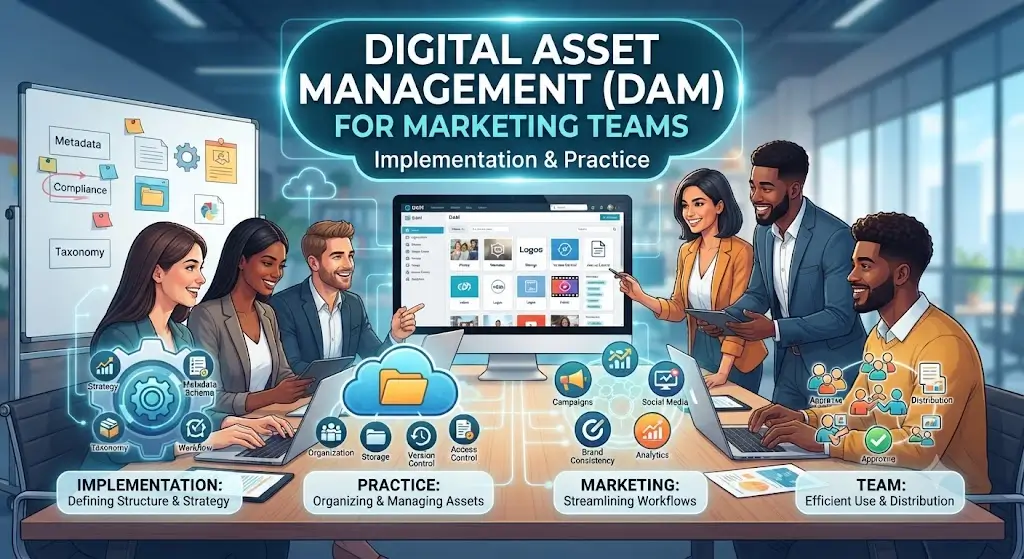
Digital Asset Management (DAM) for Marketing Teams Implementation & Practice
Introduction
The Digital Asset Management (DAM) for Marketing Teams Implementation & Practice course is a practical training program designed to help marketing professionals apply DAM principles in real working environments.
Marketing teams create and manage a large amount of digital content. Images, videos, presentations, social media graphics, advertisements, product documents, templates, and campaign materials must be stored and accessed efficiently. As content volumes grow, disconnected folders and inconsistent processes can make asset management difficult.
A well-implemented DAM process can create a more organized environment for marketing content. Teams can find approved assets faster, reduce duplication, manage versions, improve collaboration, and maintain stronger brand consistency.
This course focuses on implementation rather than theory alone. Learners will explore practical approaches to asset organization, metadata, tagging, naming standards, search, workflows, permissions, rights management, approval processes, distribution, and content reuse.
Furthermore, the course explains how DAM practices can fit into everyday marketing operations. Learners will understand how to improve existing processes and build more efficient asset management workflows.
Understanding DAM Implementation
Digital Asset Management implementation involves creating processes that help teams manage digital content throughout its lifecycle.
A practical DAM environment should support:
- Asset storage
- Asset organization
- Metadata
- Search
- Version control
- Approval
- Access management
- Distribution
- Rights management
- Archiving
However, implementation should not focus only on technology.
Processes, people, governance, and user adoption are equally important. Therefore, successful DAM implementation requires coordination between marketing, creative, operations, brand, IT, and other relevant teams.
Assessing Existing Marketing Asset Processes
Before implementing improvements, teams should understand their current workflows.
An asset management assessment can review:
- Current storage locations
- File naming practices
- Folder structures
- Metadata usage
- Search methods
- Approval processes
- Access permissions
- Version control
- Distribution methods
- Archiving practices
This review can identify common problems.
For example, teams may discover that multiple departments store similar assets in separate locations. Another issue may involve outdated files remaining mixed with approved content.
As a result, an initial assessment can provide a clear starting point for DAM improvement.
Defining DAM Objectives
DAM implementation should have clear objectives.
Common goals include:
- Reduce asset search time
- Improve content organization
- Increase asset reuse
- Reduce duplicate production
- Improve brand consistency
- Strengthen content governance
- Simplify collaboration
- Improve asset distribution
Each objective should connect to a real marketing requirement.
For example, if employees spend too much time searching for campaign files, improving metadata and search should become a priority.
Therefore, implementation should focus on measurable business needs.
Planning the Asset Library
A structured asset library makes content easier to manage.
Marketing teams can organize assets by:
- Brand
- Product
- Campaign
- Asset type
- Region
- Market
- Channel
- Audience
- Language
- Status
The best structure depends on how the organization operates.
A global business may require regional and language categories. Meanwhile, a smaller marketing team may only need product, campaign, and asset-type classifications.
Consequently, the library should remain simple enough for users to understand.
Creating Naming Standards
File naming is an important part of implementation.
Inconsistent names can make assets difficult to identify.
A practical naming standard can include:
- Brand
- Product
- Campaign
- Asset type
- Region
- Language
- Date
- Version
For example, structured names provide useful information before users even open the file.
Moreover, consistent naming can support search and reduce confusion between similar assets.
Implementing Metadata Standards
Metadata helps describe and classify digital assets.
Useful metadata fields can include:
- Title
- Description
- Product
- Campaign
- Keywords
- Region
- Language
- Creator
- Asset type
- Usage rights
- Expiration date
- Approval status
Implementation teams should identify which metadata fields are actually useful.
Too little metadata can make search difficult. On the other hand, excessive metadata can increase the workload for users.
Therefore, metadata design should balance detail with practicality.
Applying Tags and Keywords
Tags provide additional ways to find digital assets.
Marketing teams may use tags for:
- Products
- Services
- Campaigns
- Audiences
- Industries
- Regions
- Themes
- Channels
- Formats
Consistency is essential.
If different teams use different terms for the same concept, search results can become fragmented.
Consequently, organizations should create simple tagging guidelines and encourage consistent usage.
Improving Asset Search
A DAM environment should make content easy to find.
Users can search using:
- Keywords
- Metadata
- Tags
- Campaign names
- Product names
- Asset types
- Regions
- Dates
- Approval status
Filters can make large asset libraries easier to navigate.
For instance, a marketer could search for approved product images created for a specific campaign.
This process can reduce manual folder browsing and improve productivity.
Implementing Version Control
Marketing assets frequently go through revisions.
A design may have several drafts before approval. Product materials can also change after updates.
Without version control, users may select outdated content.
An effective implementation should clearly identify:
- Draft versions
- Review versions
- Approved versions
- Current versions
- Archived versions
As a result, employees can select the appropriate asset more confidently.
Building Approval Workflows
Approval workflows determine how assets move from creation to final use.
A practical process may include:
- Asset creation
- Initial review
- Editing
- Brand review
- Legal or compliance review
- Final approval
- Publication
- Distribution
- Archiving
Not every organization needs the same number of steps.
Therefore, teams should design workflows according to their actual business requirements.
Assigning Roles and Responsibilities
Successful DAM implementation requires clear ownership.
Responsibilities may include:
- Asset creation
- Asset uploading
- Metadata management
- Content approval
- Brand review
- Rights management
- User administration
- Distribution
- Archiving
Clear ownership reduces uncertainty.
For example, marketing operations may manage the DAM environment while brand managers approve brand-specific assets.
Managing User Permissions
Different employees may require different levels of access.
Permissions can control whether users can:
- View assets
- Download content
- Upload files
- Edit metadata
- Approve assets
- Share resources
- Archive content
Access can be based on role, department, region, campaign, or asset type.
Therefore, permission structures should match real organizational responsibilities.
Managing Usage Rights
Some digital assets have specific licensing requirements.
Images, videos, music, fonts, and other resources may have restrictions related to:
- Geography
- Duration
- Channels
- Audience
- Ownership
- Distribution
Rights information should be easy for relevant users to understand.
For example, an image licensed only for a specific market should not be distributed globally.
Consequently, rights management should be part of the DAM workflow.
Managing Asset Expiration
Digital content can become outdated.
A promotional image may contain an expired offer. A product image may no longer represent the current product. A campaign video may have a limited usage period.
Expiration management helps teams identify assets that require review.
Useful statuses include:
- Active
- Under review
- Expiring
- Expired
- Archived
As a result, users are less likely to select outdated content.
Applying DAM to Marketing Campaigns
Campaigns often involve many assets.
A campaign may require:
- Social media graphics
- Videos
- Email creatives
- Website banners
- Product images
- Advertisements
- Landing page content
- Presentations
- Sales collateral
A campaign-based DAM structure can make these resources easier to manage.
For example, campaign managers can quickly locate approved assets for specific channels.
Furthermore, campaign organization can make future reuse easier.
Supporting Content Reuse
Marketing teams can often reuse existing content.
A product video created for one campaign may also work for social media, websites, sales presentations, or webinars.
A searchable DAM library makes these opportunities easier to identify.
Therefore, teams can increase the value of existing creative work.
Content reuse can also reduce production time and unnecessary duplication.
Reducing Duplicate Assets
Duplicate content can create additional costs.
Teams may unknowingly create similar assets because existing files are difficult to find.
Improved search and centralized organization can make existing content more visible.
Consequently, employees can check available assets before requesting new production.
Supporting Brand Governance
Brand governance helps teams use approved resources consistently.
A DAM environment can centralize:
- Logos
- Templates
- Brand guidelines
- Photography
- Typography resources
- Messaging materials
- Approved examples
When current resources are easy to access, employees are less likely to use outdated files.
Moreover, connecting brand guidelines with approved assets can make standards easier to follow.
Managing Global and Regional Assets
Global marketing organizations may need localized content.
Regional teams can require:
- Local languages
- Regional campaigns
- Market-specific images
- Local product information
- Region-specific documents
DAM can organize these assets while maintaining central brand control.
For example, global teams can maintain master assets while regional teams access approved localized versions.
As a result, organizations can support local marketing needs without losing overall consistency.
Working With Agencies and Partners
Marketing teams often collaborate with external agencies.
Agencies may need access to:
- Brand assets
- Product images
- Templates
- Campaign resources
- Creative guidelines
Controlled DAM access can provide these resources without exposing unrelated content.
Furthermore, completed agency work can be stored centrally for future reuse.
Supporting Sales Enablement
Marketing assets frequently support sales teams.
Sales professionals may need:
- Product presentations
- Case studies
- Brochures
- Product images
- Videos
- One-page documents
A DAM environment can provide access to current and approved materials.
Therefore, DAM can improve alignment between marketing and sales.
Implementing Distribution Processes
Once assets are approved, they need to reach the correct users.
Distribution may involve:
- Marketing teams
- Sales teams
- Agencies
- Partners
- Regional offices
- Distributors
- External stakeholders
A structured distribution process can make sharing more controlled.
Users can receive the assets they need without creating multiple unmanaged copies.
DAM User Training
Training is essential for successful implementation.
Users should understand how to:
- Search for assets
- Upload content
- Add metadata
- Apply tags
- Check versions
- Request approvals
- Download approved files
- Follow usage requirements
Practical training can improve confidence and adoption.
Moreover, simple documentation can help users resolve common questions without additional support.
Encouraging User Adoption
A DAM system only creates value when people use it consistently.
Users may avoid a system if it is complicated or does not fit their workflow.
Successful adoption can involve:
- Simple navigation
- Clear processes
- Relevant assets
- User training
- Leadership support
- Ongoing communication
- Feedback collection
Therefore, user experience should remain an important implementation priority.
Measuring DAM Performance
Organizations should measure whether DAM improvements are producing useful results.
Possible metrics include:
- Asset search time
- Asset downloads
- Asset reuse
- User adoption
- Search success
- Approval time
- Workflow completion
- Duplicate reduction
- Asset usage
- User satisfaction
These indicators can help teams identify improvement opportunities.
For example, reduced search time may show that metadata and asset classification are working effectively.
Continuous Improvement
DAM implementation should not end after launch.
Marketing requirements change over time. New channels, products, markets, campaigns, and users can create new asset management needs.
Regular reviews can examine:
- Taxonomy
- Metadata
- Search
- Workflows
- Permissions
- User feedback
- Asset quality
- Governance
Consequently, teams can adjust DAM processes as business requirements evolve.
DAM Governance
Governance provides consistent rules for managing digital assets.
A governance framework can define:
- Asset ownership
- Naming standards
- Metadata requirements
- Tagging rules
- Access permissions
- Approval processes
- Rights management
- Version control
- Retention
- Archiving
- Distribution
Clear governance improves accountability.
It also helps maintain consistency as the number of assets and users increases.
Common Implementation Challenges
DAM implementation can involve several challenges.
Common issues include:
- Poor asset organization
- Inconsistent metadata
- Weak naming standards
- Duplicate files
- Outdated content
- Complex workflows
- Unclear ownership
- Limited adoption
- Incorrect permissions
- Incomplete rights information
Each issue requires a practical solution.
For example, inconsistent metadata can be improved through standardized fields and training. Similarly, low adoption may require simpler workflows and stronger communication.
DAM Implementation Best Practices
Start With Real Business Needs
Focus on problems that marketing teams actually experience.
Keep the Structure Practical
Avoid creating unnecessary categories or complicated folder systems.
Standardize Metadata
Use consistent and meaningful metadata fields.
Make Search Easy
Users should be able to find approved assets quickly.
Establish Clear Ownership
Every major DAM process should have a responsible owner.
Maintain Version Control
Clearly identify current and approved content.
Build Practical Workflows
Approval processes should provide control without unnecessary delays.
Manage Rights Carefully
Usage restrictions and expiration dates should be visible.
Train Users
Practical training can improve adoption and consistency.
Measure Results
Track performance and user feedback to identify opportunities for improvement.
Review Processes Regularly
DAM should evolve with changing marketing requirements.
What You Will Learn
By completing the Digital Asset Management (DAM) for Marketing Teams Implementation & Practice course, learners will be able to:
- Assess existing asset management processes
- Define DAM implementation objectives
- Plan structured asset libraries
- Create file naming standards
- Implement metadata standards
- Develop tagging systems
- Improve asset search
- Implement version control
- Build approval workflows
- Assign DAM responsibilities
- Manage user permissions
- Track asset usage rights
- Manage asset expiration
- Organize campaign assets
- Support content reuse
- Reduce duplicate content
- Implement brand governance
- Manage global and regional assets
- Coordinate agency access
- Support sales enablement
- Build distribution processes
- Train DAM users
- Improve user adoption
- Measure DAM performance
- Support continuous improvement
- Establish DAM governance
Skills You Will Gain
Learners will develop practical skills in:
- Digital asset management
- DAM implementation
- Marketing asset organization
- Asset taxonomy
- Metadata management
- Content tagging
- Search optimization
- Version control
- Workflow design
- Approval management
- Access management
- Rights management
- Asset lifecycle management
- Campaign asset management
- Brand governance
- Content distribution
- Content reuse
- User training
- User adoption
- DAM performance measurement
- Marketing operations
- Content governance
Benefits of This Course
Practical DAM Implementation Skills
Learners gain practical knowledge that can be applied to real marketing asset management processes.
Better Asset Organization
Structured libraries and naming standards can make digital content easier to manage.
Faster Content Discovery
Metadata, tags, and search practices can reduce the time required to locate assets.
Improved Marketing Workflows
Clear approval and distribution processes can reduce unnecessary manual coordination.
Stronger Brand Consistency
Centralized access to approved resources can help teams maintain consistent branding.
Better Collaboration
Marketing, creative, sales, agencies, and regional teams can work from shared content resources.
Reduced Content Duplication
Improved asset visibility can encourage teams to reuse existing content.
Stronger Content Governance
Clear ownership, permissions, rights, and lifecycle processes can improve asset control.
Improved Marketing Productivity
Better asset management can reduce time spent searching, recreating, and requesting content.
Who Should Enroll?
The Digital Asset Management (DAM) for Marketing Teams Implementation & Practice course is suitable for:
- Marketing Managers
- Digital Marketing Professionals
- Marketing Operations Specialists
- Content Managers
- Content Strategists
- Brand Managers
- Creative Operations Professionals
- Campaign Managers
- Product Marketing Professionals
- Communications Professionals
- Digital Content Managers
- Marketing Technology Professionals
- Sales Enablement Professionals
- Creative Project Managers
- Agency Professionals
- Business Owners
- Entrepreneurs
It is particularly useful for professionals who are responsible for creating, organizing, approving, managing, distributing, or reusing digital marketing content.
Career Opportunities
DAM implementation skills can support career development in marketing, content, brand, creative, and marketing operations.
Potential career paths include:
- Digital Asset Manager
- DAM Implementation Specialist
- Marketing Operations Specialist
- Content Operations Manager
- Digital Content Manager
- Brand Operations Manager
- Brand Manager
- Content Manager
- Content Strategist
- Marketing Technology Specialist
- Creative Operations Specialist
- Marketing Manager
- Product Marketing Specialist
- Digital Marketing Specialist
- Creative Project Manager
- Content Governance Specialist
- Marketing Systems Specialist
These skills can be applied across technology, retail, healthcare, finance, manufacturing, education, media, entertainment, professional services, and many other industries.
Practical Applications
The knowledge from this course can be applied directly to marketing operations.
A marketing team can use the concepts to organize campaign assets, establish naming standards, improve metadata, manage approvals, and distribute approved content.
For example, a global company can create structured libraries for master brand assets and localized regional materials. Meanwhile, a growing company can use DAM practices to reduce duplicate files and improve collaboration.
Creative teams can manage approved designs, templates, photography, and videos. Marketing operations teams can establish workflows for metadata, permissions, reviews, and archiving.
Sales teams can access current presentations, brochures, case studies, and product resources.
Similarly, agencies can receive controlled access to specific campaign assets while completed work remains available for future reuse.
As a result, DAM implementation can become an important part of efficient marketing operations.
Certification
Upon successful completion of the Digital Asset Management (DAM) for Marketing Teams Implementation & Practice course, learners receive a professional course completion certificate recognizing their knowledge of DAM implementation, asset organization, metadata, tagging, search, version control, workflow management, permissions, rights management, brand governance, campaign asset management, content reuse, distribution, user adoption, and DAM performance.
The certification can strengthen a professional profile and demonstrate practical knowledge relevant to marketing operations, digital marketing, content management, brand management, creative operations, and marketing technology.
Conclusion
The Digital Asset Management (DAM) for Marketing Teams Implementation & Practice course provides practical knowledge for professionals who want to improve how marketing assets are managed in real working environments.
Digital content continues to grow across campaigns, channels, products, and regions. Without structured processes, assets can become difficult to find, duplicated, outdated, or incorrectly used.
This course addresses these challenges through practical DAM implementation. Learners explore asset organization, naming standards, metadata, tagging, search, version control, workflows, permissions, rights management, brand governance, campaign management, distribution, content reuse, and performance measurement.
Furthermore, the course emphasizes user adoption and continuous improvement. Effective DAM requires more than a central storage system. It requires clear processes, responsible ownership, useful standards, and consistent user participation.
By applying these practices, marketing teams can improve asset discovery, reduce duplication, strengthen brand consistency, support collaboration, and streamline content workflows.
Whether your goal is to develop skills in digital asset management, marketing operations, content management, brand management, creative operations, or marketing technology, this course provides practical knowledge to help you implement stronger and more efficient DAM processes.
Frequently Asked Questions
1. What is the Digital Asset Management (DAM) for Marketing Teams Implementation & Practice course?
It is a practical course that teaches professionals how to implement DAM processes for organizing, managing, approving, distributing, and reusing marketing assets.
2. Who should take this course?
Marketing managers, content professionals, brand teams, creative operations specialists, digital marketers, marketing operations professionals, and communications teams can benefit from this course.
3. Do I need previous DAM experience?
No. The course explains essential concepts while focusing on practical implementation and everyday marketing applications.
4. What will I learn about DAM implementation?
You will learn about asset libraries, naming standards, metadata, tagging, search, version control, workflows, permissions, rights management, distribution, governance, and performance measurement.
5. How can DAM improve marketing workflows?
DAM can centralize assets, simplify search, support approvals, manage versions, improve distribution, and make approved content easier for teams to access.
6. How does DAM help with brand consistency?
A centralized system can provide access to current logos, templates, images, guidelines, and other approved brand resources. Therefore, teams can use more consistent marketing content.
7. Why are metadata and tags important?
Metadata and tags provide information that helps users classify and find digital assets. Consequently, large asset libraries become easier to search.
8. Can DAM reduce duplicate content?
Yes. Better asset visibility allows teams to search existing resources before creating new content. As a result, unnecessary duplication can be reduced.
9. How can DAM performance be measured?
Teams can measure search time, asset reuse, user adoption, downloads, approval time, workflow completion, duplicate reduction, and user satisfaction.
10. Will I receive a certificate after completing the course?
Yes. Learners receive a professional course completion certificate after successfully completing the Digital Asset Management (DAM) for Marketing Teams Implementation & Practice course.



Reviews
There are no reviews yet.