
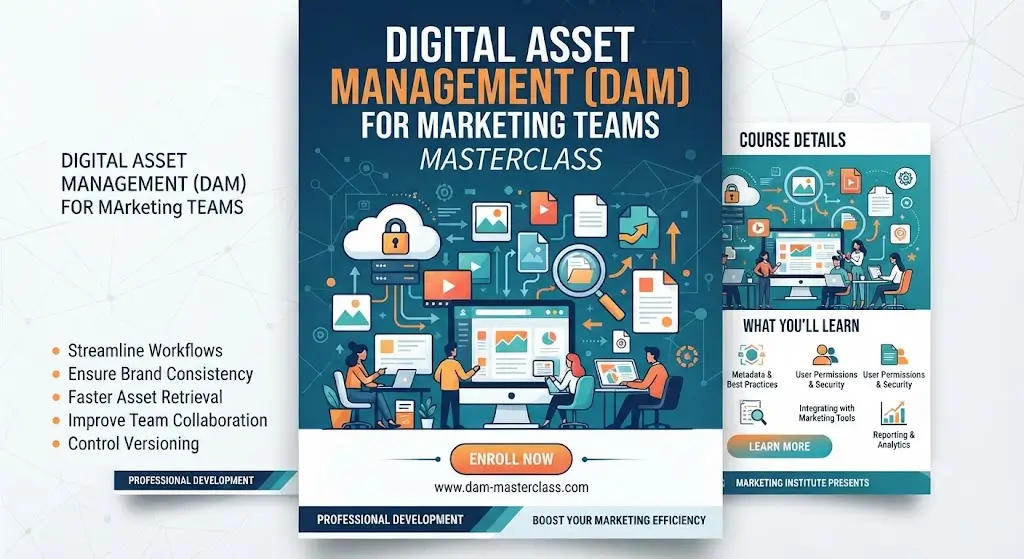
Digital Asset Management (DAM) for Marketing Teams Masterclass
Introduction
The Digital Asset Management (DAM) for Marketing Teams Masterclass is an advanced learning program designed for professionals who want to manage marketing assets with greater structure, efficiency, and strategic control.
Modern marketing teams create a constant flow of digital content. Images, videos, presentations, advertisements, product files, social media graphics, campaign materials, and brand resources must be stored and accessed efficiently. As content volumes increase, traditional folders and disconnected storage methods can create unnecessary complexity.
A strong Digital Asset Management strategy provides a structured approach to managing these resources. It can help teams find approved content faster, reduce duplication, maintain brand consistency, control access, and improve collaboration.
This masterclass goes beyond basic DAM concepts. Instead, it focuses on practical and strategic applications for modern marketing environments. Learners will explore asset architecture, metadata strategies, tagging systems, search optimization, version control, workflow design, governance, rights management, content distribution, campaign management, user adoption, and DAM performance.
Moreover, the course explains how DAM can connect with broader marketing operations. When asset management is aligned with campaigns, brand processes, creative production, and content distribution, teams can work more efficiently.
Whether you manage a growing marketing department or support a global content operation, this masterclass provides practical knowledge for building more effective digital asset processes.
Understanding Strategic Digital Asset Management
Digital Asset Management involves more than storing files in a central location. Effective DAM creates a structured environment where digital assets can be organized, discovered, managed, approved, distributed, and maintained throughout their lifecycle.
Marketing teams may manage:
- Brand assets
- Product images
- Videos
- Presentations
- Brochures
- Social media graphics
- Advertising creatives
- Campaign materials
- Product documents
- Templates
- Infographics
- Case studies
- White papers
- Event resources
- Audio files
Each asset may have different requirements for access, approval, licensing, distribution, and retention.
Therefore, an effective DAM strategy should consider the entire asset lifecycle rather than focusing only on storage.
The Strategic Role of DAM in Marketing
Digital assets support almost every part of modern marketing.
Campaign teams need creative materials. Sales teams need current collateral. Brand teams need approved resources. Digital teams need web-ready content. Regional teams may require localized versions.
Without centralized control, these teams can experience content duplication, version confusion, slow searches, and inconsistent branding.
A strategic DAM environment can address these challenges.
Key advantages include:
- Faster asset discovery
- Improved content organization
- Stronger brand consistency
- Better collaboration
- Controlled access
- Improved version management
- Reduced content duplication
- Faster campaign execution
- Better asset reuse
- More efficient distribution
Consequently, DAM can become an important part of marketing operations rather than a separate technology function.
Assessing Marketing Asset Operations
Before improving DAM, organizations should understand their current asset environment.
An assessment can examine:
- Storage locations
- File naming practices
- Metadata quality
- Search behavior
- Access permissions
- Approval workflows
- Version management
- Rights information
- Distribution methods
- Archiving practices
This assessment can reveal operational weaknesses.
For example, a team may have a large asset library but poor metadata. Another team may have strong content standards but lack centralized access.
Therefore, DAM strategy should begin with a clear assessment of business needs and current practices.
Designing a DAM Architecture
A DAM architecture defines how assets are organized within the system.
A useful structure may consider:
- Brands
- Products
- Campaigns
- Regions
- Markets
- Channels
- Asset types
- Audiences
- Languages
- Usage status
The structure should reflect actual marketing workflows.
For example, global organizations may need regional and language-based categories. Meanwhile, smaller organizations may benefit from simpler campaign and asset-type structures.
A practical architecture makes content easier to navigate.
Furthermore, it provides a foundation for metadata, permissions, search, and reporting.
Building a Scalable Asset Taxonomy
Taxonomy defines how digital assets are classified.
A marketing taxonomy can organize content around business concepts such as:
- Product
- Campaign
- Audience
- Industry
- Region
- Channel
- Content type
- Brand
- Language
A clear taxonomy improves consistency.
For instance, if every product image follows the same classification system, users can search across product categories more effectively.
However, taxonomies should remain practical. Excessive categories can make systems difficult to use.
Therefore, marketing teams should balance detail with usability.
Developing File Naming Standards
File names provide important information about digital assets.
Poor naming can make content difficult to identify. Terms such as “final,” “new,” or “latest” provide limited context.
A structured naming standard can include:
- Brand
- Product
- Campaign
- Asset type
- Region
- Language
- Date
- Version
Consistent naming can improve search and reduce confusion.
Moreover, standardized names make it easier for users to understand an asset before opening it.
Advanced Metadata Management
Metadata describes the characteristics and context of an asset.
Useful fields may include:
- Asset title
- Description
- Keywords
- Product
- Campaign
- Creator
- Region
- Language
- Channel
- Usage rights
- Expiration date
- Approval status
Advanced DAM programs should establish metadata standards that support actual marketing requirements.
For example, product marketing teams may require product identifiers and market information. Meanwhile, global brand teams may need regional and language metadata.
As a result, metadata can make asset libraries significantly more searchable and useful.
Designing Effective Tagging Systems
Tags help users discover assets through flexible keywords and categories.
Marketing teams may create tags for:
- Products
- Services
- Campaigns
- Audiences
- Industries
- Themes
- Regions
- Channels
- Content formats
Consistency remains important.
If multiple terms are used for the same concept, search quality can suffer. Therefore, teams should establish clear tagging standards and controlled vocabulary where appropriate.
Optimizing Asset Search
A DAM system should help users find content quickly.
Effective search can combine:
- Keywords
- Metadata
- Tags
- Asset types
- Campaigns
- Products
- Regions
- Dates
- Approval status
Filters can further narrow results.
For example, a campaign manager could search for approved product videos created for a particular region and channel.
This approach can reduce manual browsing and improve marketing productivity.
Managing Asset Versions
Digital assets often change throughout their lifecycle.
A campaign graphic may go through several revisions. Product documents can change after product updates. Brand materials may also be revised periodically.
Without version control, users may select outdated content.
A structured DAM process should clearly distinguish:
- Draft versions
- Review versions
- Approved versions
- Current versions
- Archived versions
Consequently, users can identify the correct asset more confidently.
Building Approval Workflows
Marketing assets often require multiple reviews before publication.
A typical workflow may include:
- Content creation
- Initial review
- Revision
- Brand review
- Legal or compliance review
- Final approval
- DAM publication
- Distribution
- Archiving
The exact process depends on organizational requirements.
For example, regulated industries may require additional approvals. In contrast, smaller teams may use a simpler workflow.
Therefore, approval processes should provide control without creating unnecessary delays.
Workflow Automation Opportunities
DAM workflows can often be streamlined through automation.
Automation may support:
- Metadata assignment
- Approval notifications
- Version updates
- Expiration alerts
- Asset distribution
- Content routing
- Archiving
- User notifications
These processes can reduce repetitive manual tasks.
Moreover, automation can improve consistency when large volumes of assets are processed.
Brand Governance Through DAM
Brand governance ensures that marketing teams use approved and current brand resources.
A DAM environment can provide controlled access to:
- Logos
- Brand templates
- Photography
- Typography resources
- Visual guidelines
- Messaging materials
- Approved examples
Centralized governance can reduce the use of outdated materials.
Furthermore, linking guidelines with relevant assets can help employees understand how resources should be used.
Managing Brand Consistency Across Channels
Brands appear across many channels.
These may include:
- Websites
- Social media
- Advertising
- Presentations
- Events
- Sales materials
- Partner communications
Each channel may require different asset formats.
A strong DAM strategy can help teams maintain consistent branding while providing channel-specific resources.
As a result, organizations can improve both consistency and operational flexibility.
Access and Permission Management
DAM systems often contain assets with different sensitivity levels.
Permissions can determine who may:
- View assets
- Download content
- Upload files
- Edit metadata
- Approve assets
- Share resources
- Archive content
Access can be based on:
- Department
- Role
- Region
- Campaign
- Asset type
- Business function
Therefore, permission structures should align with organizational responsibilities.
Rights and Licensing Management
Digital assets may have specific legal or licensing requirements.
Images, videos, music, fonts, and other resources can have restrictions related to:
- Usage duration
- Geography
- Channels
- Audience
- Ownership
- Distribution
Marketing teams should maintain this information within the asset management process.
For example, an image licensed only for a specific region should not be distributed globally.
Consequently, rights management can reduce avoidable content risks.
Asset Expiration and Lifecycle Management
Not every asset remains relevant forever.
Promotional graphics can become outdated. Product images may change. Campaign materials may expire. Licensing agreements may also end.
Lifecycle management helps teams identify assets that need review.
Useful statuses may include:
- Active
- Under review
- Expiring
- Expired
- Archived
Regular lifecycle reviews can help maintain a cleaner and more reliable asset library.
Applying DAM to Campaign Management
Marketing campaigns can involve hundreds of assets.
A campaign may require:
- Social media creatives
- Email graphics
- Website banners
- Videos
- Product photography
- Advertisements
- Landing page assets
- Presentations
- Sales collateral
A structured DAM environment can organize these materials around the campaign.
Campaign managers can then locate approved resources more quickly.
Furthermore, consistent campaign organization makes future reuse easier.
Supporting Global Marketing Operations
Global marketing teams face additional asset management challenges.
Different markets may require:
- Local languages
- Regional imagery
- Market-specific campaigns
- Local product information
- Different legal requirements
DAM can help manage these variations while maintaining global brand standards.
For example, a central team can maintain master assets while regional teams access approved localized versions.
Consequently, DAM can support both global consistency and local flexibility.
Managing Agency and Partner Collaboration
Marketing teams often work with agencies and external partners.
These partners may need access to specific:
- Brand assets
- Product images
- Templates
- Campaign files
- Creative resources
- Guidelines
DAM permissions can provide controlled access.
External teams can receive the resources required for their projects without gaining access to unrelated content.
Moreover, completed work can be stored centrally for future use.
Supporting Sales Enablement
Marketing assets often support sales activities.
Sales teams may need:
- Presentations
- Product brochures
- Case studies
- Product images
- Videos
- One-page documents
A well-managed DAM environment can provide sales teams with current and approved materials.
Therefore, DAM can strengthen alignment between marketing and sales.
Content Reuse and Repurposing
Existing content can often support multiple marketing activities.
For example, a product video may be reused for:
- Social media
- Website content
- Email campaigns
- Sales presentations
- Webinars
- Customer communications
A searchable DAM environment makes these opportunities easier to identify.
As a result, teams can increase the value of existing creative investments.
Reducing Content Duplication
Duplicate assets can increase production costs.
Teams may unknowingly recreate content because existing resources are difficult to find.
Improved search and centralized storage can make existing assets more visible.
Consequently, marketing teams can check available resources before commissioning new work.
This approach can reduce unnecessary duplication while improving creative efficiency.
DAM Performance Measurement
DAM performance should be measured regularly.
Useful metrics may include:
- Asset search time
- Search success
- Asset downloads
- Asset reuse
- User adoption
- Workflow completion
- Approval time
- Duplicate reduction
- Asset usage
- User satisfaction
These indicators can reveal whether DAM processes are meeting business needs.
For example, reduced search time may indicate that asset classification and metadata are working effectively.
User Adoption and Change Management
Technology adoption is essential to DAM success.
Employees may avoid a system if it is complicated or disconnected from their daily work.
Successful adoption can involve:
- User training
- Clear guidelines
- Simple workflows
- Useful search
- Relevant content
- Leadership support
- Ongoing feedback
Moreover, user feedback can help identify areas that require improvement.
Therefore, change management should be treated as an important part of DAM implementation.
DAM Governance Framework
Governance defines how digital assets are managed throughout their lifecycle.
A DAM governance framework can establish:
- Asset ownership
- Metadata standards
- Naming rules
- Access permissions
- Approval requirements
- Rights management
- Version control
- Retention policies
- Archiving procedures
- Distribution standards
Clear governance improves accountability.
It also helps organizations maintain consistency as content volumes and user numbers increase.
Building a DAM Operating Model
A DAM operating model defines roles and responsibilities.
Key responsibilities may include:
- DAM administration
- Asset ownership
- Metadata management
- Brand approval
- Rights management
- User support
- Content governance
- Performance reporting
Clear ownership prevents important tasks from being overlooked.
For example, marketing operations may manage the system while brand managers oversee brand-specific content.
Common DAM Challenges
Organizations can face several challenges when managing digital assets.
Common issues include:
- Poor metadata
- Inconsistent naming
- Duplicate content
- Outdated assets
- Weak search
- Complex workflows
- Unclear ownership
- Limited adoption
- Incorrect permissions
- Poor rights tracking
Each challenge requires a practical solution.
For example, inconsistent metadata can be addressed through standardized fields and user training. Likewise, low adoption may require simpler workflows and stronger communication.
Advanced DAM Best Practices
Align DAM With Business Goals
DAM should support real marketing and business objectives.
Build Practical Taxonomies
Classification systems should help users rather than create unnecessary complexity.
Standardize Metadata
Consistent metadata improves search and asset discovery.
Prioritize User Experience
Users should be able to find and access content without unnecessary steps.
Maintain Strong Governance
Ownership, permissions, approvals, and rights should be clearly defined.
Encourage Content Reuse
Teams should search existing assets before creating new content.
Automate Repetitive Tasks
Automation can reduce manual work and improve consistency.
Review Asset Quality Regularly
Outdated, duplicate, and irrelevant assets should be reviewed.
Measure Business Impact
DAM performance should be connected to meaningful marketing outcomes.
What You Will Learn
By completing the Digital Asset Management (DAM) for Marketing Teams Masterclass, learners will be able to:
- Develop strategic DAM approaches
- Assess existing asset management processes
- Design structured DAM architectures
- Build scalable asset taxonomies
- Create file naming standards
- Develop metadata strategies
- Design tagging systems
- Improve asset search
- Manage digital asset versions
- Build approval workflows
- Identify workflow automation opportunities
- Strengthen brand governance
- Maintain brand consistency
- Manage access permissions
- Track digital asset rights
- Manage asset expiration
- Organize campaign assets
- Support global marketing teams
- Manage agency collaboration
- Support sales enablement
- Improve content reuse
- Reduce duplicate content
- Measure DAM performance
- Improve user adoption
- Establish DAM governance
- Build effective DAM operating models
Skills You Will Gain
Learners will develop advanced skills in:
- Digital asset management
- DAM strategy
- Marketing asset management
- Asset taxonomy
- Metadata management
- Content tagging
- Search optimization
- Version control
- Workflow management
- Workflow automation
- Brand governance
- Content governance
- Access management
- Rights management
- Lifecycle management
- Campaign asset management
- Global content management
- Agency collaboration
- Sales enablement
- Content reuse
- Marketing operations
- DAM performance measurement
- Change management
- DAM governance
Benefits of This Masterclass
Advanced DAM Knowledge
Learners gain a deeper understanding of how DAM can support complex marketing environments.
Improved Content Discovery
Structured metadata, tagging, naming, and search practices can make assets easier to find.
Stronger Marketing Operations
Well-designed workflows can reduce manual effort and improve operational consistency.
Better Brand Control
Centralized governance can help teams use approved and current brand resources.
Improved Collaboration
Marketing, creative, sales, agencies, and regional teams can work from shared asset resources.
Reduced Content Duplication
Better asset visibility can help teams reuse existing content before producing new materials.
Greater Content Value
Repurposing existing assets can increase the return on creative investments.
Stronger Governance
Defined permissions, rights, ownership, and lifecycle processes can improve asset control.
Better Scalability
Structured DAM practices can support organizations as asset volumes, users, markets, and campaigns grow.
Who Should Enroll?
The Digital Asset Management (DAM) for Marketing Teams Masterclass is suitable for:
- Marketing Managers
- Digital Marketing Managers
- Marketing Operations Professionals
- Content Managers
- Content Strategists
- Brand Managers
- Brand Operations Professionals
- Creative Operations Specialists
- Marketing Technology Professionals
- Campaign Managers
- Product Marketing Professionals
- Communications Professionals
- Digital Content Managers
- Sales Enablement Professionals
- Creative Project Managers
- Agency Professionals
- Business Owners
- Marketing Leaders
The masterclass is particularly useful for professionals who already work with digital content and want to improve their DAM strategy, governance, and operational practices.
Career Opportunities
Advanced DAM knowledge can support career growth across marketing, content, brand, creative, and marketing technology functions.
Potential career paths include:
- Digital Asset Manager
- DAM Strategy Manager
- Marketing Operations Manager
- Content Operations Manager
- Digital Content Manager
- Brand Operations Manager
- Brand Manager
- Content Manager
- Content Strategist
- Marketing Technology Specialist
- Creative Operations Manager
- Marketing Manager
- Product Marketing Manager
- Creative Project Manager
- Digital Marketing Manager
- Content Governance Specialist
- Marketing Systems Specialist
These skills can be valuable across technology, retail, healthcare, finance, manufacturing, education, media, entertainment, professional services, and other industries.
Practical Applications
The knowledge from this masterclass can be applied across real marketing environments.
A global organization can use DAM governance to manage master brand assets and regional content. Meanwhile, a growing company can create structured asset libraries to improve collaboration and reduce duplicate production.
Creative teams can organize approved designs, templates, images, and videos. Marketing operations teams can establish workflows for metadata, approvals, permissions, and asset lifecycle management.
Sales teams can access current presentations and product collateral. Agencies can receive controlled access to campaign resources.
Similarly, product marketing teams can manage product images, videos, specifications, presentations, and promotional materials in a centralized environment.
As a result, DAM can become a connected part of marketing operations rather than simply a file storage solution.
Certification
Upon successful completion of the Digital Asset Management (DAM) for Marketing Teams Masterclass, learners receive a professional course completion certificate recognizing their knowledge of DAM strategy, asset architecture, taxonomy, metadata, tagging, search, version control, workflow management, brand governance, access management, rights management, lifecycle management, campaign asset management, content reuse, performance measurement, user adoption, and DAM governance.
The certification can strengthen a professional profile and demonstrate advanced knowledge relevant to digital marketing, marketing operations, content management, brand management, creative operations, and marketing technology.
Conclusion
The Digital Asset Management (DAM) for Marketing Teams Masterclass provides advanced knowledge for professionals who want to manage digital marketing assets more strategically.
Marketing teams increasingly depend on digital content across campaigns, channels, regions, and business functions. Without structured management, these assets can become difficult to find, outdated, duplicated, or inconsistently used.
This masterclass addresses those challenges through practical DAM strategy and governance. Learners explore asset architecture, taxonomy, metadata, tagging, search, version control, workflows, automation, permissions, rights management, lifecycle management, brand governance, campaign management, distribution, and performance measurement.
Furthermore, the course emphasizes user adoption and organizational alignment. A DAM environment becomes more valuable when its processes support real marketing activities and users can easily access trusted content.
By applying the principles covered in this masterclass, organizations can improve content discovery, strengthen brand consistency, reduce duplication, increase asset reuse, and streamline marketing operations.
Whether your goal is to advance in digital asset management, marketing operations, content management, brand management, creative operations, or marketing technology, this masterclass provides practical knowledge to help you build stronger and more scalable asset management practices.
Frequently Asked Questions
1. What is the Digital Asset Management (DAM) for Marketing Teams Masterclass?
It is an advanced course that teaches professionals how to manage, organize, govern, distribute, and optimize digital marketing assets across teams and channels.
2. Who should take this DAM masterclass?
Marketing managers, content professionals, brand teams, creative operations specialists, marketing operations professionals, digital marketers, and marketing technology professionals can benefit from it.
3. Is this course suitable for beginners?
The masterclass is designed for professionals who want deeper practical knowledge. Basic familiarity with marketing content management can be helpful, although the course explains key DAM concepts clearly.
4. What will I learn about DAM strategy?
You will learn about DAM architecture, taxonomy, metadata, tagging, search, workflows, governance, permissions, rights management, lifecycle management, and performance measurement.
5. How does DAM support marketing campaigns?
DAM can organize campaign assets, improve search, support approvals, manage versions, and make approved content easier to distribute across marketing channels.
6. How does DAM improve brand consistency?
A centralized DAM environment can provide controlled access to approved logos, templates, images, guidelines, and other brand resources. Therefore, teams can maintain more consistent brand communication.
7. What is DAM governance?
DAM governance defines rules for asset ownership, metadata, permissions, approvals, rights, versions, retention, archiving, and distribution.
8. Can DAM help marketing teams reduce duplicate content?
Yes. Better search and centralized asset visibility can help teams identify existing content before creating new assets.
9. How can organizations measure DAM performance?
Organizations can monitor search time, asset reuse, downloads, user adoption, approval time, workflow completion, duplicate reduction, and user satisfaction.
10. Will I receive a certificate?
Yes. Learners receive a professional course completion certificate after successfully completing the Digital Asset Management (DAM) for Marketing Teams Masterclass.



Reviews
There are no reviews yet.