
Introduction
The Electrical Systems Fundamentals Course is a comprehensive training program designed to equip learners with the essential knowledge and practical understanding of electrical systems used in residential, commercial, and industrial environments. Electricity powers nearly every aspect of modern life, making electrical systems one of the most important components of buildings, manufacturing facilities, transportation systems, healthcare infrastructure, and industrial operations.
Professionals working with electrical systems must understand not only how electricity flows but also how electrical components interact to create safe, reliable, and efficient systems. A strong understanding of electrical fundamentals supports safe installation, operation, maintenance, troubleshooting, and continuous improvement of electrical equipment and infrastructure.
This course provides learners with a practical introduction to electrical engineering concepts while emphasizing electrical safety, industry standards, system reliability, and preventive maintenance. Whether you are an aspiring electrician, engineering student, maintenance technician, facility operator, construction professional, or someone interested in learning electrical fundamentals, this course provides valuable knowledge and practical skills for technical career development.
Course Overview
Electrical systems consist of interconnected components that generate, transmit, distribute, and utilize electrical energy. Understanding these systems requires knowledge of electrical theory, electrical components, circuit operation, protection devices, measurement techniques, and safety procedures.
This course introduces learners to electrical principles, electrical circuits, wiring systems, electrical equipment, power distribution, electrical measurements, motors, transformers, generators, and troubleshooting methods. Participants gain practical insights into how electrical systems operate in various applications while learning industry best practices for safety and maintenance.
The curriculum combines theoretical concepts with practical applications, enabling learners to build confidence in working with electrical systems across multiple industries.
What You Will Learn
The Electrical Systems Fundamentals Course covers a broad range of topics related to electrical systems and their practical applications.
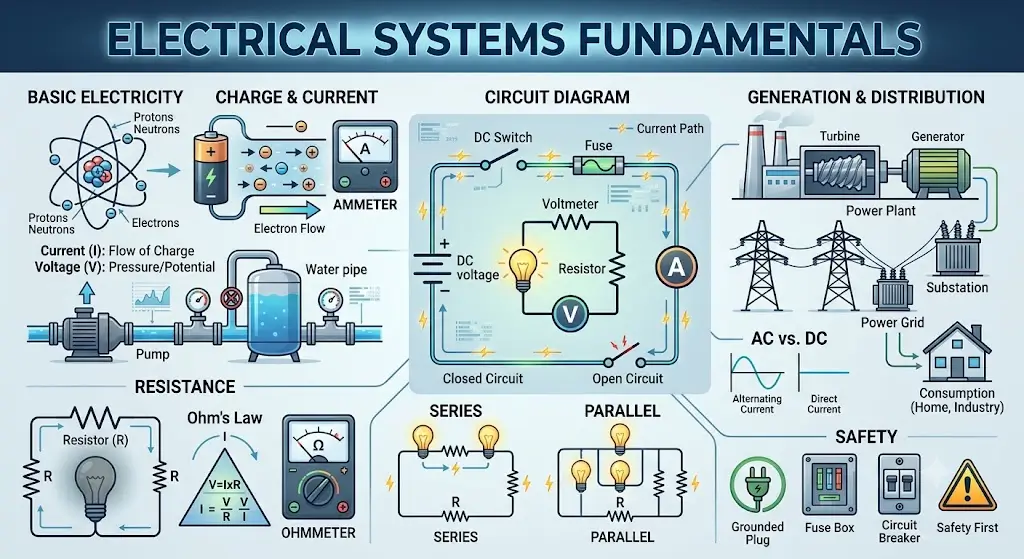
Learners begin by understanding the basic principles of electricity, including voltage, current, resistance, power, energy, and the relationships between these concepts. They explore electrical units, Ohm’s Law, electrical power calculations, and the fundamentals of alternating current (AC) and direct current (DC).
The course introduces electrical circuits, including series circuits, parallel circuits, combination circuits, circuit analysis, and common electrical components such as resistors, capacitors, inductors, switches, relays, fuses, and circuit breakers.
Participants study electrical wiring systems used in residential, commercial, and industrial installations. They learn about cables, conductors, connectors, grounding systems, electrical panels, distribution boards, and electrical installation practices.
A major component of the course focuses on electrical safety. Learners explore electrical hazards, safe work procedures, personal protective equipment (PPE), lockout/tagout procedures, grounding techniques, electrical codes, risk assessment, and accident prevention measures that reduce workplace hazards.
The course also examines electrical measuring instruments such as multimeters, clamp meters, insulation testers, voltage testers, and continuity testers. Participants learn how to safely perform basic electrical measurements and interpret test results.
Learners gain practical knowledge of electrical machines, including transformers, electric motors, generators, control devices, motor starters, and power distribution equipment commonly used across industries.
Additionally, the course covers preventive maintenance practices, inspection procedures, fault diagnosis, troubleshooting methods, equipment reliability, energy efficiency, and maintenance planning that improve electrical system performance and reduce downtime.
The curriculum also introduces electrical drawings, wiring diagrams, circuit schematics, symbols, technical documentation, and blueprint interpretation used during installation, maintenance, and repair activities.
Finally, participants explore emerging trends in electrical systems, including smart electrical systems, energy-efficient technologies, renewable energy integration, automation basics, and sustainable electrical infrastructure.
Skills You Will Gain
Upon successful completion of the course, learners will develop valuable professional skills, including:
- Electrical fundamentals
- Electrical circuit analysis
- AC and DC systems
- Electrical wiring basics
- Electrical safety practices
- Electrical equipment identification
- Electrical measurements
- Use of multimeters and testing equipment
- Transformer and motor fundamentals
- Circuit protection
- Electrical troubleshooting
- Preventive maintenance
- Reading electrical diagrams
- Energy efficiency awareness
- Technical problem-solving
These skills are highly valued across electrical contracting companies, manufacturing facilities, construction projects, maintenance departments, utilities, engineering firms, and industrial operations.
Benefits of the Course
The Electrical Systems Fundamentals Course provides learners with practical knowledge and technical skills needed to understand and work with electrical systems safely and efficiently.
Participants gain expertise in electrical theory, circuit operation, electrical safety, equipment maintenance, and troubleshooting techniques. These competencies support improved workplace safety, equipment reliability, operational efficiency, and career development.
The course also strengthens analytical thinking, technical communication, problem-solving, and maintenance planning skills that are valuable across engineering and technical industries.
As industries continue to expand their electrical infrastructure and adopt advanced technologies, professionals with strong electrical fundamentals remain in high demand.
Learners also gain the confidence to pursue advanced electrical training, certifications, and technical career opportunities.
Who Should Enroll?
This course is ideal for:
- Electrical engineering students
- Electricians
- Maintenance technicians
- Industrial technicians
- Facility maintenance personnel
- Construction professionals
- Manufacturing employees
- Engineering graduates
- Technical apprentices
- Utility workers
- HVAC technicians
- Automation technicians
- Safety professionals
- Technical supervisors
- Anyone interested in learning electrical systems
No prior electrical experience is required. The course is suitable for beginners as well as professionals seeking to strengthen their understanding of electrical systems.
Career Opportunities
After completing the course, learners may pursue opportunities such as:
- Electrical Technician
- Maintenance Technician
- Electrical Maintenance Assistant
- Industrial Electrician Trainee
- Electrical Installer
- Electrical Engineering Assistant
- Facility Maintenance Technician
- Electrical Service Technician
- Manufacturing Technician
- Utilities Technician
- Field Service Technician
- Building Maintenance Technician
- Technical Support Specialist
- Electrical Inspector Assistant
- Industrial Operations Technician
Professionals with electrical systems knowledge are employed by manufacturing companies, construction firms, power utilities, maintenance organizations, engineering consultancies, industrial facilities, renewable energy companies, and infrastructure projects.
Certification
Upon successful completion of the Electrical Systems Fundamentals Course, participants receive a certification recognizing their knowledge of electrical principles, circuit analysis, electrical safety, wiring systems, electrical equipment, troubleshooting, preventive maintenance, and technical documentation. This certification enhances professional credibility and supports career advancement in electrical engineering, maintenance, construction, manufacturing, and industrial operations.
Why Choose This Course?
The Electrical Systems Fundamentals Course combines essential electrical theory with practical industry applications to provide a comprehensive learning experience.
The curriculum focuses on electrical circuits, wiring systems, electrical safety, transformers, motors, measurement techniques, troubleshooting, preventive maintenance, and energy efficiency. Learners gain practical skills that prepare them for entry-level technical roles and future learning in electrical engineering and industrial maintenance.
Whether your goal is to become an electrician, maintenance technician, engineering assistant, industrial technician, or pursue further education in electrical engineering, this course provides the knowledge, practical skills, and confidence needed to succeed.
Enroll today and build a strong foundation in electrical systems, electrical safety, circuit analysis, maintenance, and technical problem-solving.
FAQ Section
1. What is the Electrical Systems Fundamentals Course?
The course teaches the basic principles of electrical systems, including circuits, wiring, electrical components, safety practices, measurements, and troubleshooting techniques.
2. Is this course suitable for beginners?
Yes. The course is designed for beginners and provides a clear introduction to electrical systems and electrical engineering fundamentals.
3. What topics are covered in this course?
Topics include electrical theory, AC and DC circuits, electrical components, wiring systems, transformers, motors, electrical safety, circuit protection, preventive maintenance, and troubleshooting.
4. Will I receive a certificate after completing the course?
Yes. Participants receive a certificate upon successful completion of the course.
5. Do I need prior electrical knowledge?
No. The course starts with the basics and gradually introduces more advanced electrical concepts.
6. Who should enroll in this course?
Electrical engineering students, electricians, maintenance technicians, construction professionals, facility managers, technical apprentices, and anyone interested in electrical systems can benefit from this course.
7. Is the course fully online?
Yes. The course offers flexible online learning, allowing participants to study at their own pace.
8. What skills will I gain?
You will gain skills in electrical fundamentals, circuit analysis, wiring basics, electrical safety, electrical measurements, troubleshooting, preventive maintenance, and reading electrical diagrams.
9. Can this course improve my career opportunities?
Yes. Electrical systems knowledge is valuable for careers in electrical engineering, maintenance, manufacturing, construction, utilities, automation, and industrial operations.
10. Why are electrical systems fundamentals important?
Understanding electrical systems helps professionals install, operate, maintain, and troubleshoot electrical equipment safely while improving efficiency, reliability, and workplace safety.





Reviews
There are no reviews yet.