
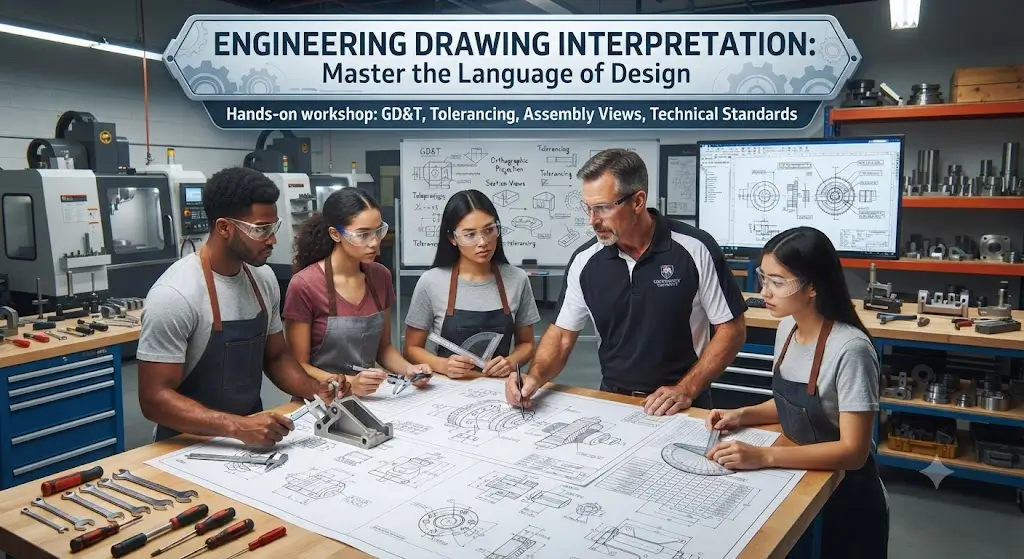
Engineering Drawing Interpretation Course
The Engineering Drawing Interpretation Course is designed to help engineers, technicians, manufacturing professionals, machine operators, quality inspectors, production supervisors, maintenance personnel, students, and aspiring engineering professionals develop the knowledge and practical skills required to accurately read and interpret engineering drawings. Engineering drawings serve as the universal language of engineering and manufacturing, enabling clear communication between designers, manufacturers, and quality teams.
This course introduces the core principles of engineering drawing interpretation, including blueprint reading, engineering drawing standards, orthographic projections, isometric views, dimensions, tolerances, drawing symbols, geometric dimensioning and tolerancing (GD&T) basics, sectional views, assembly drawings, bills of materials (BOM), CAD drawing concepts, and manufacturing documentation. Learners will gain practical knowledge of interpreting technical drawings used in mechanical, civil, electrical, and industrial engineering environments.
Whether you work in manufacturing, construction, automotive, aerospace, fabrication, maintenance, quality control, or engineering design, this course provides a comprehensive foundation in engineering drawing interpretation.
Course Overview
The course explores the essential concepts required to understand and interpret engineering drawings accurately. Learners will study drawing layouts, symbols, dimensions, tolerances, projections, assembly drawings, and technical documentation while developing the ability to communicate effectively within engineering and manufacturing teams.
The curriculum combines engineering theory with practical drawing exercises, real-world examples, manufacturing case studies, and industry standards to prepare learners for technical and industrial roles.
What You Will Learn
By completing this course, you will be able to:
- Understand engineering drawing fundamentals.
- Interpret technical drawings accurately.
- Read engineering blueprints.
- Apply engineering drawing standards.
- Understand orthographic projections.
- Interpret isometric drawings.
- Read dimensions and tolerances.
- Understand GD&T basics.
- Interpret sectional and auxiliary views.
- Read assembly drawings.
- Understand Bills of Materials (BOM).
- Interpret CAD-generated drawings.
- Support manufacturing and inspection activities.
- Improve technical communication.
- Build confidence in engineering documentation.
Course Curriculum
The curriculum begins with engineering drawing fundamentals before progressing through drawing standards, projection methods, dimensions, tolerances, GD&T basics, symbols, assembly drawings, CAD concepts, manufacturing documentation, practical exercises, case studies, and industry best practices.
Practical assignments help learners interpret engineering drawings using real-world manufacturing and engineering scenarios.
Skills You Will Gain
After completing the course, you will develop skills in:
- Engineering Drawing Interpretation
- Blueprint Reading
- Technical Drawing Analysis
- Orthographic Projection
- Isometric Drawing Interpretation
- Engineering Symbols
- Dimensions and Tolerances
- GD&T Fundamentals
- Assembly Drawing Reading
- Bill of Materials (BOM)
- CAD Drawing Interpretation
- Technical Documentation
- Manufacturing Communication
- Quality Inspection Support
- Engineering Problem-Solving
Benefits of the Course
This course helps learners improve technical communication, reduce manufacturing errors, strengthen quality control, enhance engineering documentation skills, and improve workplace productivity. Accurate drawing interpretation supports efficient production, inspection, maintenance, and engineering collaboration.
These competencies are highly valued across manufacturing companies, automotive industries, aerospace organizations, construction firms, fabrication workshops, engineering consultancies, maintenance departments, quality control laboratories, and industrial plants.
Who Should Enroll
This course is ideal for:
- Mechanical Engineers
- Civil Engineers
- Electrical Engineers
- Manufacturing Engineers
- Production Supervisors
- Machine Operators
- Maintenance Technicians
- Quality Inspectors
- CAD Operators
- Engineering Students
- Fabrication Professionals
- Industrial Technicians
- Engineering Designers
- Project Engineers
- Anyone interested in engineering drawings
Career Opportunities
After completing the Engineering Drawing Interpretation Course, learners may strengthen their qualifications for roles such as:
- Mechanical Technician
- Production Engineer
- Manufacturing Technician
- CAD Technician
- Quality Inspector
- Maintenance Engineer
- Design Technician
- Project Engineer
- Industrial Engineering Technician
- Technical Documentation Specialist
These skills are valuable across manufacturing, automotive, aerospace, construction, fabrication, industrial engineering, maintenance, quality assurance, and engineering consulting organizations.
Certification Details
Upon successful completion, learners receive a Certificate of Completion recognizing their expertise in Engineering Drawing Interpretation and technical documentation. This certification enhances your professional profile and supports career advancement in engineering, manufacturing, production, quality assurance, maintenance, construction, and industrial operations.
If you want to accurately read engineering drawings, improve technical communication, and strengthen your manufacturing or engineering skills, the Engineering Drawing Interpretation Course provides practical, industry-relevant knowledge for today’s engineering and industrial sectors.
FAQ SECTION
1. What is the Engineering Drawing Interpretation Course?
It teaches how to read, understand, and interpret engineering drawings, blueprints, symbols, dimensions, tolerances, and technical documentation used in engineering and manufacturing.
2. Is this course suitable for beginners?
Yes. The course begins with engineering drawing fundamentals and is suitable for beginners, students, technicians, and engineering professionals.
3. What topics are covered?
Blueprint reading, engineering drawing standards, orthographic projections, isometric views, dimensions, tolerances, GD&T basics, assembly drawings, BOM, CAD drawings, and technical documentation.
4. Do I need previous engineering experience?
No. The course is designed for beginners, students, technicians, engineers, production staff, and anyone interested in engineering drawing interpretation.
5. Is the course online?
Yes. The course is fully online and self-paced.
6. Will I receive a certificate?
Yes. A certificate is awarded after successfully completing the course.
7. Who should enroll?
Engineering students, technicians, production supervisors, quality inspectors, maintenance personnel, CAD operators, engineers, manufacturing professionals, and anyone working with technical drawings.
8. What skills will I gain?
Blueprint reading, technical drawing interpretation, GD&T basics, dimension and tolerance analysis, assembly drawing reading, CAD drawing interpretation, engineering documentation, and technical communication.
9. Can this course help my career?
Yes. Engineering drawing interpretation skills are highly valued across manufacturing, automotive, aerospace, construction, fabrication, engineering consulting, maintenance, production, and quality assurance industries.
10. Why is Engineering Drawing Interpretation important?
Engineering Drawing Interpretation enables professionals to accurately understand design specifications, improve manufacturing accuracy, reduce production errors, strengthen quality control, enhance communication between engineering teams, and ensure products are manufactured according to design requirements.



Reviews
There are no reviews yet.