
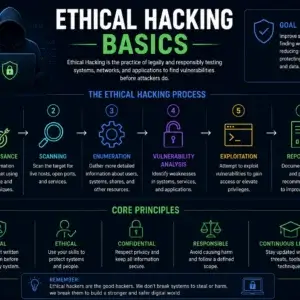
Ethical Hacking Basics Course – Learn to Protect and Defend
Cybersecurity is one of the most critical skills in today’s digital world, and ethical hacking plays a vital role in safeguarding systems against malicious attacks. Our Ethical Hacking Basics course introduces learners to the fundamentals of penetration testing, vulnerability assessment, and security best practices. Designed for beginners, this course provides a strong foundation in ethical hacking concepts, tools, and techniques.
What You’ll Learn
- Introduction to ethical hacking: definition, importance, and scope
- Types of hackers: white hat, black hat, and grey hat explained
- Cybersecurity fundamentals: networks, operating systems, and encryption basics
- Common vulnerabilities: SQL injection, phishing, malware, and weak passwords
- Penetration testing basics: reconnaissance, scanning, and exploitation
- Popular tools: Kali Linux, Nmap, Wireshark, and Metasploit
- Legal and ethical aspects: laws, compliance, and responsible practices
- Career opportunities: roles in cybersecurity, penetration testing, and IT security
Why Choose This Course?
- Beginner‑friendly: No prior hacking experience required
- Hands‑on learning: Practical exercises with safe, simulated environments
- Career boost: Ethical hacking skills are in high demand across industries
- Future‑ready: Gain knowledge to protect systems and data in a digital age
Who Should Enroll?
- Students interested in cybersecurity and IT
- Professionals seeking to upskill in ethical hacking and penetration testing
- Entrepreneurs and business owners wanting to secure their digital assets
- Anyone curious about how hackers think and how to defend against them
By the end of this course, you’ll understand the mindset of ethical hackers, identify vulnerabilities, and apply basic security measures to protect systems. This course empowers you to take the first step toward a career in cybersecurity and ethical hacking.
FAQ SECTION
1. What is an Ethical Hacking Basics Course?
This course introduces cybersecurity concepts, ethical hacking principles, network security, and cyber threat awareness.
2. Is this course suitable for beginners?
Yes, the course is specifically designed for beginners with little or no cybersecurity experience.
3. Do I need programming knowledge?
No, prior programming knowledge is not required for this introductory course.
4. What skills will I learn?
Cybersecurity fundamentals, threat awareness, network security concepts, and security best practices.
5. Will I receive a certificate?
Yes, participants receive a course completion certificate.
6. What is ethical hacking?
Ethical hacking involves identifying security vulnerabilities to help organizations improve cybersecurity defenses.
7. Can this course help me start a cybersecurity career?
Yes, it provides foundational knowledge that supports entry-level cybersecurity learning and career development.
8. Is the course available online?
Yes, learners can complete the course online.
9. What industries need cybersecurity professionals?
Healthcare, finance, education, government, technology, retail, and virtually every modern industry.
10. Why is cybersecurity important?
Cybersecurity protects systems, networks, and data from cyber threats, attacks, and unauthorized access.





Reviews
There are no reviews yet.