
INTRODUCTION
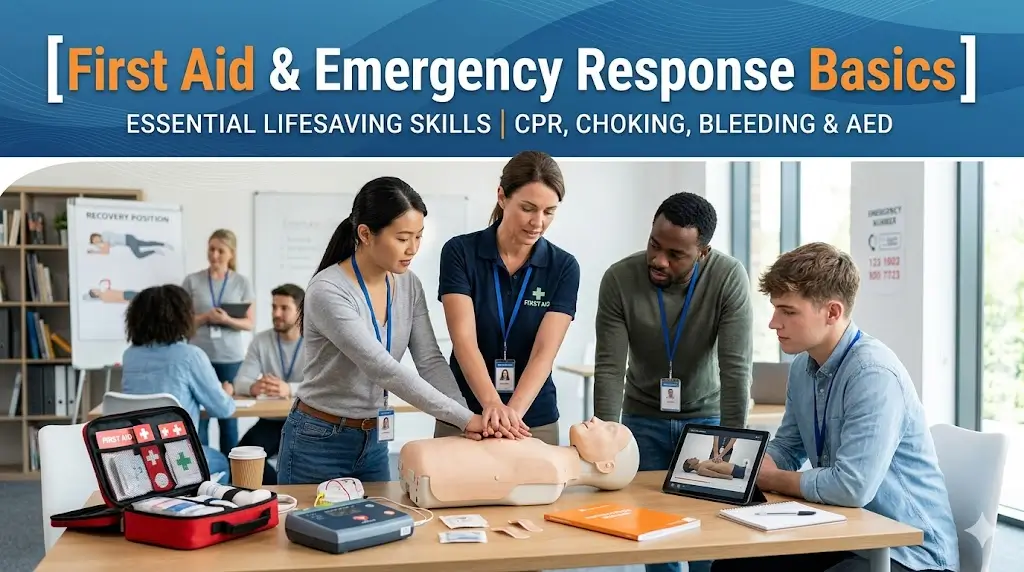
The First Aid & Emergency Response Basics Course is a structured beginner-level health and safety training program designed to help learners understand how to respond effectively during medical emergencies, accidents, and unexpected health situations. Emergencies can happen anytime, anywhere—at home, workplace, school, or public places—and having basic first aid knowledge can make the difference between life and death.
This course focuses on building practical life-saving skills that anyone can learn and apply immediately. It is designed for beginners with no prior medical background and provides simple, clear, and actionable knowledge.
WHAT IS FIRST AID?
First aid is the immediate care given to a person who is injured or suddenly becomes ill.
Additionally, it is provided before professional medical help arrives.
It helps stabilize the condition and prevent further harm.
First aid can save lives in critical situations.
It includes basic medical and emergency response actions.
COURSE OVERVIEW
This course provides a step-by-step introduction to emergency care procedures.
Learners will understand how to assess and respond to different emergencies.
Moreover, the course explains real-world safety practices and response techniques.
As a result, learners develop confidence in handling emergency situations.
The course is highly practical and life-oriented.
IMPORTANCE OF FIRST AID TRAINING
First aid training is important because emergencies are unpredictable.
Moreover, immediate response can significantly reduce injury severity.
Consequently, it increases survival chances in critical situations.
Proper knowledge prevents panic and confusion.
This course helps learners act quickly and effectively.
BASIC PRINCIPLES OF FIRST AID
There are key principles every first aider must follow:
Stay calm and assess the situation
Ensure safety of yourself and the victim
Call emergency services if needed
Provide immediate care without delay
Avoid causing further harm
These principles form the foundation of emergency response.
EMERGENCY ASSESSMENT
Before giving first aid, assessment is essential.
This includes checking consciousness, breathing, and injuries.
Additionally, identifying risks helps decide the correct response.
Proper assessment improves safety and effectiveness.
CPR (CARDIOPULMONARY RESUSCITATION) BASICS
CPR is a life-saving technique used when a person stops breathing.
It involves chest compressions and rescue breaths.
Moreover, it helps maintain blood circulation and oxygen flow.
CPR can save lives during cardiac emergencies.
This section introduces basic CPR awareness for beginners.
WOUND CARE AND BLEEDING CONTROL
Cuts and injuries are common emergencies.
This section explains how to clean and dress wounds properly.
Additionally, it covers methods to stop bleeding safely.
Proper wound care prevents infection and complications.
FRACTURE AND INJURY MANAGEMENT
Fractures require careful handling.
This section explains how to stabilize injuries.
Moreover, it teaches how to avoid further damage before medical help arrives.
Proper handling is critical for recovery.
BURNS AND SCALD TREATMENT
Burns can occur from heat, chemicals, or electricity.
This section explains immediate cooling and protection methods.
Additionally, it teaches what not to do during burn treatment.
Quick response reduces injury severity.
CHOKING EMERGENCY RESPONSE
Choking is a life-threatening emergency.
This section explains how to recognize and respond quickly.
Moreover, it introduces basic relief techniques.
Immediate action is critical in such cases.
SHOCK MANAGEMENT
Shock is a dangerous condition caused by injury or illness.
This section explains symptoms like weakness and confusion.
Additionally, it teaches supportive care methods.
Proper care can stabilize the patient until help arrives.
WORKPLACE AND HOME SAFETY
First aid is important in both workplace and home environments.
This section explains common accident prevention strategies.
Moreover, it promotes safety awareness and preparedness.
DISASTER AND EMERGENCY RESPONSE BASICS
Natural disasters and accidents require quick action.
This section explains evacuation and emergency coordination basics.
Additionally, it promotes community safety awareness.
REAL-LIFE APPLICATIONS
First aid skills are used in homes, workplaces, schools, and public spaces.
They are essential for teachers, employees, parents, and caregivers.
Moreover, they support disaster response teams and safety officers.
These skills are universally valuable.
SKILLS YOU WILL GAIN
After completing this course, learners will develop:
First aid knowledge
Emergency response skills
CPR awareness
Injury management skills
Wound care understanding
Safety awareness
Quick decision-making skills
Calmness under pressure
Basic medical response skills
Life-saving readiness
BENEFITS OF THE COURSE
The First Aid & Emergency Response Basics Course helps learners become prepared for emergencies.
Additionally, it builds confidence and responsibility.
Furthermore, first aid knowledge is useful in everyday life.
Benefits include:
Ability to save lives
Improved safety awareness
Better emergency handling
Workplace safety readiness
Confidence in crisis situations
Community contribution
Personal preparedness
Health awareness
WHO SHOULD ENROLL
This course is suitable for:
Students
Teachers
Parents
Office employees
Healthcare beginners
Security staff
Caregivers
Fitness trainers
Community workers
Anyone interested in safety
CAREER OPPORTUNITIES
After completing this course, learners may pursue roles such as:
First Aid Assistant (Entry Level)
Safety Support Staff
Workplace Safety Helper
Health & Safety Assistant
Emergency Response Trainee
School Safety Assistant
Community Health Volunteer
Hospital Support Staff
Disaster Response Assistant
Caregiver Assistant
CERTIFICATION DETAILS
Upon successful completion of the First Aid & Emergency Response Basics Course, learners receive a certification recognizing their skills in emergency response, first aid awareness, and basic life-saving techniques.
CONCLUSION
The First Aid & Emergency Response Basics Course provides essential life-saving knowledge that can be used in everyday emergencies. It helps learners stay prepared, act quickly, and provide critical assistance when needed.
Therefore, mastering first aid is not only a skill but a responsibility that can save lives in homes, workplaces, and communities.
FAQ SECTION
1. What is First Aid & Emergency Response Basics Course?
It is a beginner-level course that teaches emergency response and life-saving skills.
2. Who should take this course?
Anyone interested in safety, health, and emergency preparedness.
3. Do I need medical experience?
No, it is designed for beginners.
4. What will I learn in this course?
You will learn CPR basics, wound care, and emergency response.
5. Is this useful in real life?
Yes, it helps in everyday emergencies.
6. Will I learn CPR?
Yes, CPR awareness is included.
7. Is this useful for workplaces?
Yes, it improves workplace safety readiness.
8. Will I get a certificate?
Yes, a completion certificate is provided.
9. Can it help save lives?
Yes, it teaches essential life-saving skills.
10. Is this useful for career growth?
Yes, it supports safety and healthcare-related roles.


Reviews
There are no reviews yet.