
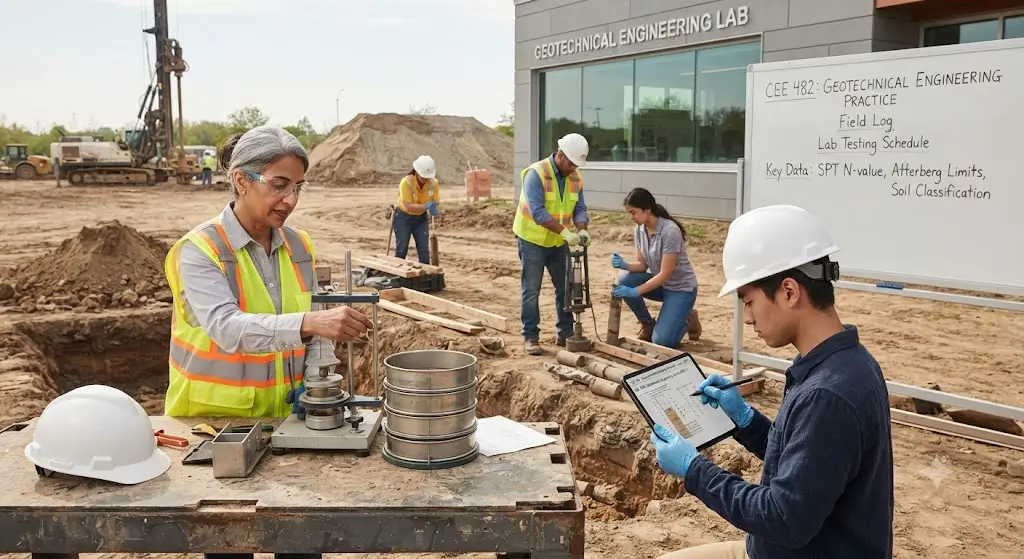
Introduction to Geotechnical Engineering Practice
The Geotechnical Engineering Practice Course is a professional training program designed to help learners understand the practical applications of geotechnical engineering in construction, infrastructure, mining, and environmental projects. Geotechnical engineering focuses on the behavior of soil and rock to ensure the safety and stability of structures built on or within the ground.
Geotechnical engineers evaluate subsurface conditions, analyze soil properties, design foundations, assess slope stability, and recommend ground improvement techniques. Their work is essential for minimizing construction risks and ensuring long-term structural performance.
This course combines soil mechanics, foundation engineering, site investigation, and geotechnical design methodologies to provide practical knowledge applicable across civil engineering, transportation, energy, and infrastructure development.
Why Geotechnical Engineering Practice Matters
Understanding ground conditions is essential for designing safe foundations, retaining structures, tunnels, embankments, and other civil engineering projects. Proper geotechnical practices help prevent settlement, slope failures, and structural instability.
Geotechnical engineering also supports cost-effective project planning, regulatory compliance, and sustainable construction by optimizing foundation systems and ground improvement methods.
The Geotechnical Engineering Practice Course enables learners to build strong technical expertise in geotechnical analysis and engineering decision-making.
Course Overview
The Geotechnical Engineering Practice Course introduces learners to modern geotechnical principles and field applications.
Participants begin by studying soil and rock mechanics, site investigation methods, and engineering properties of soils. The course explores foundation engineering, retaining walls, earth pressure theories, groundwater control, and slope stability.
Learners also study ground improvement techniques, geotechnical testing, construction quality control, and engineering standards.
Practical case studies demonstrate how geotechnical solutions are applied to buildings, highways, bridges, dams, and infrastructure projects.
Topics Covered
Throughout the Geotechnical Engineering Practice Course, learners will study:
Soil Mechanics Fundamentals
Understand the engineering behavior of soils.
Site Investigation
Conduct geotechnical investigations and interpret field data.
Soil Classification
Classify soils based on engineering properties.
Foundation Engineering
Design shallow and deep foundation systems.
Groundwater Assessment
Evaluate groundwater conditions and drainage.
Earth Pressure and Retaining Structures
Analyze lateral earth pressures and retaining wall design.
Slope Stability
Assess natural and engineered slope performance.
Ground Improvement Techniques
Study methods to strengthen weak soils.
Geotechnical Testing
Interpret laboratory and field test results.
Engineering Standards and Quality Control
Apply geotechnical codes and construction quality practices.
Skills You Will Gain
After completing the Geotechnical Engineering Practice Course, learners will develop valuable professional skills including:
- Soil mechanics analysis
- Geotechnical site investigation
- Soil classification
- Foundation design support
- Earth pressure analysis
- Slope stability evaluation
- Ground improvement techniques
- Geotechnical testing interpretation
- Groundwater assessment
- Engineering calculations
- Technical reporting
- Construction quality control
- Risk assessment
- Problem-solving
- Geotechnical decision-making
These competencies are valuable across civil engineering firms, geotechnical consultancies, construction companies, mining operations, transportation projects, and government infrastructure organizations.
Benefits of the Course
The Geotechnical Engineering Practice Course provides practical knowledge for solving real-world geotechnical engineering challenges.
Participants gain confidence in evaluating soil conditions, recommending foundation solutions, interpreting test results, and supporting infrastructure development. The course also strengthens analytical thinking, engineering judgment, and technical expertise.
As infrastructure and urban development continue to grow, professionals with geotechnical engineering skills remain highly sought after.
Who Should Enroll?
This course is suitable for:
- Civil engineers
- Geotechnical engineers
- Construction engineers
- Site engineers
- Structural engineers
- Infrastructure professionals
- Engineering consultants
- Project engineers
- Engineering students
- Quality control professionals
Basic knowledge of civil engineering and soil mechanics is recommended.
Career Opportunities
After completing the Geotechnical Engineering Practice Course, learners may pursue careers such as:
- Geotechnical Engineer
- Civil Engineer
- Foundation Engineer
- Site Investigation Engineer
- Construction Engineer
- Infrastructure Engineer
- Geotechnical Consultant
- Slope Stability Engineer
- Ground Improvement Specialist
- Project Engineer
- Field Engineer
- Quality Control Engineer
- Engineering Consultant
- Technical Manager
- Chief Geotechnical Engineer (future path)
Certification
Upon successful completion of the Geotechnical Engineering Practice Course, learners receive a professional certificate recognizing their expertise in soil mechanics, geotechnical investigation, foundation engineering, slope stability, and ground improvement techniques. This certification supports career advancement across civil engineering, geotechnical consulting, construction, and infrastructure industries.
Frequently Asked Questions (FAQs)
1. What is the Geotechnical Engineering Practice Course?
It teaches practical geotechnical engineering concepts used in construction and infrastructure projects.
2. Who should enroll in this course?
Civil engineers, geotechnical engineers, construction professionals, and engineering students can benefit.
3. Do I need prior experience?
Basic knowledge of civil engineering and soil mechanics is recommended.
4. What topics are covered?
Soil mechanics, site investigation, foundations, retaining walls, slope stability, groundwater, and ground improvement.
5. Is this course practical?
Yes. It includes real-world engineering applications, field investigation concepts, and case studies.
6. Will I learn foundation engineering and slope stability?
Yes. Both topics are covered extensively.
7. How does this help my career?
It develops specialized skills for geotechnical engineering, construction, and infrastructure projects.
8. Does it include field and laboratory testing?
Yes. The course covers geotechnical testing methods and data interpretation.
9. Can this improve my job opportunities?
Yes. Geotechnical engineering expertise is in demand across civil engineering and construction industries.
10. What industries use geotechnical engineering practices?
Construction, infrastructure, transportation, mining, environmental engineering, geotechnical consulting, energy, and government engineering projects.





Reviews
There are no reviews yet.