
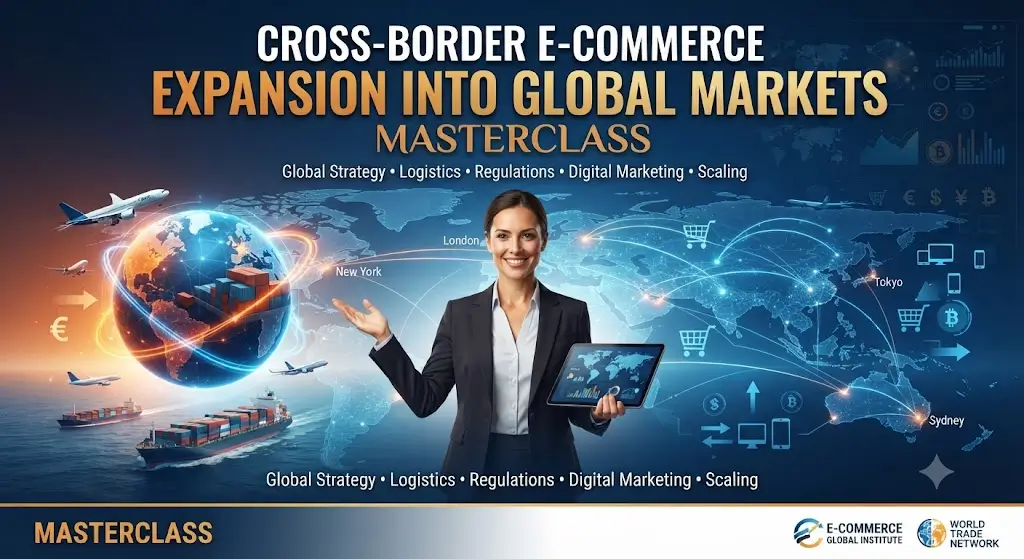
Cross-Border E-Commerce Expansion into Global Markets Masterclass
Master Global E-Commerce Expansion
Taking an e-commerce business into international markets requires more than simply accepting orders from another country. Businesses need to understand market opportunity, customer behavior, localization, pricing, payments, logistics, compliance, customer experience, and operational scalability.
This Global E-Commerce Expansion Masterclass provides an end-to-end framework for understanding and applying these elements.
Cross-border e-commerce involves online buying and selling between businesses and customers in different countries, with success often depending on how effectively businesses coordinate localized experiences, payments, fulfillment, shipping, and customer expectations.
What You Will Master
The course covers:
- Global e-commerce strategy
- Cross-border market research
- International market selection
- Market prioritization
- Customer and competitor analysis
- Global market-entry strategy
- E-commerce localization
- International pricing
- Multi-currency considerations
- Cross-border payments
- International logistics
- Fulfillment strategy
- Customs and duties
- Tax and regulatory considerations
- International customer experience
- Returns and reverse logistics
- International marketing
- Performance measurement
- Global e-commerce optimization
- Expansion risk management
- International scaling
Building a Global E-Commerce Strategy
A successful expansion strategy connects strategic objectives with operational execution.
The masterclass uses the framework:
Business Objective → Market Research → Market Prioritization → Customer Analysis → Market Entry → Localization → Pricing → Payments → Logistics → Compliance → Launch → Measurement → Optimization → Scale
This helps learners understand how individual decisions contribute to the overall international growth strategy.
1. Identify Global Market Opportunities
The first step is identifying where international demand may exist.
Learners will explore how to assess potential markets using factors such as:
- Existing international traffic
- Customer demand
- Market size
- Purchasing behavior
- Competition
- Product-market fit
- E-commerce maturity
- Market growth
- Logistics feasibility
- Payment preferences
- Regulatory complexity
International market research should combine internal business data with external market information when prioritizing expansion opportunities.
2. Prioritize International Markets
Not every potential market should be entered simultaneously.
Learners will develop frameworks for ranking markets based on:
Opportunity + Demand + Commercial Potential + Operational Feasibility + Risk
This allows businesses to distinguish between attractive markets and markets that are realistically scalable for their current capabilities.
3. Develop Market-Entry Strategies
The masterclass explores different approaches to international expansion and how businesses can determine which approach best fits their goals and resources.
Learners will evaluate considerations such as:
- Direct cross-border selling
- International marketplaces
- Local partnerships
- Regional fulfillment
- Localized storefronts
- Distribution arrangements
- International operational infrastructure
The appropriate model depends on the business, target market, product category, resources, and regulatory environment.
4. Understand International Customers
Customer expectations can differ significantly between markets.
You will explore:
- Buying behavior
- Customer preferences
- Local competition
- Price sensitivity
- Payment expectations
- Delivery expectations
- Communication preferences
- Customer-service requirements
These insights can then be translated into market-specific e-commerce strategies.
5. Master E-Commerce Localization
Global expansion requires more than translating a website.
Learners will explore localization of:
- Language
- Currency
- Product information
- Pricing
- Payment methods
- Marketing content
- Promotions
- Customer support
- Delivery information
- Returns policies
- Cultural elements
Localization can be prioritized according to customer needs, business objectives, and available resources.
6. International Pricing Strategy
Selling internationally introduces additional pricing considerations.
The course examines:
- Local competitor pricing
- Currency fluctuations
- Purchasing power
- Shipping costs
- Duties
- Taxes
- Payment costs
- Promotional pricing
- Margin requirements
- Market positioning
Learners will develop frameworks for evaluating how pricing decisions can differ across international markets.
7. Cross-Border Payments
Payment is a critical part of the international customer experience.
You will explore:
- Local payment methods
- Multi-currency checkout
- Currency conversion
- Payment processing
- Transaction costs
- Checkout friction
- Payment security
- Customer trust
Offering familiar payment options and clear pricing can help create a smoother international purchasing experience.
8. International Logistics and Fulfillment
Global growth requires a scalable logistics strategy.
The course explores:
- Cross-border shipping
- International fulfillment
- Warehousing
- Third-party logistics
- Delivery-time expectations
- Shipping costs
- Tracking
- Customs processing
- Returns
- Reverse logistics
International logistics should be considered alongside customer experience and profitability rather than as a separate operational function.
9. Customs, Duties, Tax and Compliance
International e-commerce can involve market-specific requirements around customs, duties, taxation, product rules, consumer protection, and other regulations.
Learners will develop a framework for identifying which requirements need to be researched before entering a market.
The World Customs Organization highlights the distinctive characteristics of cross-border e-commerce, including high volumes of small packages, time-sensitive flows, and the need to manage return and refund processes.
Because legal and tax requirements vary by jurisdiction, product, transaction structure, and business model, businesses should verify current requirements with appropriate government or professional sources.
10. Build the International Customer Experience
A global customer journey can include:
Discovery → Product Research → Localized Storefront → Checkout → Payment → Shipping → Delivery → Support → Returns → Repeat Purchase
Learners will explore how each stage can be adapted to international customer expectations.
11. International Marketing Strategy
The masterclass connects global market entry with marketing execution.
Topics include:
- International positioning
- Market-specific messaging
- Digital advertising
- Search marketing
- Social media
- Content localization
- Marketplace marketing
- Customer acquisition
- Retention strategies
The goal is to build marketing strategies that reflect the characteristics of each target market.
12. Measure Global E-Commerce Performance
International expansion should be measured at both overall and market levels.
Learners will explore:
- International traffic
- Conversion rate
- Revenue
- Average order value
- Customer acquisition cost
- Customer lifetime value
- Repeat purchase rate
- Return rate
- Shipping performance
- Payment success
- Market profitability
Performance analysis can help businesses determine which markets deserve additional investment and which require strategic adjustment.
13. Global E-Commerce Optimization
The masterclass introduces a continuous optimization framework:
Launch → Measure → Analyze → Test → Optimize → Scale
Potential optimization areas include:
- Pricing
- Product assortment
- Localization
- Checkout
- Payments
- Marketing
- Fulfillment
- Customer service
- Returns
- Market positioning
14. International Expansion Risk Management
Global expansion can introduce additional risks.
Learners will examine:
- Market risk
- Currency risk
- Logistics risk
- Supply chain risk
- Payment risk
- Compliance risk
- Operational risk
- Customer experience risk
- Reputation risk
The objective is to identify potential issues before they become barriers to international growth.
Practical Masterclass Framework
Learners will work through an end-to-end model:
1. Research the Market
↓
2. Select the Opportunity
↓
3. Analyze Customers & Competitors
↓
4. Build the Market-Entry Strategy
↓
5. Localize the Experience
↓
6. Plan Pricing & Payments
↓
7. Design Logistics & Fulfillment
↓
8. Review Compliance Requirements
↓
9. Launch & Acquire Customers
↓
10. Measure Performance
↓
11. Optimize
↓
12. Scale
Practical Case Studies
The masterclass can include practical scenarios such as:
Case Study 1: Market Selection
Compare several international markets and determine which market should receive expansion priority.
Case Study 2: Global Store Localization
Identify which website, pricing, payment, and communication elements should be adapted for a target market.
Case Study 3: International Pricing
Develop a pricing framework considering competition, currency, logistics, duties, taxes, and margins.
Case Study 4: Cross-Border Logistics
Design an international fulfillment and delivery approach.
Case Study 5: Market-Entry Plan
Build an end-to-end expansion roadmap for entering a new country.
Case Study 6: Global Performance Optimization
Review market-level performance and identify opportunities to improve conversion, profitability, customer experience, or operational efficiency.
Who Should Take This Masterclass?
This course is suitable for:
- E-commerce professionals
- E-commerce managers
- Entrepreneurs
- Business owners
- Digital marketers
- International business professionals
- Global marketing professionals
- Business development professionals
- Export-oriented businesses
- Supply chain professionals
- Online retailers
- Startup teams
- Experienced e-commerce learners
Prerequisites
A basic or intermediate understanding of e-commerce, digital marketing, international business, or cross-border selling is recommended.
Learning Outcomes
After completing the masterclass, learners should be able to:
- Develop a global e-commerce expansion framework
- Identify and prioritize international markets
- Analyze international customers and competitors
- Develop market-entry strategies
- Apply e-commerce localization principles
- Evaluate international pricing considerations
- Understand cross-border payment strategies
- Plan international logistics and fulfillment
- Identify customs, tax, and regulatory considerations
- Develop international customer-experience strategies
- Measure market-level e-commerce performance
- Identify global expansion risks
- Optimize international e-commerce operations
- Develop scalable strategies for global market expansion
Why Learn Global E-Commerce Expansion?
International e-commerce creates opportunities to reach customers beyond domestic markets, but sustainable global growth requires coordination across strategy, marketing, operations, logistics, payments, localization, and customer experience.
This masterclass brings these areas together into a structured learning framework, helping learners understand how to move from international market opportunity to practical expansion and long-term optimization.
Master Cross-Border E-Commerce and build the strategic knowledge needed to evaluate, enter, optimize, and scale global markets.
Frequently Asked Questions
1. What is global e-commerce expansion?
Global e-commerce expansion is the process of extending an online business into international markets and developing the strategy, operations, customer experience, and infrastructure needed to serve customers across countries.
2. What will I learn in this Cross-Border E-Commerce Masterclass?
You will learn global market research, market selection, market-entry strategy, localization, international pricing, payments, logistics, compliance considerations, customer experience, performance measurement, and scaling.
3. Who should take this Global E-Commerce Expansion Masterclass?
The course is suitable for e-commerce professionals, entrepreneurs, business owners, digital marketers, international business professionals, online retailers, and experienced learners interested in global expansion.
4. What is cross-border e-commerce?
Cross-border e-commerce involves buying and selling goods or services online between businesses and customers located in different countries.
5. How do businesses choose international markets?
Businesses can evaluate markets using factors such as customer demand, competition, product-market fit, market potential, logistics, payment preferences, operational complexity, and regulatory considerations.
6. Why is localization important for global e-commerce?
Localization allows businesses to adapt elements such as language, currency, pricing, payment methods, content, customer support, and shopping experiences to the needs of a specific market.
7. What are the major challenges of cross-border e-commerce?
Challenges may include international logistics, customs, duties, taxes, payment differences, currency, localization, regulatory requirements, customer service, returns, and market-specific competition.
8. How important are international payments?
Payment preferences can vary by market. Supporting appropriate payment methods and presenting prices clearly can be important parts of reducing friction in international checkout experiences.
9. How can international e-commerce performance be measured?
Businesses can monitor traffic, conversion rate, revenue, average order value, customer acquisition cost, repeat purchases, returns, delivery performance, payment success, and market-level profitability.
10. Can this masterclass help with global market-entry planning?
Yes. The course provides an end-to-end framework covering market research, market selection, customer analysis, localization, pricing, payments, logistics, compliance review, launch, measurement, and optimization.



Reviews
There are no reviews yet.