
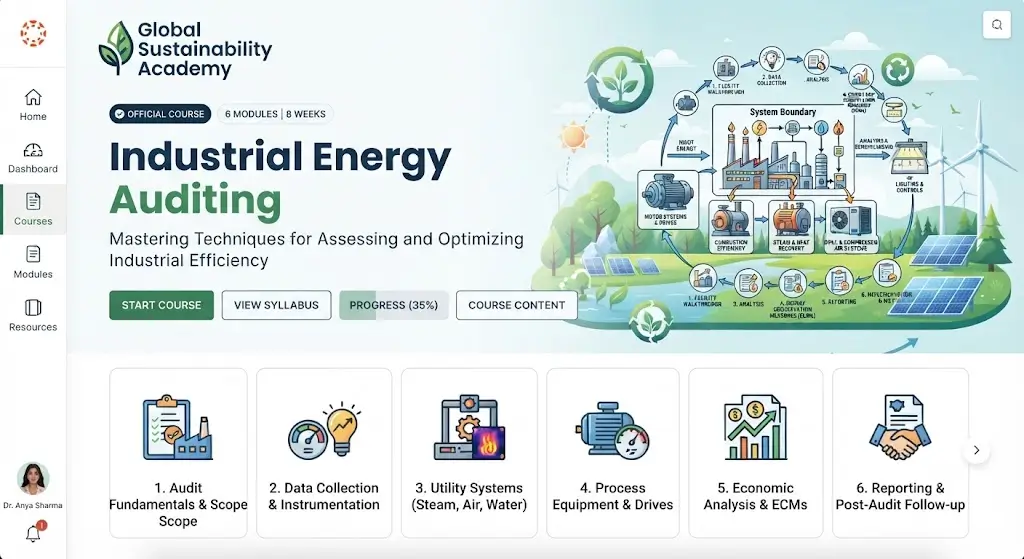
Industrial Energy Auditing Course
The Industrial Energy Auditing Course is designed to help engineers, plant managers, maintenance professionals, energy managers, sustainability specialists, consultants, technicians, students, and industrial professionals develop the knowledge and practical skills required to evaluate energy usage and improve energy efficiency in industrial facilities. As organizations focus on reducing operational costs and achieving sustainability goals, energy auditing has become an essential part of industrial operations.
This course introduces the core principles of industrial energy auditing, including energy consumption analysis, utility management, electrical and thermal energy systems, boiler efficiency, steam systems, HVAC optimization, compressed air systems, motors and pumps, lighting efficiency, energy conservation measures, ISO 50001 energy management systems, performance monitoring, reporting, and continuous improvement. Learners will gain practical knowledge of identifying energy-saving opportunities while improving productivity and reducing environmental impact.
Whether you work in manufacturing, processing industries, utilities, engineering, or facility management, this course provides a comprehensive foundation in industrial energy auditing.
Course Overview
The course explores the complete industrial energy auditing process, from collecting energy data and analyzing utility consumption to identifying energy losses, recommending efficiency improvements, implementing conservation measures, and monitoring energy performance. Learners will understand how systematic energy audits contribute to lower operating costs, improved equipment performance, regulatory compliance, and sustainable industrial development.
The curriculum combines industrial energy management concepts with practical exercises, audit simulations, case studies, and industry best practices to prepare learners for real-world industrial environments.
What You Will Learn
By completing this course, you will be able to:
- Understand industrial energy auditing principles.
- Conduct different types of energy audits.
- Analyze industrial energy consumption.
- Evaluate electrical and thermal systems.
- Improve boiler and steam system efficiency.
- Optimize HVAC and compressed air systems.
- Assess motors, pumps, and lighting systems.
- Identify energy-saving opportunities.
- Implement energy conservation measures.
- Apply ISO 50001 energy management principles.
- Prepare professional energy audit reports.
- Monitor energy performance.
- Reduce operational costs.
- Improve industrial sustainability.
- Support continuous energy improvement.
Course Curriculum
The curriculum begins with industrial energy management fundamentals before progressing through energy audit methodologies, utility analysis, electrical and thermal systems, equipment efficiency, energy conservation, ISO 50001 implementation, reporting techniques, industrial case studies, and future trends.
Practical assignments help learners perform industrial energy audits using real-world scenarios and operational data.
Skills You Will Gain
After completing the course, you will develop skills in:
- Industrial Energy Auditing
- Energy Management
- Energy Consumption Analysis
- Utility Management
- Energy Efficiency
- Electrical Energy Auditing
- Thermal Energy Auditing
- Boiler Efficiency
- HVAC Optimization
- Compressed Air Systems
- Motor and Pump Efficiency
- ISO 50001 Energy Management
- Energy Conservation
- Energy Performance Monitoring
- Sustainability Management
Benefits of the Course
This course helps learners improve industrial energy efficiency, reduce utility costs, optimize equipment performance, and support environmental sustainability. Strong energy auditing skills enable organizations to identify cost-saving opportunities, minimize energy waste, improve operational reliability, and meet sustainability objectives.
These skills are highly valuable across manufacturing industries, power plants, engineering firms, process industries, utility companies, oil and gas organizations, chemical plants, food processing companies, facility management organizations, and environmental consulting firms.
Who Should Enroll
This course is ideal for:
- Energy Managers
- Electrical Engineers
- Mechanical Engineers
- Plant Managers
- Maintenance Engineers
- Facility Managers
- Energy Auditors
- Sustainability Professionals
- Industrial Consultants
- Operations Managers
- Engineering Students
- Utility Professionals
- Process Engineers
- Manufacturing Professionals
- Anyone interested in industrial energy management
Career Opportunities
After completing the Industrial Energy Auditing Course, learners may strengthen their qualifications for roles such as:
- Energy Auditor
- Energy Manager
- Industrial Energy Engineer
- Facility Manager
- Plant Engineer
- Maintenance Engineer
- Sustainability Consultant
- Utility Engineer
- Energy Efficiency Specialist
- Industrial Operations Manager
These skills are valuable across manufacturing companies, engineering consultancies, utility providers, industrial plants, oil and gas companies, chemical industries, food processing organizations, facility management firms, government agencies, and sustainability consulting companies.
Certification Details
Upon successful completion, learners receive a Certificate of Completion recognizing their expertise in Industrial Energy Auditing and energy management. This certification enhances your professional profile and supports career advancement in industrial engineering, facility management, sustainability, manufacturing, energy consulting, utility management, and operations leadership.
If you want to improve industrial energy efficiency, reduce operating costs, and support sustainable industrial operations, the Industrial Energy Auditing Course provides practical, industry-relevant knowledge for today’s energy-conscious industries.
FAQ SECTION
1. What is the Industrial Energy Auditing Course?
It teaches how to assess industrial energy consumption, identify energy-saving opportunities, and improve energy efficiency across manufacturing and industrial facilities.
2. Is this course suitable for beginners?
Yes. The course starts with industrial energy management fundamentals and is suitable for beginners as well as engineers and industry professionals.
3. What topics are covered?
Energy auditing, energy management, utility systems, electrical and thermal audits, HVAC optimization, boiler efficiency, compressed air systems, ISO 50001, energy conservation, and sustainability.
4. Do I need previous industrial experience?
No. The course is designed for beginners, engineering students, technicians, managers, and professionals interested in industrial energy management.
5. Is the course online?
Yes. The course is fully online and self-paced.
6. Will I receive a certificate?
Yes. A certificate is awarded after successfully completing the course.
7. Who should enroll?
Energy managers, engineers, plant managers, maintenance professionals, facility managers, sustainability specialists, consultants, engineering students, and anyone interested in industrial energy efficiency.
8. What skills will I gain?
Industrial energy auditing, energy management, utility analysis, electrical and thermal auditing, energy conservation, ISO 50001 implementation, performance monitoring, and sustainability management.
9. Can this course help my career?
Yes. Industrial energy auditing skills are highly valued across manufacturing industries, engineering firms, utility companies, process industries, oil and gas organizations, facility management companies, government agencies, and environmental consulting firms.
10. Why is Industrial Energy Auditing important?
Industrial Energy Auditing helps organizations reduce energy consumption, lower operating costs, improve equipment efficiency, minimize environmental impact, comply with energy regulations, and achieve long-term sustainability through systematic energy management.




Reviews
There are no reviews yet.