
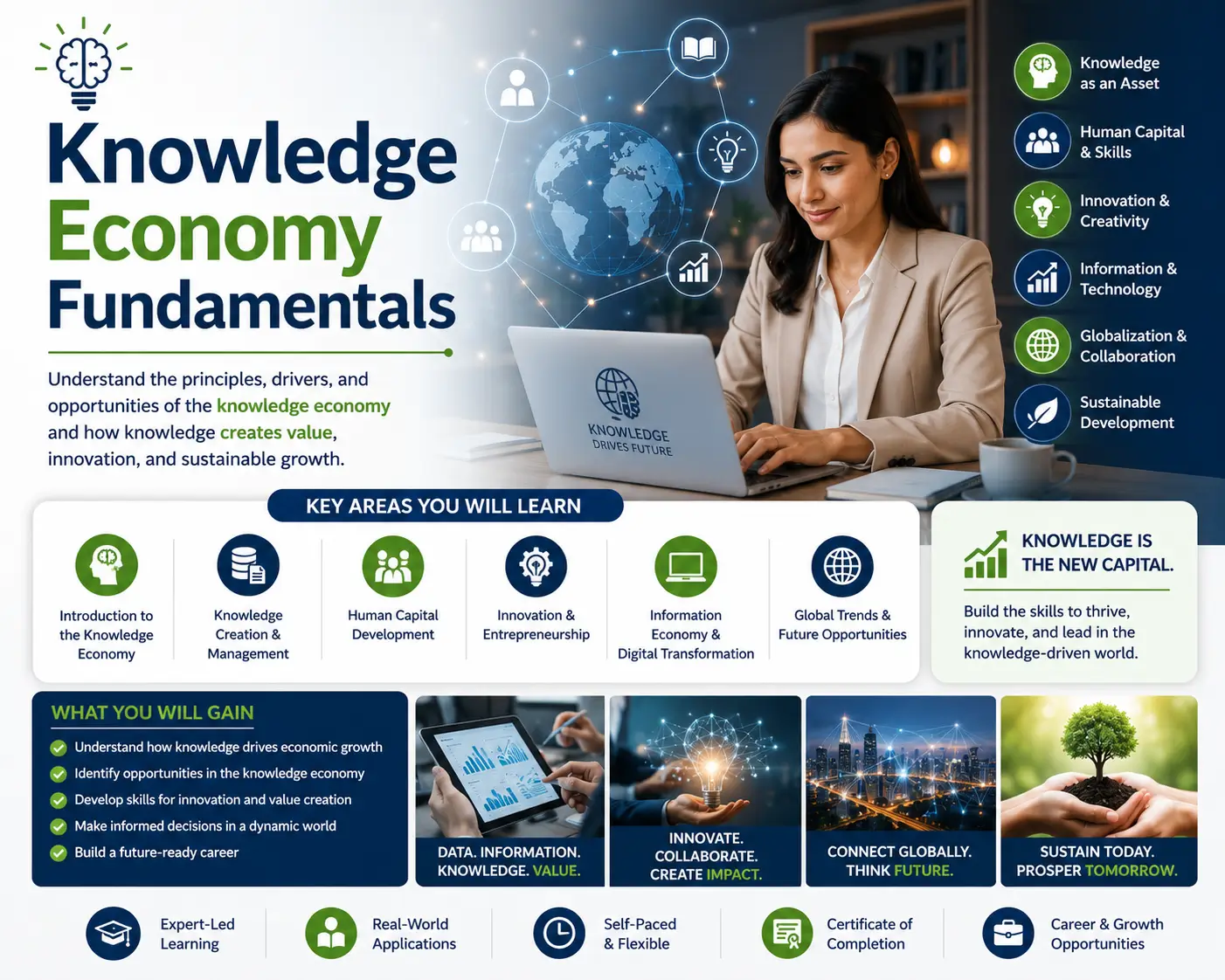
Understand the Future of Business with a Knowledge Economy Fundamentals Course
The Knowledge Economy Fundamentals Course is designed to help learners understand how knowledge, innovation, technology, and intellectual capital have become the primary drivers of economic growth in the modern world. Unlike traditional economies that relied heavily on physical resources and manufacturing, today’s knowledge economy focuses on information, creativity, research, digital technologies, and continuous innovation.
As organizations increasingly depend on data, technology, and skilled professionals, understanding the principles of the knowledge economy has become essential for career growth and business success. This course introduces learners to the foundations of knowledge-based economic systems, innovation management, digital transformation, intellectual capital, and the evolving nature of work.
Whether you are a student, entrepreneur, manager, policymaker, consultant, or business professional, this course provides valuable insights into the economic forces shaping the future.
Knowledge Economy Fundamentals Course Overview
The knowledge economy refers to an economic system where growth is driven by the production, distribution, and use of knowledge and information. Businesses compete through innovation, technology adoption, research capabilities, and intellectual assets rather than relying solely on physical resources.
The Knowledge Economy Fundamentals Course explores how organizations leverage knowledge to create value, improve productivity, foster innovation, and achieve sustainable competitive advantages.
Why Learn Knowledge Economy Fundamentals?
Knowledge has become one of the most valuable assets in modern organizations.
Benefits of learning Knowledge Economy Fundamentals include:
- Understanding modern economic systems
- Learning innovation management concepts
- Exploring digital transformation strategies
- Understanding intellectual capital
- Enhancing strategic thinking skills
- Improving business awareness
- Preparing for future workforce trends
- Increasing career opportunities
What You Will Learn in This Knowledge Economy Fundamentals Course
Throughout the course, learners will explore:
- Knowledge economy principles
- Innovation-driven growth
- Digital transformation concepts
- Knowledge management systems
- Intellectual capital strategies
- Technology and economic development
- Information-based business models
- Future workforce trends
- Global competitiveness factors
- Economic sustainability concepts
Knowledge-Based Economies
Learn how countries and organizations create value through knowledge, innovation, and technology.
Innovation and Technology
Understand the role of research, development, and emerging technologies in economic growth.
Intellectual Capital Management
Explore how organizations leverage employee expertise, organizational knowledge, and intellectual assets.
Digital Transformation
Learn how businesses use digital technologies to improve performance and competitiveness.
Future Economic Trends
Understand emerging developments that will shape the global economy in the coming decades.
Skills You Will Gain from the Knowledge Economy Fundamentals Course
After completing this course, learners will be able to:
- Understand knowledge economy concepts
- Analyze innovation-driven business models
- Evaluate digital transformation initiatives
- Apply knowledge management principles
- Understand intellectual capital strategies
- Assess economic trends
- Improve strategic planning capabilities
- Support innovation-focused decision-making
Career Benefits
Knowledge economy expertise is valuable across multiple sectors.
Potential career opportunities include:
- Business Analyst
- Innovation Manager
- Knowledge Management Specialist
- Digital Transformation Consultant
- Economic Research Analyst
- Strategy Consultant
- Policy Analyst
- Business Development Executive
- Corporate Planning Specialist
- Innovation Program Coordinator
Who Should Enroll?
This course is ideal for:
- Students
- Entrepreneurs
- Business professionals
- Managers
- Consultants
- Policymakers
- Researchers
- Anyone interested in innovation and economic development
No prior economics knowledge is required.
Certification Benefits
Upon successful completion of the Knowledge Economy Fundamentals Course, learners receive a certificate validating their understanding of knowledge-driven economic systems and innovation principles.
Benefits include:
- Enhanced professional credibility
- Improved strategic business knowledge
- Better understanding of economic trends
- Increased employability
- Preparation for advanced business and innovation programs
Conclusion
The Knowledge Economy Fundamentals Course provides a strong foundation in innovation, digital transformation, intellectual capital, and modern economic systems. Learners gain practical knowledge that helps them understand how knowledge and technology drive business success and economic growth. Whether you are preparing for future career opportunities or expanding your business expertise, this course offers valuable future-focused insights.
FAQ SECTION
1. What is a knowledge economy?
A knowledge economy is an economic system where growth is driven by knowledge, innovation, technology, and information.
2. Is this course suitable for beginners?
Yes, the course is designed for beginners and professionals interested in modern economic systems.
3. What skills will I learn?
You will learn knowledge management, innovation principles, digital transformation concepts, and intellectual capital strategies.
4. Why is the knowledge economy important?
It drives innovation, productivity, competitiveness, and long-term economic growth.
5. What industries benefit from the knowledge economy?
Technology, education, healthcare, finance, consulting, manufacturing, and research sectors all benefit significantly.
6. Does the course cover digital transformation?
Yes, digital transformation is a key component of the curriculum.
7. Will I receive a certificate?
Yes, learners receive a course completion certificate.
8. Is this course useful for entrepreneurs?
Absolutely. Understanding innovation and knowledge-driven business models can support business growth and competitiveness.
9. Do I need economics knowledge before enrolling?
No, prior economics experience is not required.
10. What should I study after this course?
Innovation Management, Digital Transformation, Knowledge Management, Business Strategy, and Data Analytics courses are recommended.



Reviews
There are no reviews yet.