
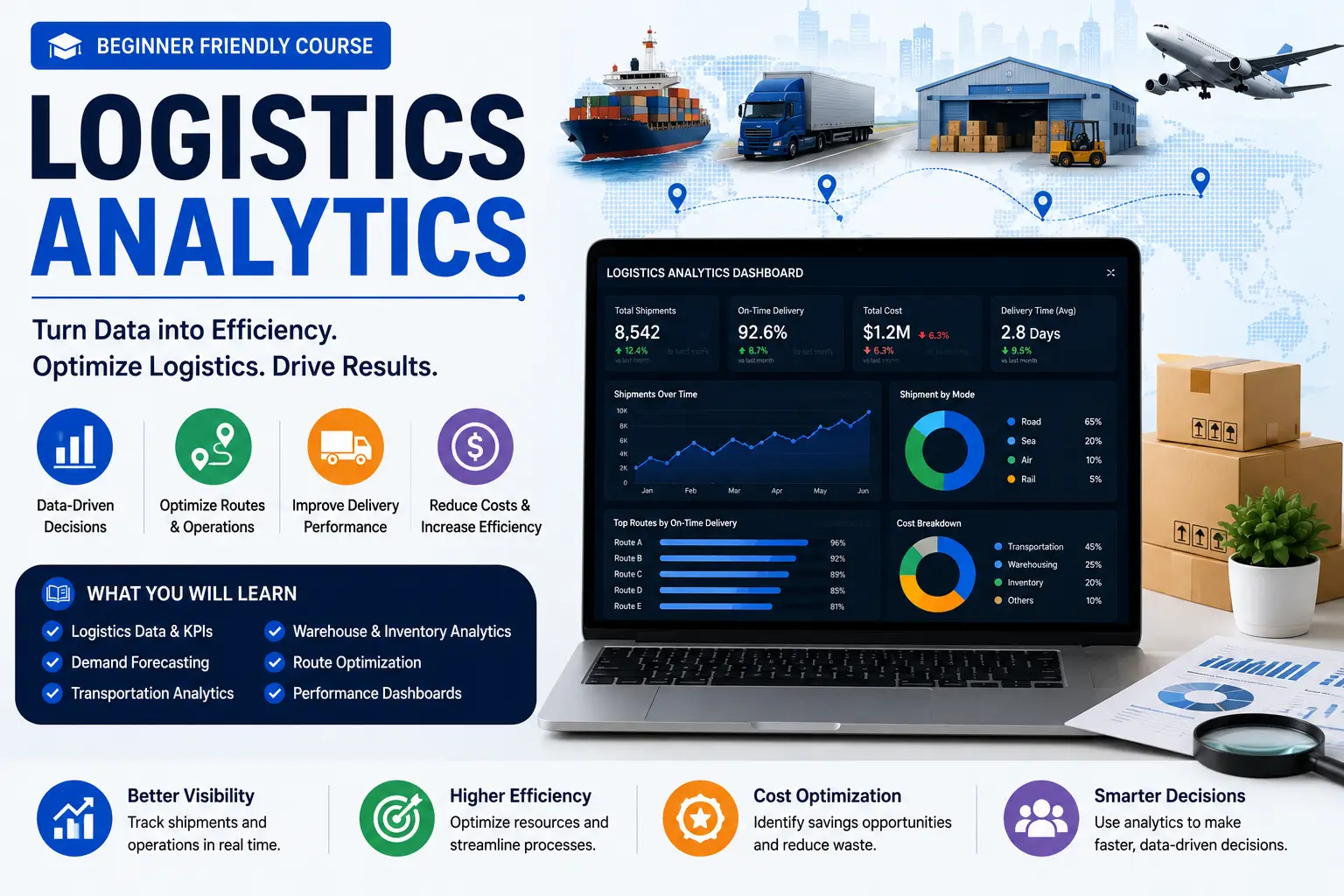
Logistics Analytics Course
The Logistics Analytics Course is designed to help learners understand how data analysis improves logistics operations and supply chain performance. Moreover, the course provides practical knowledge of logistics metrics, forecasting techniques, data visualization, and performance optimization. As a result, learners develop analytical skills that support better business decisions and operational efficiency.
Course Overview
In today’s competitive business environment, organizations rely on data to improve logistics and supply chain operations. Therefore, logistics analytics has become an essential tool for monitoring performance, reducing costs, and enhancing customer satisfaction. This Logistics Analytics Course provides a comprehensive understanding of how data-driven strategies improve logistics management.
In addition, learners explore modern analytical tools and reporting techniques. Furthermore, they gain insights into how businesses use data to optimize transportation, warehousing, and inventory management processes.
Fundamentals of Logistics Analytics
The course begins with the fundamentals of logistics analytics. Therefore, students learn key concepts related to data collection, analysis, and performance measurement. Moreover, they understand how analytics supports logistics planning and operational decision-making.
These foundations help learners build strong analytical skills for logistics management.
Supply Chain Data Analysis
Effective supply chain management depends on accurate data analysis. Consequently, learners study supply chain performance indicators, operational metrics, and business intelligence techniques. In addition, they explore methods for identifying trends and improving supply chain efficiency.
As a result, students gain practical knowledge of supply chain analytics.
Logistics Performance Metrics
Performance measurement is critical for logistics success. Therefore, the course covers key performance indicators (KPIs), logistics scorecards, and operational benchmarks. Furthermore, learners understand how organizations track and improve logistics performance.
These skills support effective performance management.
Demand Forecasting and Predictive Analytics
Forecasting helps businesses plan resources and reduce uncertainty. Consequently, students learn demand forecasting methods, predictive analytics techniques, and trend analysis. In addition, they explore how data-driven forecasting improves inventory and transportation planning.
These concepts help organizations make informed business decisions.
Transportation and Warehouse Analytics
Transportation and warehouse operations generate valuable business data. Therefore, learners study transportation analytics, warehouse performance measurement, and operational reporting. Moreover, they understand how analytics improves efficiency and resource utilization.
As a result, students develop practical logistics optimization skills.
Data Visualization and Reporting
Presenting data clearly is essential for decision-making. Consequently, the course introduces dashboards, reporting tools, and visualization techniques. In addition, learners explore how businesses communicate logistics insights to stakeholders.
These skills enhance professional reporting capabilities.
Logistics Optimization Techniques
Optimization is a key objective of logistics analytics. Therefore, students learn methods for reducing costs, improving delivery performance, and enhancing operational efficiency. Furthermore, they understand how analytical insights support continuous improvement initiatives.
These concepts prepare learners for modern logistics environments.
Practical Learning and Case Studies
The Logistics Analytics Course includes practical assignments, analytical projects, and industry case studies. Moreover, learners apply logistics analytics concepts to real-world business scenarios and supply chain challenges.
As a result, students gain hands-on experience and industry-relevant knowledge.
Learning Outcomes
By the end of this course, learners will be able to:
- Understand logistics analytics principles and applications.
- Analyze supply chain and logistics performance data.
- Apply forecasting and predictive analytics techniques.
- Create logistics reports and performance dashboards.
- Measure operational efficiency using KPIs.
- Support data-driven decision-making processes.
- Improve logistics and supply chain performance through analytics.
Who Should Enroll?
This course is ideal for logistics professionals, supply chain managers, business analysts, warehouse supervisors, operations executives, students, and entrepreneurs. Moreover, it benefits anyone interested in data-driven logistics and supply chain management.
Conclusion
The Logistics Analytics Course provides comprehensive training in data analysis, forecasting, logistics performance measurement, and supply chain optimization. Furthermore, it combines theoretical concepts with practical applications. As a result, learners gain the expertise needed to analyze logistics operations, improve efficiency, and support strategic business decisions.
9. FAQ SECTION
What is a Logistics Analytics Course?
A Logistics Analytics Course teaches data analysis, performance measurement, forecasting, and optimization techniques for logistics and supply chain operations.
Who can enroll in this course?
Students, logistics professionals, supply chain managers, analysts, and beginners can enroll.
Do I need prior analytics experience?
No, beginners can join and learn logistics analytics fundamentals.
What skills will I learn?
You will learn logistics reporting, KPI analysis, forecasting, data visualization, and supply chain analytics.
Is practical training included?
Yes, the course includes projects, case studies, and analytical exercises.
Will I receive a certificate?
Yes, learners receive a course completion certificate.
Does the course cover forecasting techniques?
Yes, demand forecasting and predictive analytics are important parts of the curriculum.
What career opportunities are available?
Career options include Logistics Analyst, Supply Chain Analyst, Operations Analyst, Data Analyst, and Logistics Manager.
Can entrepreneurs benefit from this course?
Yes, entrepreneurs can use analytics to improve logistics efficiency and business performance.
Why should I study Logistics Analytics?
The course helps develop analytical and decision-making skills that are highly valuable in modern supply chain operations.





Reviews
There are no reviews yet.