
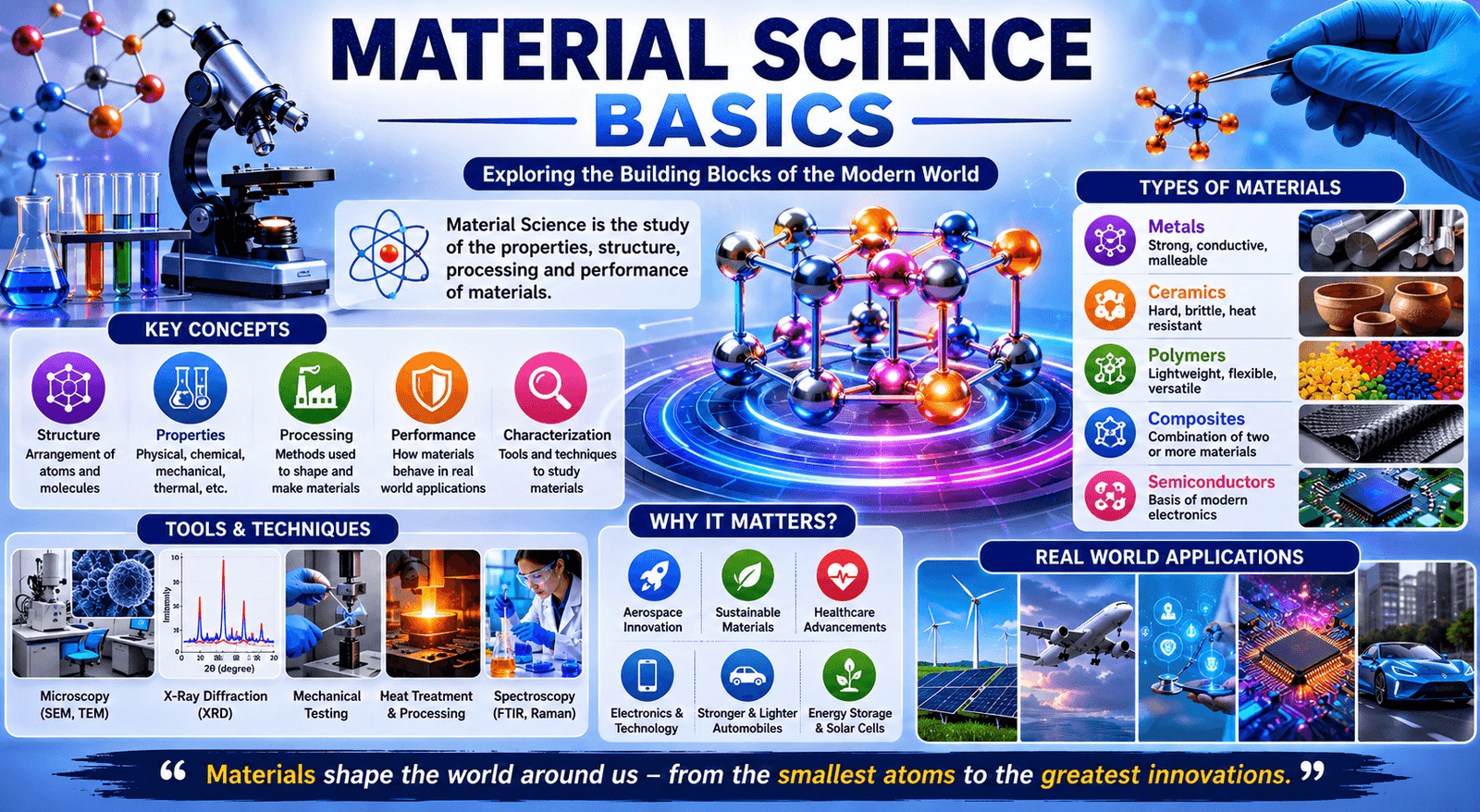
The Material Science Basics Course is a beginner-friendly program designed to help learners understand the fundamental principles of materials used in engineering, manufacturing, construction, and technology industries.
Material science is an interdisciplinary field that combines physics, chemistry, and engineering to study the properties, structure, performance, and applications of materials. Understanding how materials behave is essential for designing products that are durable, efficient, safe, and sustainable.
This course provides a strong foundation in material properties, classifications, and real-world applications used in modern industries.
Whether you are a student, engineering aspirant, working professional, researcher, or technology enthusiast, this course will help you develop practical knowledge and analytical skills in material science.
Why Learn Material Science?
Materials are at the heart of every technological advancement. From smartphones and electric vehicles to bridges and medical devices, every product depends on selecting the right material.
Learning material science helps you understand:
- How materials are developed
- Why certain materials are chosen
- How material properties affect performance
- How innovation drives modern industries
Material science is highly valuable in industries such as:
- Manufacturing
- Aerospace
- Automotive
- Electronics
- Construction
- Renewable Energy
- Biomedical Engineering
- Research and Development
What You Will Learn
Introduction to Material Science
Understand the principles, history, and importance of material science.
Classification of Materials
Learn about major material categories:
- Metals
- Polymers
- Ceramics
- Composites
- Semiconductors
- Nanomaterials
Material Properties
Understand mechanical, physical, thermal, electrical, and chemical properties.
Atomic Structure and Bonding
Learn how atoms and molecules influence material behavior.
Material Testing
Understand how engineers evaluate material strength and performance.
Manufacturing Processes
Explore how materials are processed for industrial applications.
Material Selection
Learn how engineers choose materials for specific products and projects.
Emerging Technologies
Understand advanced materials used in modern innovations.
Skills You Will Gain
After completing the course, learners will develop:
- Material analysis skills
- Problem-solving abilities
- Engineering fundamentals
- Research skills
- Critical thinking
- Technical knowledge
- Data interpretation skills
- Industrial awareness
- Innovation mindset
- Design thinking abilities
Who Should Enroll?
This course is ideal for:
- Engineering students
- Science students
- Researchers
- Manufacturing professionals
- Quality engineers
- Product designers
- Working professionals
- Technology enthusiasts
- Educators
- Career changers
No prior experience is required.
Career Opportunities
Completing a Material Science Basics Course can support careers such as:
- Material Engineer
- Research Assistant
- Quality Control Engineer
- Product Development Engineer
- Manufacturing Engineer
- Materials Analyst
- Laboratory Technician
- Design Engineer
- Metallurgy Technician
- R&D Associate
Industries Hiring
Professionals with material science knowledge are valuable in:
- Automotive industries
- Aerospace companies
- Electronics manufacturing
- Construction companies
- Energy sectors
- Research laboratories
- Biomedical companies
- Industrial manufacturing organizations
Certification Benefits
Upon successful completion, learners receive a certificate that validates their foundational material science knowledge.
Benefits include:
- Improved technical skills
- Better employability
- Enhanced engineering knowledge
- Professional development
- Career advancement opportunities
9. FAQ SECTION
1. What is a Material Science Basics Course?
A Material Science Basics Course teaches the fundamental principles of materials, their properties, classifications, and industrial applications.
2. Who should enroll in this course?
Engineering students, science students, researchers, and professionals interested in materials and technology can enroll.
3. Do I need prior knowledge?
No. This course is beginner-friendly and suitable for learners from all backgrounds.
4. What topics will I learn?
You will learn material classifications, material properties, atomic structures, testing methods, and industrial applications.
5. How long does the course take?
Most Material Science Basics Courses can be completed within 4 to 8 weeks.
6. Will I receive a certificate?
Yes. A certificate is provided upon successful completion.
7. Is Material Science a good career option in India?
Yes. Material science professionals are increasingly in demand in manufacturing, automotive, aerospace, electronics, and research sectors.
8. Is this course suitable for engineering students?
Yes. It is especially beneficial for engineering students seeking foundational knowledge.
9. Will I learn about modern materials?
Yes. The course includes nanomaterials, composites, and emerging material technologies.
10. What industries use material science?
Material science is widely used in automotive, aerospace, construction, energy, healthcare, and electronics industries.



Reviews
There are no reviews yet.