
Introduction to Mechanical Systems Fundamentals
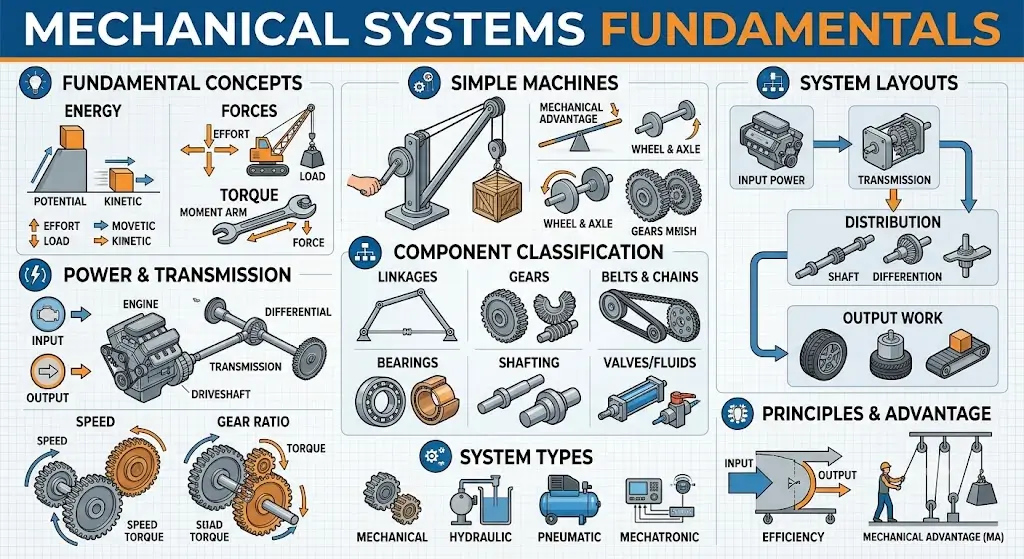
Mechanical Systems Fundamentals provides a strong foundation in the principles, components, and operation of mechanical systems used across modern industries. Mechanical systems convert energy into useful work and play an essential role in manufacturing, transportation, construction, energy production, and industrial automation.
This course introduces the basic concepts of mechanical engineering, machine components, motion, force, power transmission, maintenance practices, and equipment reliability. Learners gain practical knowledge that supports both technical understanding and workplace applications.
Understanding Mechanical Systems
Mechanical systems consist of interconnected components that perform specific functions to achieve controlled movement and efficient operation. Understanding these systems helps professionals improve equipment performance, reduce failures, and maintain safe working environments.
Learners explore important concepts such as:
- Mechanical engineering fundamentals
- Machine elements
- Mechanical motion
- Force and power transmission
- Equipment operation
- Mechanical safety
These concepts establish the foundation for understanding industrial machinery.
Mechanical Components and Power Transmission
Industrial equipment depends on various mechanical components working together efficiently. The course explains how mechanical power is transferred between different machine parts to perform useful work.
Learners study practical topics including:
- Gears and gear systems
- Bearings
- Shafts and couplings
- Belt and chain drives
- Mechanical linkages
- Power transmission systems
These components are commonly found in manufacturing plants, production facilities, and industrial machinery.
Maintenance and Equipment Reliability
Proper maintenance helps mechanical systems operate safely and efficiently. Organizations use preventive maintenance, inspections, lubrication, and condition monitoring to reduce equipment downtime and improve reliability.
The course explains how maintenance planning supports longer equipment life, lower operating costs, and improved productivity.
Industrial Applications of Mechanical Systems
Mechanical systems are widely used across manufacturing, construction, mining, transportation, utilities, energy production, oil and gas, and process industries. Understanding their operation enables professionals to solve technical problems, improve equipment efficiency, and support operational excellence.
Learners also explore the importance of teamwork, documentation, and safety in mechanical work environments.
Skills You Will Develop
After completing this course, learners will understand:
- Mechanical systems fundamentals
- Mechanical components
- Machine elements
- Power transmission
- Mechanical maintenance
- Equipment reliability
- Lubrication practices
- Mechanical troubleshooting
- Industrial safety
- Technical problem-solving
Who Should Enroll?
This course is suitable for:
- Engineering students
- Mechanical technicians
- Maintenance professionals
- Production supervisors
- Industrial workers
- Manufacturing professionals
- Technical apprentices
- Anyone interested in mechanical engineering
No previous mechanical engineering experience is required.
Career Opportunities
This course supports careers such as:
- Mechanical Technician
- Maintenance Technician
- Mechanical Engineer
- Production Engineer
- Plant Operator
- Industrial Maintenance Specialist
- Equipment Maintenance Coordinator
- Manufacturing Technician
FAQ Section
1. What is the Mechanical Systems Fundamentals Course?
The course teaches the basic principles of mechanical systems, including machine components, power transmission, hydraulics, pneumatics, maintenance, and workplace safety.
2. Is this course suitable for beginners?
Yes. The course is designed for beginners and introduces mechanical engineering concepts in a simple and practical manner.
3. What topics are covered in this course?
Topics include mechanical principles, gears, bearings, shafts, belts, hydraulic systems, pneumatic systems, engineering drawings, preventive maintenance, lubrication, troubleshooting, and safety.
4. Will I receive a certificate after completing the course?
Yes. Participants receive a certificate upon successful completion of the course.
5. Do I need prior mechanical engineering knowledge?
No. The course starts with fundamental concepts and gradually introduces more advanced mechanical system topics.
6. Who should enroll in this course?
Mechanical engineering students, maintenance technicians, industrial workers, manufacturing professionals, construction personnel, engineering graduates, and anyone interested in mechanical systems can benefit from this course.
7. Is the course fully online?
Yes. The course offers flexible online learning, allowing participants to study at their own pace.
8. What skills will I gain?
You will gain skills in mechanical systems, power transmission, hydraulics, pneumatics, preventive maintenance, troubleshooting, equipment inspection, engineering drawing interpretation, and workplace safety.
9. Can this course improve my career opportunities?
Yes. Mechanical systems knowledge is valuable for careers in manufacturing, engineering, construction, industrial maintenance, automotive industries, HVAC, utilities, and energy sectors.
10. Why are mechanical systems fundamentals important?
Understanding mechanical systems helps professionals operate, maintain, troubleshoot, and improve machinery safely and efficiently while increasing equipment reliability, productivity, and workplace safety.





Reviews
There are no reviews yet.