
INTRODUCTION
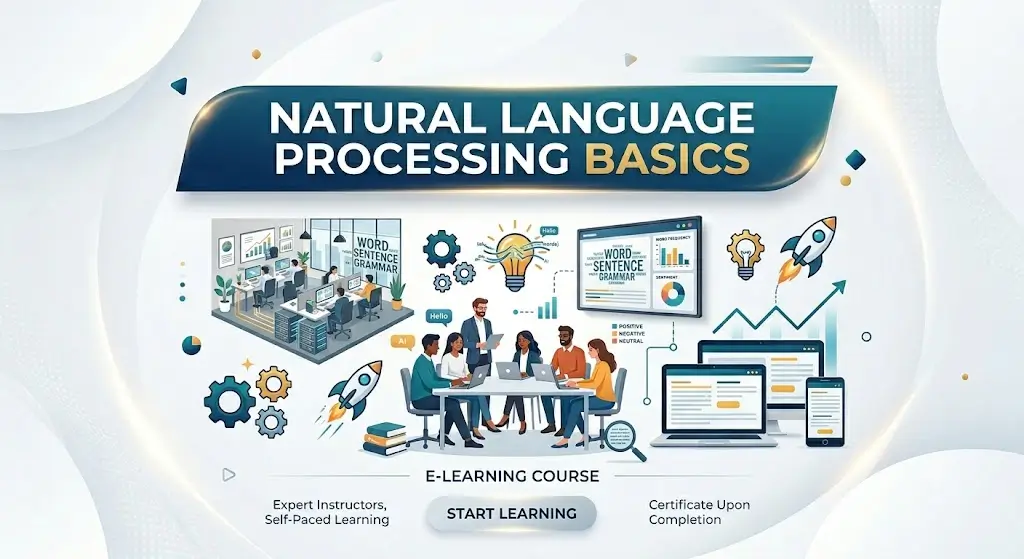
The Natural Language Processing Basics Course is a comprehensive beginner-level program designed to help learners understand how computers communicate with humans through language. In today’s digital world, people interact with technology using text messages, emails, voice commands, search engines, chatbots, and virtual assistants. Behind these intelligent systems lies a powerful branch of artificial intelligence known as Natural Language Processing.
Natural Language Processing, commonly referred to as NLP, enables computers to read, understand, analyze, interpret, and generate human language. Moreover, NLP combines artificial intelligence, machine learning, linguistics, data science, and computer science to create systems that can interact naturally with people.
As organizations increasingly adopt AI-driven communication tools, NLP has become one of the most valuable and rapidly growing fields in technology. Therefore, understanding NLP fundamentals provides learners with valuable knowledge applicable across numerous industries.
WHAT IS NATURAL LANGUAGE PROCESSING?
Natural Language Processing is a branch of Artificial Intelligence that focuses on enabling computers to understand and process human language.
Unlike traditional programming systems that rely solely on structured commands, NLP allows computers to work with natural communication patterns.
Additionally, NLP helps machines analyze spoken language, written text, and conversational interactions.
Because of these capabilities, NLP powers many modern technologies used daily by millions of people worldwide.
IMPORTANCE OF NATURAL LANGUAGE PROCESSING
The volume of digital text and speech data continues to grow rapidly.
Moreover, businesses need efficient methods to analyze customer feedback, automate communication, and improve decision-making.
Consequently, NLP helps organizations extract meaningful information from large amounts of language-based data.
In addition, NLP improves accessibility, customer service, automation, and human-computer interaction.
Therefore, it has become an essential technology in the modern digital economy.
HISTORY AND EVOLUTION OF NLP
The development of NLP began with early research in computational linguistics.
Initially, systems relied on rule-based language processing techniques.
However, advances in machine learning significantly improved language understanding capabilities.
Later, deep learning and transformer-based models revolutionized NLP performance.
Today, modern AI systems can generate highly accurate and context-aware responses.
UNDERSTANDING HUMAN LANGUAGE
Human language is complex and contains grammar, context, emotions, idioms, and cultural references.
Moreover, the same word can have different meanings depending on context.
Therefore, NLP systems must identify patterns and relationships within language.
This challenge makes language processing one of the most advanced areas of artificial intelligence.
COMPONENTS OF NLP
Natural Language Processing involves multiple components.
These include:
- Text processing
- Language understanding
- Language generation
- Speech recognition
- Sentiment analysis
- Machine translation
- Conversational AI
- Text classification
Together, these components enable intelligent language interactions.
TEXT PROCESSING FUNDAMENTALS
Text processing is the first stage of NLP.
Additionally, it involves cleaning and preparing text data for analysis.
Common tasks include:
- Removing unnecessary characters
- Standardizing text
- Identifying words and phrases
- Organizing text structure
As a result, text becomes suitable for machine analysis.
LANGUAGE MODELING
Language models help computers predict and understand language patterns.
Additionally, they learn relationships between words and phrases.
Modern language models can generate text, answer questions, and summarize information.
As a result, language modeling has become a major focus of NLP research.
TEXT CLASSIFICATION
Text classification organizes content into predefined categories.
Examples include:
- Spam detection
- Topic categorization
- Customer feedback classification
- News article categorization
Therefore, text classification is widely used across industries.
SENTIMENT ANALYSIS
Sentiment analysis identifies emotions and opinions expressed in text.
Additionally, businesses use sentiment analysis to understand customer satisfaction.
Applications include:
- Product reviews
- Social media monitoring
- Customer feedback analysis
- Brand reputation management
Consequently, organizations gain valuable insights into customer perceptions.
NAMED ENTITY RECOGNITION
Named Entity Recognition identifies important information within text.
Examples include:
- Person names
- Company names
- Locations
- Dates
- Organizations
Moreover, this technique improves information extraction and search capabilities.
MACHINE TRANSLATION
Machine translation converts text from one language to another.
Additionally, it helps break communication barriers across regions.
Modern NLP systems provide increasingly accurate translations.
Therefore, machine translation supports global communication.
SPEECH RECOGNITION
Speech recognition converts spoken language into text.
Moreover, it enables voice assistants and voice-controlled systems.
Applications include:
- Voice search
- Virtual assistants
- Smart devices
- Accessibility tools
As a result, speech recognition has become a key NLP application.
CHATBOTS AND CONVERSATIONAL AI
Chatbots use NLP to interact with users naturally.
Additionally, conversational AI systems can answer questions and provide support.
Businesses use chatbots to improve customer service efficiency.
Consequently, customer experiences become faster and more personalized.
NLP IN SEARCH ENGINES
Search engines use NLP to understand user queries.
Moreover, NLP helps identify search intent and relevant content.
As a result, users receive more accurate search results.
This significantly improves information retrieval.
NLP IN HEALTHCARE
Healthcare organizations use NLP to process medical documents and patient records.
Applications include:
- Clinical documentation
- Medical coding
- Patient data analysis
- Healthcare research
Therefore, NLP contributes to improved healthcare efficiency.
NLP IN FINANCE
Financial institutions use NLP for:
- Fraud detection
- Risk assessment
- Market sentiment analysis
- Financial reporting
Additionally, NLP improves decision-making in financial services.
NLP IN E-COMMERCE
Online businesses use NLP to understand customer preferences.
Applications include:
- Product recommendations
- Review analysis
- Customer support automation
- Search optimization
Consequently, customer satisfaction and sales performance improve.
NLP AND MACHINE LEARNING
Machine learning plays a central role in modern NLP.
Instead of relying entirely on manually created rules, systems learn patterns from data.
Moreover, machine learning models continuously improve performance through training.
As a result, NLP systems become more accurate over time.
NLP AND ARTIFICIAL INTELLIGENCE
NLP is one of the most important applications of AI.
Additionally, it helps bridge communication between humans and machines.
By combining AI with language understanding, organizations create intelligent systems capable of meaningful interactions.
Therefore, NLP is considered a foundational technology within artificial intelligence.
CHALLENGES IN NATURAL LANGUAGE PROCESSING
Although NLP has advanced significantly, challenges still exist.
These include:
- Language ambiguity
- Context understanding
- Sarcasm detection
- Multilingual processing
- Cultural variations
- Data quality issues
Therefore, continuous research remains important.
FUTURE OF NLP
The future of NLP is closely connected to artificial intelligence innovation.
Emerging trends include:
- Advanced language models
- Real-time translation
- Multimodal AI systems
- Personalized AI assistants
- Intelligent automation
Consequently, NLP will continue transforming how humans interact with technology.
SKILLS YOU WILL GAIN
After completing this course, learners will develop:
- NLP fundamentals understanding
- Text processing knowledge
- Language analysis skills
- Sentiment analysis concepts
- Conversational AI awareness
- Machine learning foundations
- Text classification understanding
- Language modeling knowledge
- Analytical thinking
- AI technology awareness
BENEFITS OF THE COURSE
This course helps learners:
- Understand NLP concepts
- Build AI knowledge
- Improve analytical thinking
- Learn language technology fundamentals
- Develop understanding of machine learning applications
- Prepare for advanced AI studies
- Explore emerging technology careers
- Gain industry-relevant knowledge
CAREER OPPORTUNITIES
After completing this course, learners may explore opportunities such as:
- NLP Analyst Trainee
- AI Research Assistant
- Data Annotation Specialist
- Chatbot Support Specialist
- Text Analytics Assistant
- Machine Learning Support Associate
- Business Intelligence Assistant
- AI Operations Associate
- Data Processing Executive
- Language Technology Support Specialist
CONCLUSION
The Natural Language Processing Basics Course provides a strong foundation for understanding how computers process and understand human language. By combining artificial intelligence, machine learning, linguistics, and data analysis, NLP enables intelligent communication between humans and machines.
As AI technologies continue to evolve, NLP will remain one of the most influential and in-demand fields across industries. Therefore, learning NLP fundamentals is an excellent step toward understanding the future of artificial intelligence and digital communication.
FAQ SECTION
1. What is Natural Language Processing Basics Course?
It is a beginner-level course that teaches how computers understand and process human language.
2. Who should take this course?
Students, AI enthusiasts, data analysts, software learners, and technology professionals.
3. Do I need coding experience?
No, this course is beginner-friendly and focuses on foundational concepts.
4. What will I learn in this course?
You will learn NLP fundamentals, text processing, sentiment analysis, language models, and conversational AI concepts.
5. Is NLP part of Artificial Intelligence?
Yes, NLP is one of the most important branches of Artificial Intelligence.
6. Is NLP used in ChatGPT and chatbots?
Yes, NLP is a core technology behind conversational AI systems.
7. Will I receive a certificate?
Yes, a certificate is awarded upon successful completion.
8. Is NLP in demand?
Yes, NLP professionals are increasingly sought after in technology, business, and research sectors.
9. Is this useful for future AI learning?
Absolutely. NLP provides an excellent foundation for advanced AI and machine learning studies.
10. What skills will I gain?
You will gain understanding of NLP concepts, text analytics, language processing, AI applications, and analytical thinking skills.



Reviews
There are no reviews yet.