
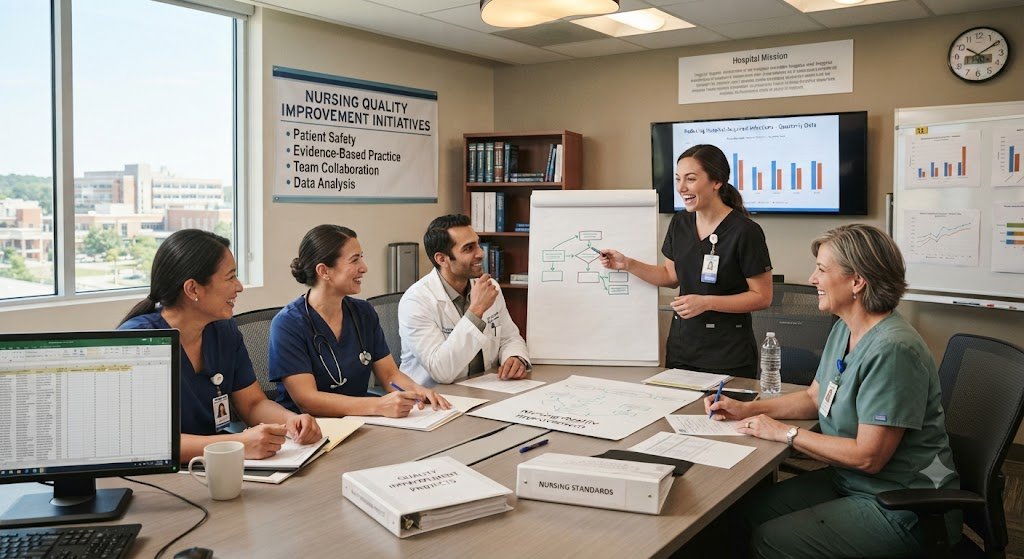
Nursing Quality Improvement Course
The Nursing Quality Improvement Course is designed to help nurses, nursing supervisors, healthcare professionals, quality assurance specialists, hospital administrators, clinical educators, students, and individuals interested in healthcare quality develop the knowledge and practical skills needed to improve patient outcomes, enhance clinical performance, and promote excellence in healthcare delivery. Quality improvement is a key component of modern nursing practice, helping healthcare organizations deliver safe, effective, patient-centered, timely, efficient, and equitable care.
This course introduces the core principles of nursing quality improvement, including healthcare quality management, patient safety, evidence-based practice, clinical audits, quality assessment, continuous quality improvement (CQI), performance measurement, root cause analysis, incident reporting, infection prevention, interdisciplinary teamwork, healthcare accreditation standards, leadership, ethics, and regulatory compliance. Learners will gain practical knowledge of identifying improvement opportunities, implementing quality initiatives, and measuring clinical outcomes.
Whether you work in hospitals, clinics, long-term care facilities, community healthcare, public health, or healthcare administration, this course provides a comprehensive foundation in nursing quality improvement.
Course Overview
The course explores the complete quality improvement process, from identifying healthcare challenges and analyzing performance to implementing improvement strategies, monitoring outcomes, and sustaining continuous quality improvement initiatives. Learners will understand how structured quality programs contribute to safer patient care, improved clinical outcomes, and greater organizational efficiency.
The curriculum combines healthcare quality principles with practical exercises, clinical case studies, quality improvement tools, and evidence-based practices to prepare learners for leadership roles in healthcare quality and patient safety.
What You Will Learn
By completing this course, you will be able to:
- Understand nursing quality improvement principles.
- Apply healthcare quality management concepts.
- Improve patient safety practices.
- Implement evidence-based nursing care.
- Conduct clinical audits.
- Measure healthcare performance indicators.
- Perform root cause analysis.
- Manage incident reporting systems.
- Strengthen infection prevention practices.
- Improve interdisciplinary communication.
- Support healthcare accreditation requirements.
- Lead quality improvement initiatives.
- Apply ethical and legal standards.
- Monitor patient care outcomes.
- Promote continuous healthcare improvement.
Course Curriculum
The curriculum begins with nursing quality fundamentals before progressing through patient safety, clinical audits, evidence-based practice, CQI, performance measurement, root cause analysis, infection prevention, accreditation standards, leadership, ethics, case studies, and future trends in healthcare quality improvement.
Practical assignments help learners apply quality improvement methods using real-world healthcare scenarios.
Skills You Will Gain
After completing the course, you will develop skills in:
- Nursing Quality Improvement
- Patient Safety Management
- Clinical Quality Assessment
- Evidence-Based Practice
- Continuous Quality Improvement (CQI)
- Clinical Audit Techniques
- Root Cause Analysis
- Risk Management
- Infection Prevention
- Performance Measurement
- Healthcare Quality Assurance
- Leadership in Nursing
- Regulatory Compliance
- Interdisciplinary Collaboration
- Healthcare Process Improvement
Benefits of the Course
This course helps learners improve patient care quality, reduce clinical risks, strengthen healthcare processes, enhance teamwork, and support regulatory compliance. Strong nursing quality improvement skills enable healthcare professionals to improve patient outcomes, increase operational efficiency, strengthen organizational performance, and build a culture of continuous improvement.
These skills are highly valuable across hospitals, clinics, community health centers, rehabilitation facilities, long-term care organizations, healthcare consulting firms, government health departments, educational institutions, and accreditation organizations.
Who Should Enroll
This course is ideal for:
- Registered Nurses
- Nursing Supervisors
- Nurse Managers
- Healthcare Professionals
- Quality Assurance Specialists
- Clinical Educators
- Hospital Administrators
- Nursing Students
- Public Health Professionals
- Infection Control Nurses
- Healthcare Consultants
- Clinical Coordinators
- Healthcare Managers
- Patient Safety Officers
- Anyone interested in healthcare quality
Career Opportunities
After completing the Nursing Quality Improvement Course, learners may strengthen their qualifications for roles such as:
- Quality Improvement Nurse
- Clinical Quality Coordinator
- Patient Safety Officer
- Nurse Manager
- Quality Assurance Specialist
- Healthcare Quality Analyst
- Infection Control Coordinator
- Clinical Audit Officer
- Healthcare Consultant
- Hospital Quality Manager
These skills are valuable across hospitals, specialty clinics, rehabilitation centers, long-term care facilities, community healthcare organizations, healthcare consulting firms, accreditation agencies, government health departments, educational institutions, and public health organizations.
Certification Details
Upon successful completion, learners receive a Certificate of Completion recognizing their expertise in Nursing Quality Improvement and healthcare quality management. This certification enhances your professional profile and supports career advancement in nursing leadership, healthcare quality assurance, patient safety, clinical management, hospital administration, and healthcare consulting.
If you want to improve patient care quality, strengthen healthcare systems, and build expertise in continuous quality improvement, the Nursing Quality Improvement Course provides practical, industry-relevant knowledge for today’s healthcare sector.
FAQ SECTION
1. What is the Nursing Quality Improvement Course?
It teaches methods for improving healthcare quality, enhancing patient safety, conducting clinical audits, and implementing continuous quality improvement initiatives in nursing practice.
2. Is this course suitable for beginners?
Yes. The course starts with quality improvement fundamentals and is suitable for beginners, nursing students, and experienced healthcare professionals.
3. What topics are covered?
Healthcare quality management, patient safety, evidence-based practice, clinical audits, CQI, performance measurement, root cause analysis, infection prevention, accreditation standards, leadership, and ethics.
4. Do I need prior nursing experience?
No. The course is suitable for nursing students, registered nurses, healthcare professionals, healthcare managers, and anyone interested in healthcare quality improvement.
5. Is the course online?
Yes. The course is fully online and self-paced.
6. Will I receive a certificate?
Yes. A certificate is awarded after successfully completing the course.
7. Who should enroll?
Registered nurses, nurse managers, nursing supervisors, healthcare professionals, quality assurance specialists, hospital administrators, nursing students, patient safety officers, and healthcare consultants.
8. What skills will I gain?
Patient safety management, clinical audits, quality improvement planning, evidence-based practice, performance measurement, risk management, infection prevention, healthcare quality assurance, and leadership.
9. Can this course help my career?
Yes. Nursing quality improvement skills are highly valued across hospitals, healthcare organizations, rehabilitation centers, community health services, healthcare consulting firms, accreditation agencies, and public health institutions.
10. Why is Nursing Quality Improvement important?
Nursing Quality Improvement helps improve patient safety, enhance healthcare quality, reduce clinical errors, strengthen evidence-based practice, support accreditation standards, improve operational efficiency, increase patient satisfaction, and promote continuous improvement across healthcare organizations.





Reviews
There are no reviews yet.