
Introduction
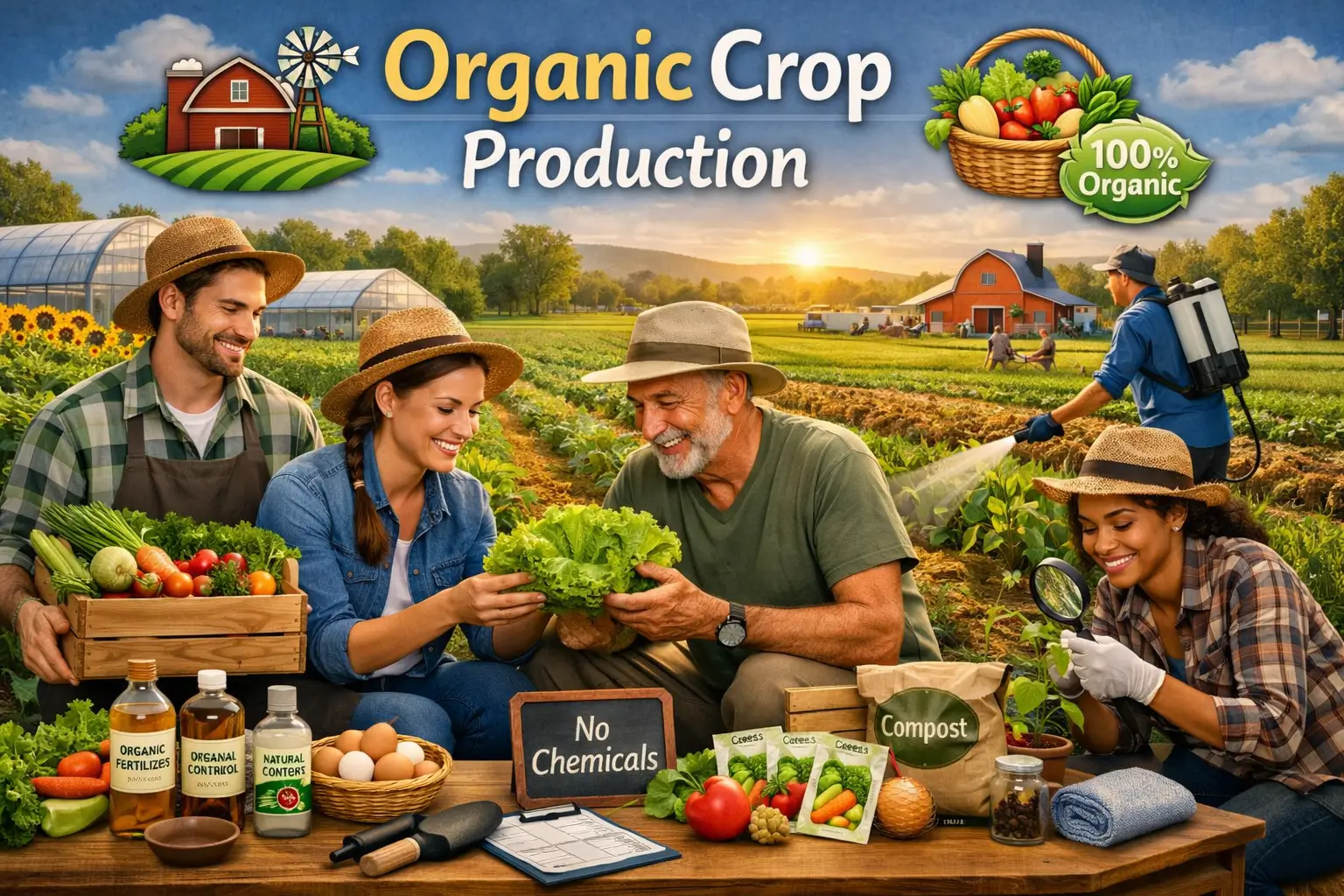
The Organic Crop Production Course is designed for individuals who want to learn sustainable farming practices and develop expertise in organic agriculture. As consumers increasingly seek chemical-free and environmentally friendly food products, organic farming has become one of the fastest-growing sectors in agriculture.
This course provides a practical introduction to organic crop production, helping learners understand how to cultivate healthy crops while protecting soil fertility, biodiversity, and environmental resources. Whether you are a farmer, agriculture student, entrepreneur, or agricultural professional, this course offers valuable knowledge to support successful organic farming practices.
Course Overview
Organic crop production focuses on growing crops without the use of synthetic fertilizers, pesticides, or genetically modified organisms. Instead, it relies on natural methods that promote soil health, ecological balance, and sustainable agricultural production.
In this course, participants will explore the principles of organic farming, crop planning, soil management, pest control, and sustainable cultivation techniques. The course combines theoretical concepts with practical approaches that can be applied in small-scale farms, commercial agricultural operations, and home-based farming projects.
By understanding organic farming systems, learners can contribute to healthier food production and more sustainable agricultural practices.
What You Will Learn
By completing this course, you will learn how to:
- Understand the fundamentals of organic crop production
- Apply sustainable farming techniques
- Improve soil fertility naturally
- Manage organic crop cultivation processes
- Implement effective crop rotation practices
- Control pests using organic methods
- Reduce environmental impact in farming
- Understand organic certification requirements
- Improve crop quality and productivity
- Promote sustainable agricultural development
Skills You Will Gain
This course helps learners develop practical skills such as:
- Organic farming techniques
- Crop production management
- Soil health improvement
- Organic pest and disease control
- Sustainable agriculture practices
- Farm planning and management
- Environmental stewardship
- Resource conservation
- Agricultural problem-solving
- Crop monitoring and evaluation
These skills are highly valuable for modern agricultural professionals and farming entrepreneurs.
Benefits of the Course
The Organic Crop Production Course provides learners with the knowledge needed to implement environmentally responsible farming practices. Participants gain a better understanding of how organic agriculture supports soil health, biodiversity, and long-term farm sustainability.
Additionally, the course helps learners reduce dependence on synthetic agricultural inputs while improving the quality and market value of agricultural products. Understanding organic farming practices can also open new business opportunities in the growing organic food industry.
Furthermore, organic agriculture contributes to environmental conservation, making it an important approach for the future of sustainable food production.
Who Should Enroll
This course is ideal for:
- Farmers and agricultural producers
- Agriculture students
- Organic farming enthusiasts
- Farm managers
- Agricultural entrepreneurs
- Agricultural extension workers
- Sustainable agriculture advocates
- Rural development professionals
- Agribusiness professionals
- Anyone interested in organic farming
No prior organic farming experience is required.
Career Opportunities
After completing the Organic Crop Production Course, learners can explore opportunities in agriculture, agribusiness, organic farming enterprises, and rural development organizations.
Potential career paths include:
- Organic Farmer
- Farm Manager
- Agricultural Consultant
- Organic Farming Advisor
- Agribusiness Entrepreneur
- Sustainable Agriculture Specialist
- Agricultural Extension Officer
- Organic Certification Support Professional
The course can also help individuals establish and manage their own organic farming ventures.
Certification Details
Upon successful completion of the course, participants receive a certification recognizing their knowledge of organic crop production, sustainable farming methods, and environmentally responsible agricultural practices.
This certification can strengthen professional credibility and demonstrate expertise in modern organic agriculture.
Conclusion
The Organic Crop Production Course offers a comprehensive introduction to sustainable farming and organic agriculture. Through practical learning and industry-relevant concepts, participants gain the skills needed to cultivate crops responsibly while supporting environmental sustainability.
Whether you are looking to improve farming practices, start an organic agriculture business, or expand your agricultural knowledge, this course provides valuable insights for success in the growing organic farming sector.
FAQ SECTION
1. What is the Organic Crop Production Course?
This course teaches the principles and practices of organic farming, sustainable agriculture, and eco-friendly crop production.
2. Who should enroll in this course?
Farmers, agriculture students, agribusiness professionals, and anyone interested in organic farming can enroll.
3. Do I need farming experience to join?
No, the course is beginner-friendly and suitable for learners with no prior farming experience.
4. What skills will I learn?
You will learn organic farming methods, soil fertility management, crop planning, pest control, and sustainable agriculture practices.
5. What is organic crop production?
Organic crop production involves growing crops using natural methods without synthetic fertilizers, pesticides, or genetically modified organisms.
6. Will I receive a certificate after completion?
Yes, participants receive a certificate upon successfully completing the course.
7. What career opportunities are available after this course?
Career options include Organic Farmer, Farm Manager, Agricultural Consultant, Sustainable Agriculture Specialist, and Agribusiness Entrepreneur.
8. Is organic farming profitable?
Yes, organic farming can offer strong market opportunities due to increasing demand for organic food products.
9. How long does the course take to complete?
The duration depends on the course structure and learning schedule.
10. Why should I choose this course?
This course provides practical organic farming knowledge, sustainable agriculture skills, and valuable insights into environmentally responsible crop production.




Reviews
There are no reviews yet.