
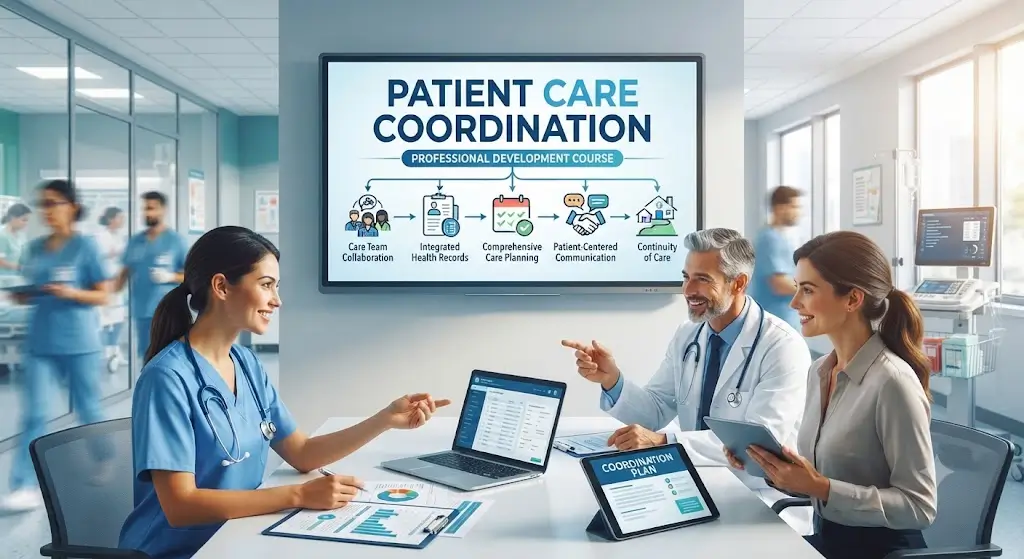
Patient Care Coordination Course: Build Strong Healthcare Management Skills
The Patient Care Coordination Course is a comprehensive, beginner-friendly, and career-focused training program designed to help learners understand how patient care is organized and managed across healthcare systems. Effective coordination is essential for smooth hospital operations and improved patient outcomes.
First, this course introduces learners to patient care coordination fundamentals, including hospital workflows, communication channels, and healthcare roles. Understanding these basics is essential for careers in healthcare administration, nursing, and hospital operations.
Additionally, the course presents concepts in a structured and simple format, making it suitable for beginners as well as professionals seeking to strengthen their healthcare management knowledge. Whether you are a medical student, nursing student, healthcare worker, or aspiring professional, this course provides practical coordination skills that support career growth.
Why Learn Patient Care Coordination?
Modern healthcare systems require efficient coordination between departments. Moreover, hospitals depend on structured patient management to ensure quality care.
Learning patient care coordination helps you:
- Manage patient flow efficiently
- Improve hospital communication systems
- Learn appointment and scheduling systems
- Understand discharge planning
- Enhance teamwork in healthcare
- Reduce delays in patient care
As a result, learners become well-prepared for careers in healthcare administration and hospital management.
What You Will Learn
Introduction to Care Coordination
First, learners will understand hospital coordination systems.
Patient Flow Management
Next, learners will study how patients move through healthcare systems.
Scheduling & Appointment Systems
Additionally, learners will explore hospital booking processes.
Interdepartmental Communication
Moreover, learners will learn coordination between hospital units.
Discharge Planning
Therefore, learners will study patient exit and follow-up systems.
Case Management
Furthermore, learners will understand patient case tracking.
Real Hospital Scenarios
Finally, learners will explore practical coordination examples.
Skills You Will Gain
After completing this course, learners will develop:
- Patient coordination skills
- Healthcare management knowledge
- Communication and teamwork
- Hospital workflow understanding
- Scheduling and planning skills
- Problem-solving ability
- Administrative skills
- Healthcare readiness
Who Should Enroll?
This course is suitable for:
- Medical students
- Nursing students
- Paramedical students
- Healthcare workers
- Hospital administrators
- Front desk staff
- Healthcare coordinators
- Anyone interested in hospital operations
No prior experience is required.
Career Opportunities
Completing this course can support careers such as:
- Patient Care Coordinator
- Hospital Administrator
- Healthcare Operations Executive
- Medical Office Manager
- Clinical Coordinator
- Case Manager
- Healthcare Assistant
- Patient Services Executive
- Nursing Coordinator
- Hospital Operations Manager
Industries Hiring
Professionals with care coordination skills are valuable in:
- Hospitals
- Clinics
- Nursing homes
- Diagnostic centers
- Healthcare management companies
- Insurance healthcare divisions
- Rehabilitation centers
- Telemedicine services
- Public health organizations
- Medical outsourcing companies
Certification Benefits
Upon successful completion, learners receive a certificate validating their patient coordination skills.
Benefits include:
- Improved employability
- Strong healthcare operations foundation
- Professional credibility
- Career advancement opportunities
- Industry-ready coordination skills
9. FAQ SECTION
1. What is a Patient Care Coordination Course?
It teaches how to manage and organize patient care in hospitals.
2. Who should enroll in this course?
Medical, nursing, and healthcare students or professionals.
3. Do I need prior experience?
No, it is beginner friendly.
4. What skills will I learn?
Patient flow, scheduling, and hospital coordination.
5. How long is the course?
Typically, 4–8 weeks.
6. Will I get a certificate?
Yes, after completion.
7. Why is care coordination important?
It improves hospital efficiency and patient outcomes.
8. Which industries hire coordination professionals?
Hospitals, clinics, and healthcare organizations.
9. Can this course help my career?
Yes, it supports healthcare administration careers.
10. Is it suitable for beginners?
Yes, fully designed for beginners.





Reviews
There are no reviews yet.