
Introduction
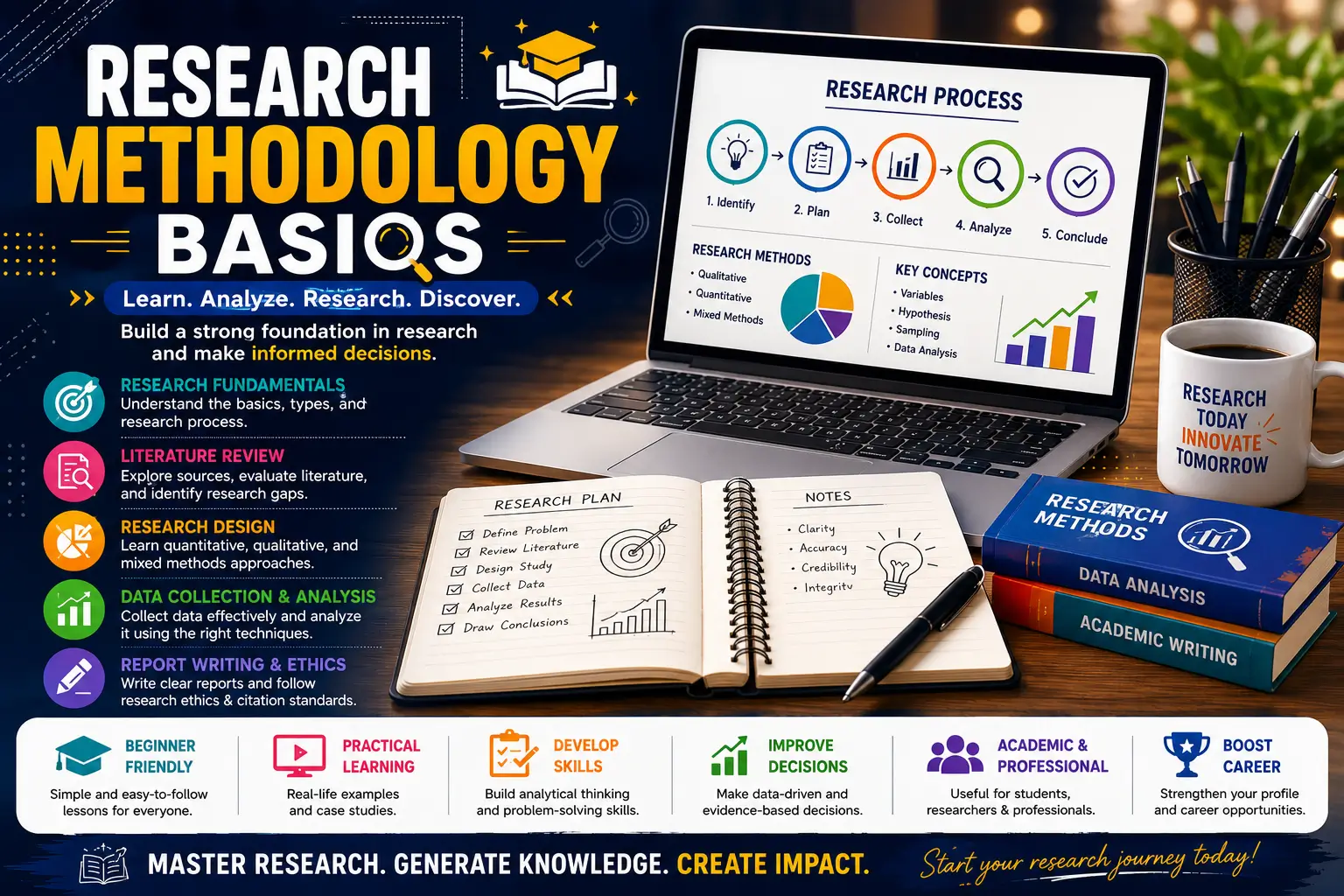
The Research Methodology Basics Course is a comprehensive beginner-level program designed to help learners understand how research is systematically planned, executed, and analyzed. Research methodology is the backbone of all academic studies, scientific investigations, business analysis, and data-driven decision-making processes. Therefore, a strong understanding of research methods is essential for students, researchers, and professionals across multiple disciplines.
Moreover, research methodology helps ensure that information is collected and analyzed in a structured, reliable, and valid manner, leading to accurate and meaningful conclusions.
Understanding Research Methodology
This section introduces the core concept of research methodology and its importance in academic and professional work. Learners understand how research helps solve problems, test theories, and generate new knowledge.
In addition, the course explains the difference between structured research and informal observation, helping learners understand the value of systematic investigation.
Types of Research Methods
This section explains different types of research approaches such as qualitative, quantitative, and mixed methods. Learners understand when and how each method is used based on research objectives.
Moreover, selecting the correct method ensures accuracy, reliability, and relevance of research findings.
Research Design and Planning
This part focuses on how to design a research study effectively. Learners study research objectives, problem statements, and study frameworks.
Furthermore, proper planning ensures that research is structured, focused, and aligned with expected outcomes.
Data Collection Methods
This section explains various methods of collecting data such as surveys, interviews, observations, and questionnaires. Learners understand how to gather reliable and valid information from different sources.
As a result, accurate data collection improves the quality of research outcomes.
Sampling Techniques
This section introduces sampling methods used to select participants or data sources. Learners study probability and non-probability sampling techniques.
Moreover, proper sampling ensures that research results are representative and unbiased.
Data Analysis and Interpretation
This part explains how collected data is analyzed and interpreted to draw conclusions. Learners understand basic statistical tools and analytical methods used in research.
In addition, data interpretation helps transform raw information into meaningful insights.
Hypothesis Development and Testing
This section focuses on forming hypotheses and testing them using research data. Learners understand how assumptions are validated or rejected based on evidence.
Therefore, hypothesis testing strengthens the credibility of research findings.
Research Writing and Reporting
This section explains how to structure research reports, academic papers, and project documentation. Learners study introduction, methodology, results, and conclusion sections.
Moreover, clear reporting ensures that research findings are communicated effectively.
Practical Applications
Learners apply research methodology in academic projects, business analysis, market research, and scientific studies. In addition, these skills are valuable for higher education, data analysis, and professional research roles.
Conclusion
The Research Methodology Basics Course provides a strong foundation in research design, data collection, and analytical thinking. Therefore, learners gain essential skills to conduct structured and meaningful research. In addition, this course prepares beginners for academic success, professional research roles, and advanced studies in multiple disciplines.
FAQ SECTION (NUMBERED)
1. What is Research Methodology Basics Course?
It is a beginner-level course that teaches how to design, conduct, and analyze research systematically.
2. Who should take this course?
This course is suitable for students, researchers, academicians, and professionals.
3. Do I need prior research experience?
No, this course is designed for beginners.
4. What will I learn in this course?
You will learn research design, data collection, sampling, analysis, and reporting.
5. Why is research methodology important?
It helps ensure accurate, reliable, and structured research outcomes.
6. Is this course practical or theoretical?
It includes both theoretical concepts and practical research applications.
7. Can this help in academic studies?
Yes, it is highly useful for assignments, thesis, and projects.
8. Will I learn data analysis?
Yes, basic data analysis and interpretation methods are included.
9. Will I get a certificate?
Yes, a completion certificate is provided.
10. Is this useful for higher studies?
Yes, it builds a strong foundation for advanced academic research.



Reviews
There are no reviews yet.