
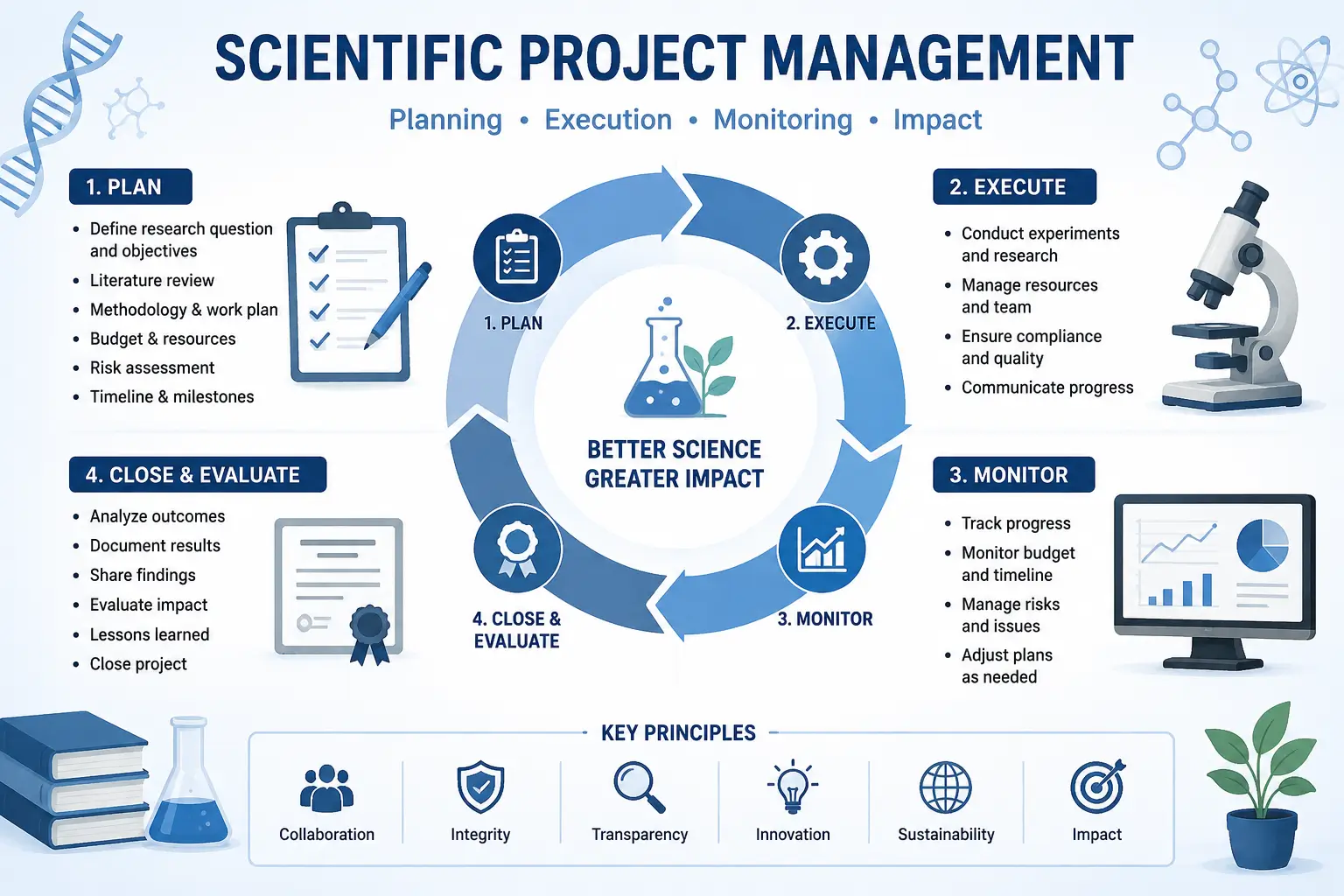
Scientific Project Management Course
The Scientific Project Management Course is designed to help learners develop the skills needed to plan, coordinate, and manage scientific research projects successfully. Moreover, the course covers project planning, budgeting, resource allocation, risk management, research compliance, and team leadership. As a result, learners gain the expertise required to manage scientific projects efficiently from initiation to completion.
Scientific Project Management Course Overview
Scientific research projects often involve complex processes, multiple stakeholders, strict timelines, and resource constraints. Therefore, effective project management is essential for achieving research objectives and ensuring successful outcomes. This Scientific Project Management Course provides a comprehensive understanding of project management principles tailored to scientific and research environments.
In addition, learners explore research operations, project coordination techniques, and performance monitoring strategies. Furthermore, they gain practical insights into managing research activities while maintaining quality and compliance standards.
Fundamentals of Scientific Project Management
The course begins with the fundamentals of scientific project management. Therefore, students learn project life cycles, management methodologies, and key project management concepts. Moreover, they understand how structured planning contributes to successful scientific outcomes.
These foundations help learners develop effective project management capabilities.
Research Planning and Scheduling
Proper planning is critical for scientific project success. Consequently, learners study project planning techniques, scheduling methods, milestone development, and workflow management. In addition, they explore strategies for organizing research activities efficiently.
As a result, students gain practical project planning expertise.
Budgeting and Resource Management
Scientific projects require careful allocation of resources. Therefore, the course covers budgeting principles, financial planning, resource utilization, and cost management techniques. Furthermore, learners understand how to maximize efficiency while maintaining project quality.
These skills support effective project execution.
Team Leadership and Collaboration
Scientific projects often involve multidisciplinary teams. Consequently, students learn leadership strategies, communication techniques, conflict resolution methods, and collaboration practices. In addition, they explore approaches for managing diverse research teams successfully.
These concepts strengthen leadership and teamwork abilities.
Risk Management in Scientific Projects
Research projects face various uncertainties and challenges. Therefore, learners study risk identification, risk assessment, mitigation planning, and contingency management. Moreover, they understand how proactive risk management improves project outcomes.
As a result, students gain valuable problem-solving and decision-making skills.
Data Management and Reporting
Data plays a central role in scientific research. Consequently, the course introduces data management practices, documentation standards, reporting procedures, and project performance evaluation methods. In addition, learners explore techniques for maintaining data quality and transparency.
These skills support effective research administration.
Research Compliance and Ethics
Compliance and ethics are essential in scientific work. Therefore, students learn research regulations, ethical standards, documentation requirements, and governance practices. Furthermore, they understand how compliance supports credibility and accountability.
These concepts strengthen professional research practices.
Practical Learning and Case Studies
The Scientific Project Management Course includes practical assignments, project planning exercises, and real-world case studies. Moreover, learners analyze scientific project scenarios and apply management principles to realistic research environments.
As a result, students gain hands-on experience and industry-relevant knowledge.
Learning Outcomes
By the end of this course, learners will be able to:
- Understand scientific project management principles and frameworks.
- Plan and schedule research projects effectively.
- Manage budgets, resources, and project timelines.
- Lead scientific teams and improve collaboration.
- Apply risk management strategies in research environments.
- Maintain research compliance and ethical standards.
- Support successful scientific project delivery and innovation.
Who Should Enroll?
This course is ideal for researchers, scientists, project coordinators, laboratory managers, research administrators, students, and professionals involved in scientific and innovation projects. Moreover, it benefits anyone seeking to improve project management skills in research environments.
Conclusion
The Scientific Project Management Course provides comprehensive training in research planning, budgeting, leadership, risk management, and project coordination. Furthermore, it combines theoretical knowledge with practical applications. As a result, learners gain the expertise needed to manage scientific projects effectively and achieve successful research outcomes.
9. FAQ SECTION
What is a Scientific Project Management Course?
A Scientific Project Management Course teaches project planning, coordination, budgeting, and leadership skills for research projects.
Who can enroll in this course?
Researchers, scientists, project coordinators, students, and beginners can enroll.
Do I need prior project management experience?
No, the course is suitable for both beginners and experienced professionals.
What skills will I learn?
You will learn project planning, budgeting, leadership, risk management, and research coordination skills.
Is practical training included?
Yes, the course includes case studies, project exercises, and practical assignments.
Will I receive a certificate?
Yes, learners receive a course completion certificate.
Does the course cover research compliance?
Yes, research ethics and compliance are important parts of the curriculum.
What career opportunities are available?
Career options include Research Project Manager, Scientific Coordinator, Laboratory Manager, Research Administrator, and Innovation Project Manager.
Is risk management covered?
Yes, learners study risk identification, assessment, and mitigation strategies.
Why should I study Scientific Project Management?
The course helps develop leadership and project management skills required for successful research and innovation projects.




Reviews
There are no reviews yet.