
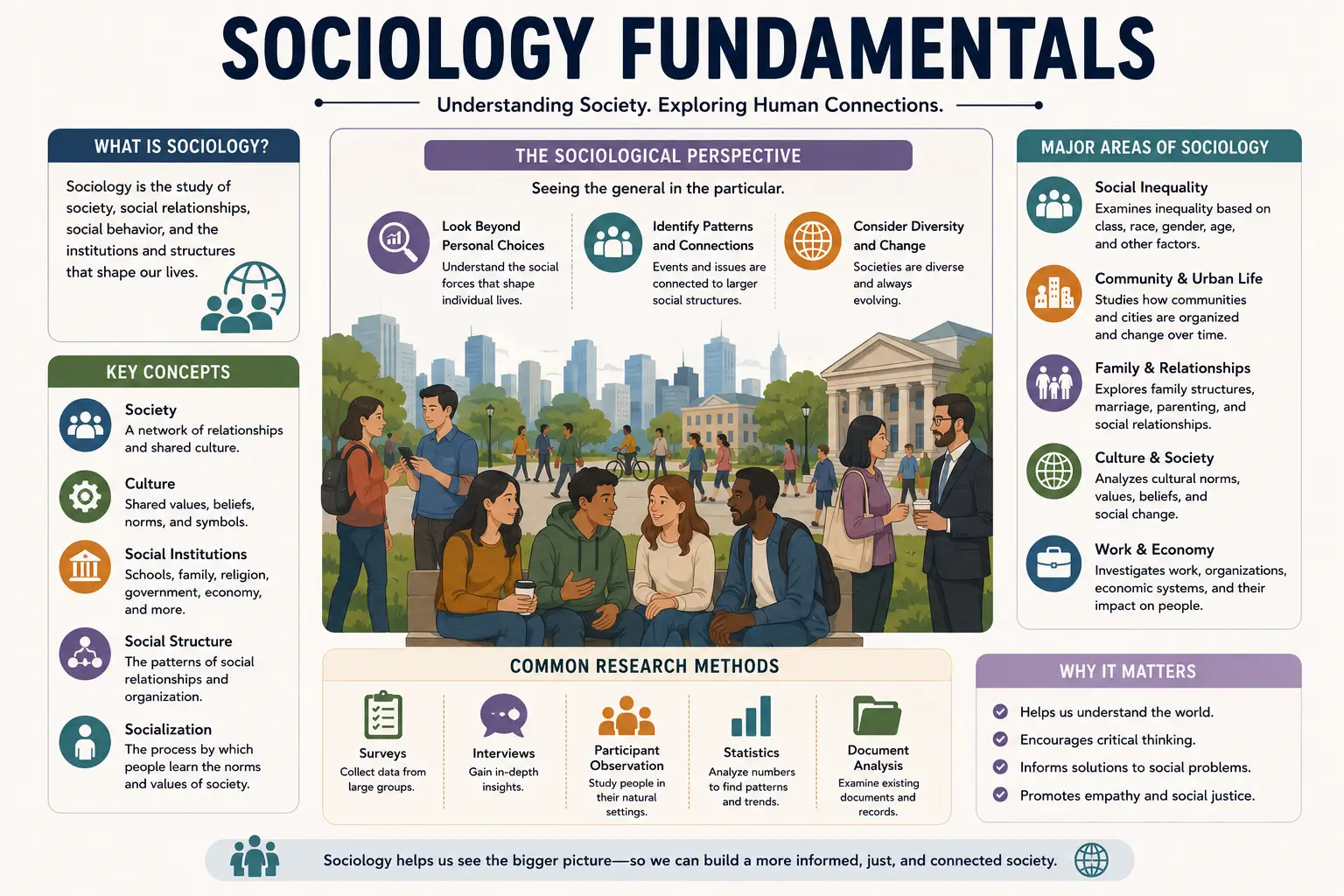
Introduction to Sociology Fundamentals
The Sociology Fundamentals course provides learners with an introduction to the study of society, social relationships, culture, and human behavior. Sociology is a social science that explores how individuals interact with each other and how communities, institutions, and social systems influence human life.
Understanding sociology helps individuals analyze social patterns, cultural differences, and the factors that shape communities. This course introduces learners to important sociological concepts and explains how society develops and changes over time.
The course provides basic knowledge of social structures, relationships, institutions, and social processes that influence everyday experiences.
Importance of Sociology Fundamentals
Learning sociology helps individuals better understand people and communities.
The Sociology Fundamentals course helps learners:
- Understand social structures
- Learn about human relationships
- Develop cultural awareness
- Understand community systems
- Analyze social issues
- Improve communication skills
- Develop social awareness
- Understand social changes
Sociological knowledge helps individuals become more aware of society and their role within it.
Understanding Society and Social Structure
Society is formed through relationships, shared values, and common systems.
Learners explore:
Social Groups
Understanding how people form groups and communities.
Social Relationships
Learning how individuals interact with each other.
Social Organization
Understanding how societies are structured.
Social Roles
Exploring responsibilities and behaviors expected from individuals.
These concepts help learners understand how societies function.
Culture and Social Values
Culture influences how people think, behave, and communicate.
The course covers:
Cultural Practices
Understanding traditions, beliefs, and customs.
Social Values
Learning how values influence behavior.
Social Norms
Understanding rules and expectations within societies.
Cultural Diversity
Exploring differences among communities and groups.
Cultural awareness helps learners appreciate diversity and social differences.
Human Behavior and Social Interaction
Human behavior is influenced by social environments.
Learners understand:
Social Influence
Learning how society affects individual actions.
Communication Patterns
Understanding interactions between people.
Group Behavior
Exploring how individuals behave in groups.
Social Identity
Understanding how people develop their sense of belonging.
These concepts help explain human interactions.
Social Institutions
Social institutions organize important areas of human life.
The course introduces:
Family Institution
Understanding the role of family in society.
Education System
Learning how education influences social development.
Economic Institutions
Understanding the relationship between society and economic activities.
Political Institutions
Exploring how governance affects communities.
Social institutions help maintain social organization.
Community and Social Development
Communities play an important role in society.
Learners explore:
- Community structures
- Social cooperation
- Community relationships
- Social development activities
- Public awareness
Understanding communities helps learners recognize social needs and opportunities.
Social Issues and Inequality
Societies face various challenges that affect people differently.
The course discusses:
Social Inequality
Understanding differences in opportunities and resources.
Social Challenges
Learning about issues affecting communities.
Inclusion Awareness
Understanding the importance of equal participation.
Social Responsibility
Developing awareness of individual roles in society.
These concepts encourage social understanding and responsibility.
Social Change and Modern Society
Society continuously changes due to various factors.
Learners understand:
Causes of Social Change
Exploring factors that influence social development.
Technology and Society
Understanding how technology affects social life.
Modern Social Trends
Learning about changing social patterns.
Future Communities
Exploring how societies may develop.
Social change awareness helps learners understand modern challenges.
Research and Observation Skills
Sociology involves studying social patterns and behaviors.
Learners develop awareness of:
- Social observation
- Data understanding
- Community analysis
- Critical thinking
- Social research basics
These skills help analyze social situations effectively.
Skills You Will Gain
After completing this course, learners may develop:
- Sociology knowledge
- Social awareness skills
- Cultural understanding
- Human behavior awareness
- Communication skills
- Community understanding
- Critical thinking abilities
- Social analysis skills
Benefits of Sociology Fundamentals Course
This course provides several benefits:
- Better understanding of society
- Improved social awareness
- Enhanced cultural knowledge
- Better understanding of human behavior
- Improved communication abilities
- Foundation for social science studies
- Awareness of social challenges
Who Should Join
This course is suitable for:
- Students
- Social science learners
- Community workers
- Beginners
- Educators
- Researchers
- Social development enthusiasts
- Individuals interested in society and culture
No previous sociology experience is required.
Career Opportunities
After completing this course, learners may explore:
- Social Research Assistant
- Community Support Assistant
- Social Development Assistant
- Education Support Worker
- Human Services Assistant
- Research Coordinator Assistant
- Community Program Assistant
FAQ Section
1. What is Sociology Fundamentals?
Sociology Fundamentals is a beginner course that introduces society, culture, social relationships, human behavior, and social structures.
2. Who can join this course?
Students, beginners, social science learners, and anyone interested in understanding society can join.
3. Do I need previous sociology knowledge?
No, this course is designed for beginners.
4. What will I learn in Sociology Fundamentals?
You will learn about society, culture, social groups, institutions, human behavior, and social changes.
5. Why is sociology important?
Sociology helps individuals understand communities, relationships, social issues, and human interactions.
6. Does this course cover culture and society?
Yes, learners gain knowledge about cultural practices, values, norms, and social structures.
7. What skills will I gain?
You will gain social awareness, cultural understanding, communication skills, and analytical abilities.
8. Is this course suitable for beginners?
Yes, it provides basic knowledge without requiring previous sociology experience.
9. Can this course help in social science careers?
Yes, it provides foundational knowledge useful for education, research, community development, and social services.
10. How does sociology help understand human behavior?
Sociology explains how social environments, relationships, and communities influence human actions and experiences.





Reviews
There are no reviews yet.