
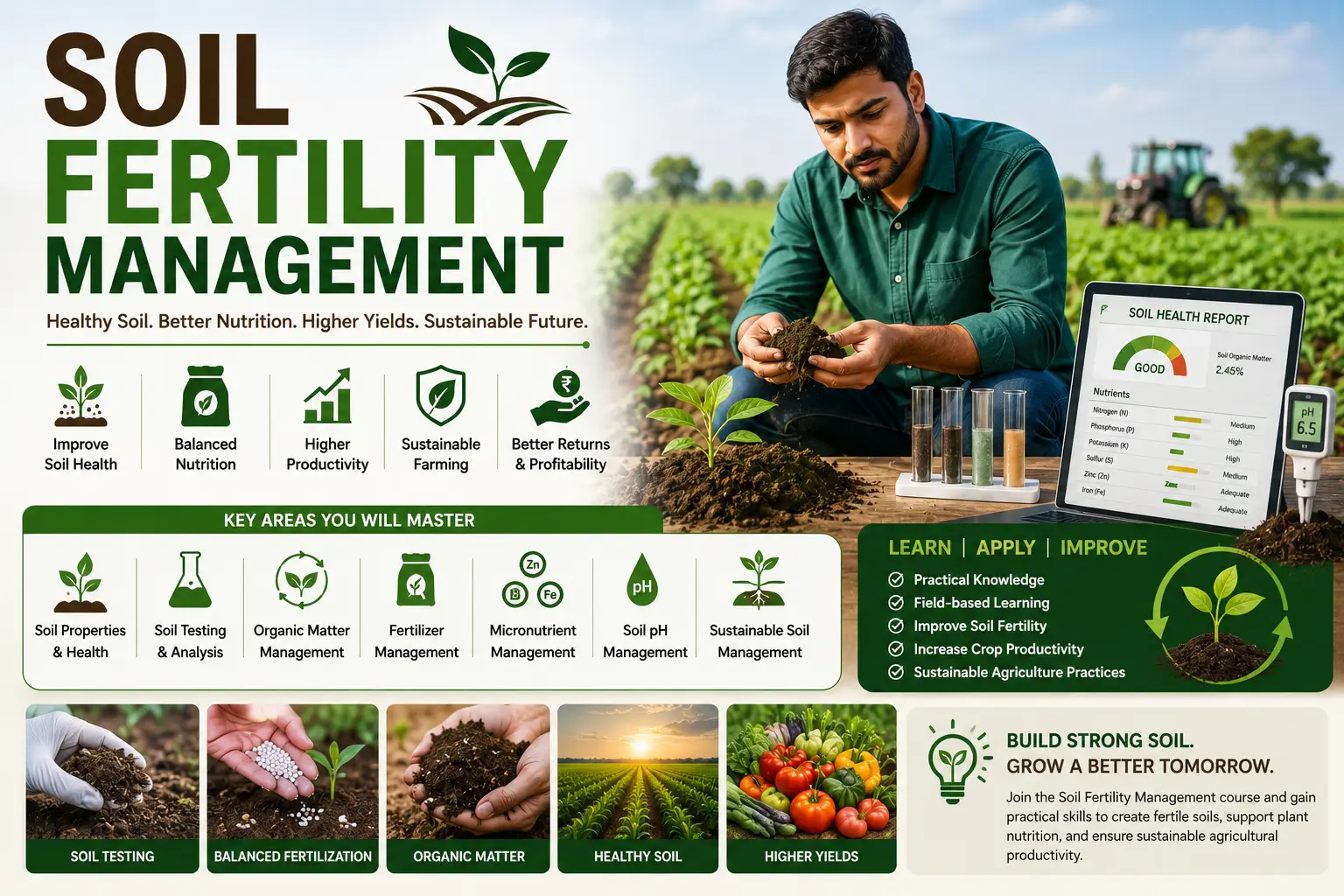
Soil Fertility Management Course
The Soil Fertility Management Course is designed to help farmers, agronomists, agricultural professionals, soil scientists, crop advisors, researchers, students, agribusiness professionals, and individuals interested in sustainable agriculture develop the knowledge and practical skills required to improve soil health and optimize crop productivity. Healthy soil is the foundation of successful agriculture, making effective soil fertility management essential for increasing yields, maintaining environmental sustainability, and ensuring long-term agricultural success.
This course introduces the core principles of soil fertility management, including soil science, soil testing, nutrient analysis, plant nutrition, fertilizer management, integrated nutrient management (INM), organic matter management, composting, soil pH correction, soil amendments, precision nutrient management, soil conservation, sustainable farming practices, and environmental stewardship. Learners will gain practical knowledge of maintaining productive soils while reducing nutrient losses and improving resource efficiency.
Whether you work in agriculture, agribusiness, crop production, agricultural consulting, research, or environmental management, this course provides a comprehensive foundation in soil fertility management.
Course Overview
The course explores the complete process of soil fertility management, from understanding soil properties and nutrient requirements to developing fertilizer plans, improving soil structure, conserving natural resources, and supporting sustainable crop production. Learners will understand how healthy soils contribute to better plant growth, higher yields, and long-term farm profitability.
The curriculum combines soil science with practical exercises, nutrient management planning, industry case studies, and best practices to prepare learners for careers in agriculture and soil management.
What You Will Learn
By completing this course, you will be able to:
- Understand soil fertility principles.
- Evaluate soil health and productivity.
- Interpret soil test results.
- Identify essential plant nutrients.
- Develop fertilizer management plans.
- Apply integrated nutrient management techniques.
- Improve soil organic matter.
- Manage soil pH effectively.
- Apply soil amendments correctly.
- Implement precision nutrient management.
- Reduce nutrient losses.
- Support sustainable agriculture.
- Improve crop productivity.
- Conserve soil resources.
- Strengthen environmental stewardship.
Course Curriculum
The curriculum begins with soil science fundamentals before progressing through soil testing, nutrient analysis, fertilizer management, integrated nutrient management, composting, soil amendments, precision agriculture, soil conservation, sustainability, industry case studies, and future innovations in soil fertility management.
Practical assignments help learners apply soil fertility techniques using real-world agricultural scenarios.
Skills You Will Gain
After completing the course, you will develop skills in:
- Soil Fertility Management
- Soil Health Assessment
- Soil Testing
- Nutrient Management
- Fertilizer Planning
- Integrated Nutrient Management (INM)
- Organic Matter Management
- Composting Techniques
- Soil Amendment Practices
- Precision Agriculture
- Soil Conservation
- Crop Nutrition
- Sustainable Agriculture
- Environmental Management
- Agricultural Productivity Improvement
Benefits of the Course
This course helps learners improve soil health, increase crop yields, optimize fertilizer use, reduce production costs, and promote environmentally sustainable farming. Strong soil fertility management skills enable farmers and agricultural organizations to enhance productivity, conserve natural resources, reduce environmental impact, and improve long-term profitability.
These skills are highly valuable across farms, agribusiness companies, fertilizer manufacturers, agricultural cooperatives, research institutions, government agriculture departments, environmental organizations, consulting firms, and sustainable agriculture projects.
Who Should Enroll
This course is ideal for:
- Farmers
- Agronomists
- Soil Scientists
- Agricultural Professionals
- Crop Advisors
- Agribusiness Professionals
- Agricultural Consultants
- Researchers
- Students of Agriculture
- Environmental Specialists
- Extension Officers
- Farm Managers
- Entrepreneurs
- Sustainability Professionals
- Anyone interested in soil management
Career Opportunities
After completing the Soil Fertility Management Course, learners may strengthen their qualifications for roles such as:
- Soil Scientist
- Agronomist
- Crop Nutrition Specialist
- Agricultural Consultant
- Farm Manager
- Soil Testing Technician
- Fertilizer Advisor
- Sustainability Officer
- Agricultural Extension Officer
- Agribusiness Manager
These skills are valuable across agricultural companies, fertilizer industries, research institutions, government agencies, environmental organizations, consulting firms, agricultural cooperatives, food production companies, and sustainable farming enterprises.
Certification Details
Upon successful completion, learners receive a Certificate of Completion recognizing their expertise in Soil Fertility Management and sustainable soil practices. This certification enhances your professional profile and supports career advancement in agriculture, agronomy, soil science, crop production, agribusiness, environmental management, and sustainable farming.
If you want to improve soil health, optimize crop nutrition, and build expertise in sustainable soil management, the Soil Fertility Management Course provides practical, industry-relevant knowledge for today’s agriculture sector.
FAQ SECTION
1. What is the Soil Fertility Management Course?
It teaches modern techniques for improving soil health, managing plant nutrients, optimizing fertilizer use, and supporting sustainable agricultural productivity.
2. Is this course suitable for beginners?
Yes. The course starts with soil science fundamentals and is suitable for beginners as well as agricultural professionals.
3. What topics are covered?
Soil science, soil testing, nutrient management, fertilizer planning, integrated nutrient management, composting, soil amendments, precision agriculture, soil conservation, and sustainable farming.
4. Do I need previous agricultural experience?
No. The course is designed for beginners, students, farmers, agribusiness professionals, consultants, researchers, and anyone interested in soil fertility management.
5. Is the course online?
Yes. The course is fully online and self-paced.
6. Will I receive a certificate?
Yes. A certificate is awarded after successfully completing the course.
7. Who should enroll?
Farmers, agronomists, soil scientists, crop advisors, agricultural consultants, agribusiness professionals, researchers, students, entrepreneurs, and anyone interested in sustainable agriculture.
8. What skills will I gain?
Soil testing, nutrient management, fertilizer planning, composting, soil health assessment, precision nutrient management, crop nutrition, soil conservation, and sustainable farming practices.
9. Can this course help my career?
Yes. Soil fertility management skills are highly valued across agriculture, agribusiness, fertilizer companies, research institutions, government departments, consulting firms, environmental organizations, agricultural cooperatives, and sustainable farming projects.
10. Why is Soil Fertility Management important?
Soil Fertility Management improves soil health, enhances nutrient availability, increases crop yields, optimizes fertilizer use, reduces environmental impact, conserves natural resources, supports sustainable agriculture, improves farm profitability, and ensures long-term agricultural productivity.




Reviews
There are no reviews yet.