
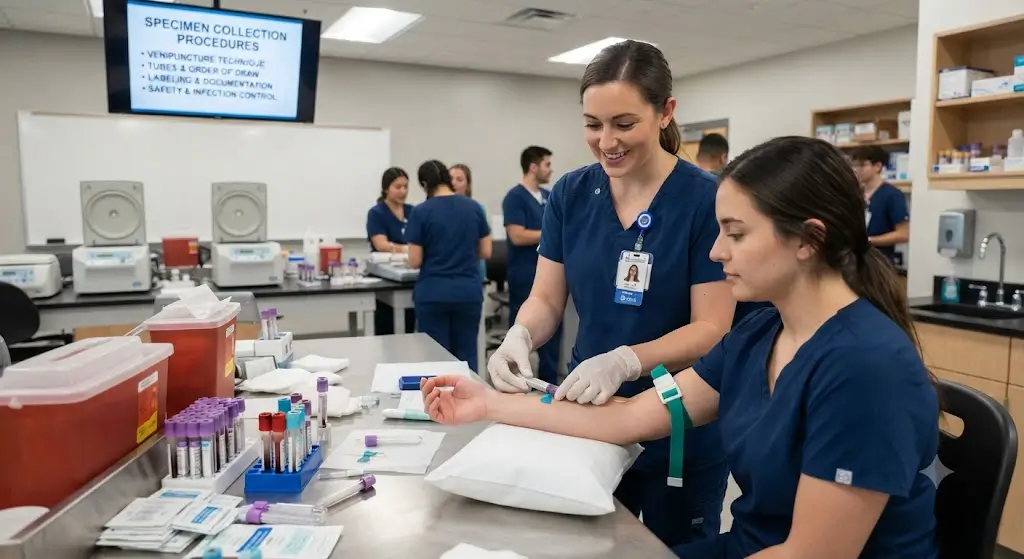
Specimen Collection Procedures Course
The Specimen Collection Procedures Course is designed to help laboratory technicians, phlebotomists, healthcare professionals, nurses, medical assistants, students, diagnostic laboratory staff, and individuals interested in clinical laboratory services develop the knowledge and practical skills needed to collect, handle, label, store, and transport biological specimens safely and accurately. Proper specimen collection is essential for reliable laboratory results, accurate diagnosis, patient safety, and quality healthcare delivery.
This course introduces the core principles of specimen collection, including patient identification, specimen types, infection prevention, biosafety practices, blood collection fundamentals, urine and stool sample collection, swab and tissue specimen handling, specimen labeling, documentation, storage, transportation, quality control, laboratory safety, regulatory compliance, and error prevention. Learners will gain practical knowledge of following standardized procedures that ensure specimen integrity and accurate laboratory testing.
Whether you work in hospitals, diagnostic laboratories, clinics, blood collection centers, research laboratories, or healthcare organizations, this course provides a comprehensive foundation in specimen collection procedures.
Course Overview
The course explores the complete specimen collection process, from patient preparation and specimen collection to labeling, documentation, transportation, quality assurance, and laboratory compliance. Learners will understand how standardized specimen collection procedures reduce errors, improve laboratory accuracy, and contribute to better patient outcomes.
The curriculum combines laboratory best practices with practical exercises, real-world healthcare scenarios, and industry standards to prepare learners for professional roles in diagnostic and clinical laboratory settings.
What You Will Learn
By completing this course, you will be able to:
- Understand specimen collection principles.
- Identify different clinical specimen types.
- Prepare patients for specimen collection.
- Follow infection prevention and biosafety protocols.
- Perform basic blood collection procedures.
- Collect urine, stool, sputum, and swab specimens.
- Label and document specimens accurately.
- Handle and transport specimens safely.
- Maintain specimen quality and integrity.
- Apply laboratory safety standards.
- Prevent specimen collection errors.
- Follow quality assurance procedures.
- Comply with healthcare regulations.
- Improve diagnostic accuracy.
- Support efficient laboratory operations.
Course Curriculum
The curriculum begins with specimen collection fundamentals before progressing through patient preparation, specimen types, biosafety, blood collection, sample labeling, transportation, quality assurance, laboratory documentation, regulatory compliance, case studies, and emerging trends in laboratory diagnostics.
Practical assignments help learners apply specimen collection techniques using real-world healthcare scenarios.
Skills You Will Gain
After completing the course, you will develop skills in:
- Specimen Collection Techniques
- Patient Identification
- Blood Collection Fundamentals
- Clinical Sample Handling
- Specimen Labeling
- Laboratory Documentation
- Sample Storage and Transport
- Infection Prevention
- Biosafety Practices
- Laboratory Quality Control
- Medical Laboratory Procedures
- Healthcare Compliance
- Diagnostic Sample Management
- Laboratory Safety
- Error Prevention
Benefits of the Course
This course helps learners improve specimen collection accuracy, strengthen patient safety, reduce laboratory errors, maintain specimen integrity, support quality assurance, and enhance diagnostic reliability. Strong specimen collection skills contribute to efficient laboratory operations and improved healthcare outcomes.
These skills are highly valuable across hospitals, diagnostic laboratories, pathology laboratories, blood banks, clinics, research institutions, healthcare organizations, public health laboratories, and medical testing centers.
Who Should Enroll
This course is ideal for:
- Laboratory Technicians
- Phlebotomists
- Nurses
- Medical Assistants
- Healthcare Professionals
- Clinical Laboratory Staff
- Pathology Laboratory Personnel
- Diagnostic Center Staff
- Healthcare Students
- Laboratory Assistants
- Research Laboratory Staff
- Blood Bank Technicians
- Quality Assurance Personnel
- Healthcare Administrators
- Anyone interested in laboratory diagnostics
Career Opportunities
After completing the Specimen Collection Procedures Course, learners may strengthen their qualifications for roles such as:
- Phlebotomist
- Laboratory Technician
- Medical Laboratory Assistant
- Diagnostic Laboratory Technician
- Specimen Collection Technician
- Pathology Laboratory Assistant
- Blood Bank Technician
- Clinical Laboratory Assistant
- Healthcare Support Professional
- Laboratory Quality Assistant
These skills are valuable across hospitals, diagnostic laboratories, pathology laboratories, blood banks, healthcare organizations, clinics, research institutions, public health laboratories, and medical testing facilities.
Certification Details
Upon successful completion, learners receive a Certificate of Completion recognizing their expertise in Specimen Collection Procedures and laboratory sample management. This certification enhances your professional profile and supports career advancement in clinical laboratories, healthcare services, diagnostic testing, pathology, laboratory quality management, and medical support services.
If you want to improve specimen collection accuracy, strengthen laboratory quality, and build expertise in clinical sample handling, the Specimen Collection Procedures Course provides practical, industry-relevant knowledge for today’s healthcare and laboratory sectors.
FAQ SECTION
1. What is the Specimen Collection Procedures Course?
It teaches the principles and techniques for collecting, labeling, handling, storing, and transporting clinical specimens safely while following laboratory quality standards.
2. Is this course suitable for beginners?
Yes. The course starts with specimen collection fundamentals and is suitable for beginners as well as laboratory and healthcare professionals.
3. What topics are covered?
Patient identification, blood collection, urine and stool sample collection, infection prevention, specimen labeling, documentation, biosafety, sample transport, quality assurance, and laboratory safety.
4. Do I need previous laboratory experience?
No. The course is designed for beginners, students, laboratory technicians, nurses, healthcare workers, and anyone interested in laboratory diagnostics.
5. Is the course online?
Yes. The course is fully online and self-paced.
6. Will I receive a certificate?
Yes. A certificate is awarded after successfully completing the course.
7. Who should enroll?
Laboratory technicians, phlebotomists, nurses, medical assistants, healthcare professionals, students, diagnostic laboratory staff, and anyone interested in specimen collection.
8. What skills will I gain?
Specimen collection, patient preparation, sample handling, specimen labeling, laboratory documentation, infection prevention, biosafety, quality control, and laboratory safety.
9. Can this course help my career?
Yes. Specimen collection skills are highly valued across hospitals, diagnostic laboratories, pathology laboratories, blood banks, clinics, healthcare organizations, research laboratories, and medical testing centers.
10. Why are Specimen Collection Procedures important?
Specimen Collection Procedures help ensure accurate laboratory test results, maintain specimen integrity, improve patient safety, reduce diagnostic errors, support infection prevention, strengthen laboratory quality, ensure regulatory compliance, and enhance the overall efficiency of healthcare services.




Reviews
There are no reviews yet.