
SQL Database Queries: Master the Language of Data
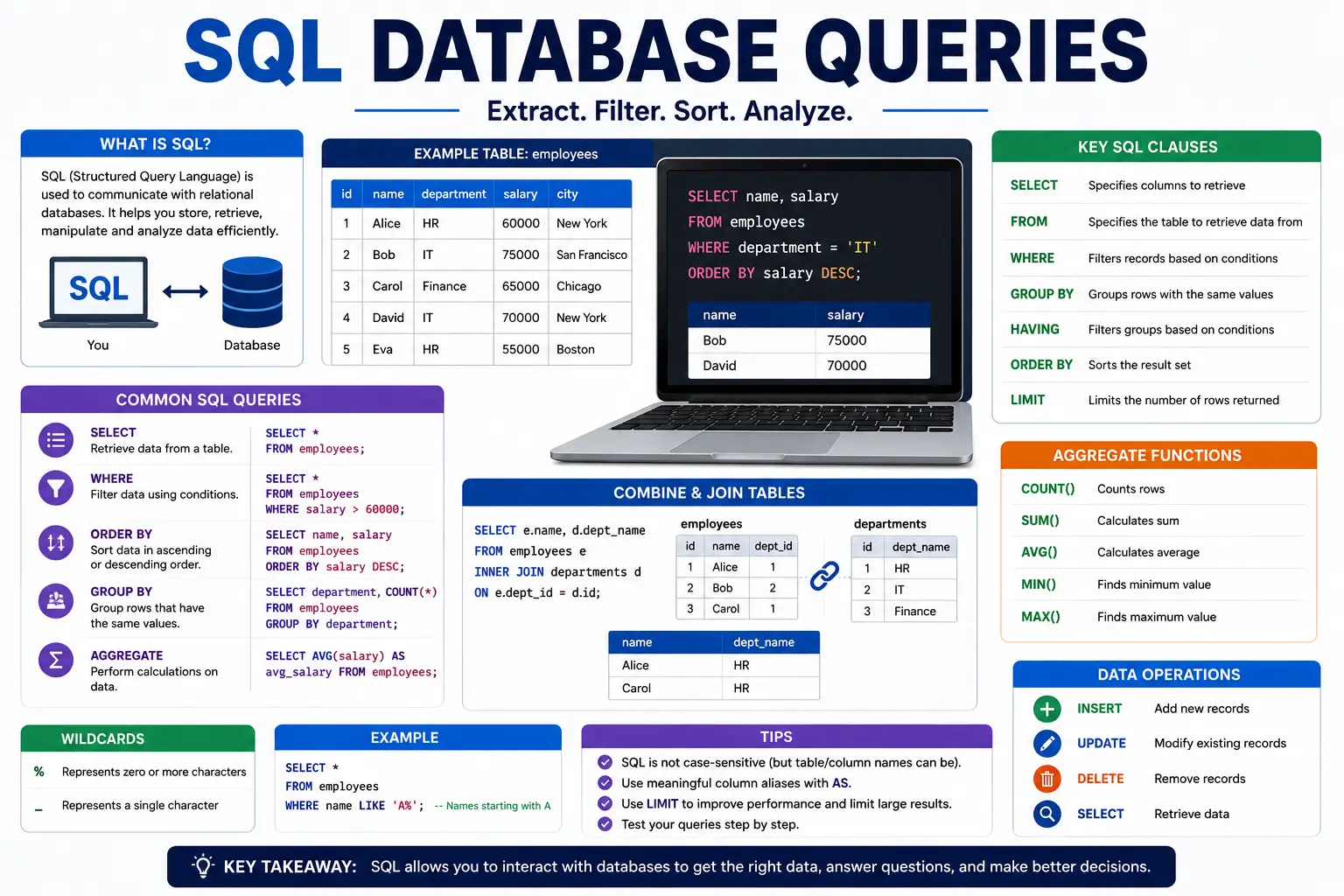
Structured Query Language (SQL) is the backbone of modern data management, enabling professionals to interact with databases efficiently. The SQL Database Queries course is designed to provide learners with a solid foundation in writing, optimizing, and managing queries to extract meaningful insights from relational databases. Whether you’re a beginner or an aspiring data professional, this course equips you with practical skills to handle real‑world datasets.
What You’ll Learn
- SQL Basics: Understand tables, rows, columns, and relational database concepts.
- Data Retrieval: Learn SELECT statements, filtering with WHERE, and sorting with ORDER BY.
- Joins & Relationships: Master INNER JOIN, LEFT JOIN, RIGHT JOIN, and FULL JOIN to combine data across tables.
- Aggregation: Use COUNT, SUM, AVG, MIN, and MAX to summarize data.
- Subqueries: Write nested queries for advanced data analysis.
- Data Modification: Learn how to insert, update, and delete records safely.
- Optimization: Explore indexing, query performance tuning, and best practices.
- Advanced SQL: Dive into stored procedures, triggers, and views.
Why This Course Matters
SQL is a universal skill across industries. By mastering database queries, you will:
- Extract actionable insights from large datasets.
- Improve efficiency in reporting and analytics.
- Support business intelligence and decision‑making.
- Gain a competitive edge in data‑driven careers.
Career Opportunities
Completing this course opens doors to roles such as:
- Database Administrator
- Data Analyst
- Business Intelligence Developer
- SQL Developer
- Data Engineer
FAQ SECTION
What is SQL?
SQL (Structured Query Language) is a programming language used to manage, retrieve, and manipulate data stored in relational databases.
Who should take this course?
Students, data analysts, software developers, database administrators, and professionals working with data can benefit from this course.
Is prior programming knowledge required?
No. This course is beginner-friendly and starts with SQL fundamentals.
Will I receive a certificate?
Yes. Participants receive certification after successfully completing course assessments.
Why is SQL important?
SQL is widely used for database management, data analysis, reporting, and business intelligence across industries.
What databases use SQL?
Popular SQL databases include MySQL, PostgreSQL, Microsoft SQL Server, Oracle Database, and SQLite.
Can SQL help me become a data analyst?
Yes. SQL is one of the most important skills required for data analyst and business intelligence roles.
What skills will I gain?
You will learn SQL querying, database management, data retrieval, joins, reporting, and analytical techniques.
Is SQL difficult to learn?
No. SQL is considered one of the easiest programming languages for beginners.
How long does the course take?
Most learners complete the course within 6–8 weeks.




Reviews
There are no reviews yet.