
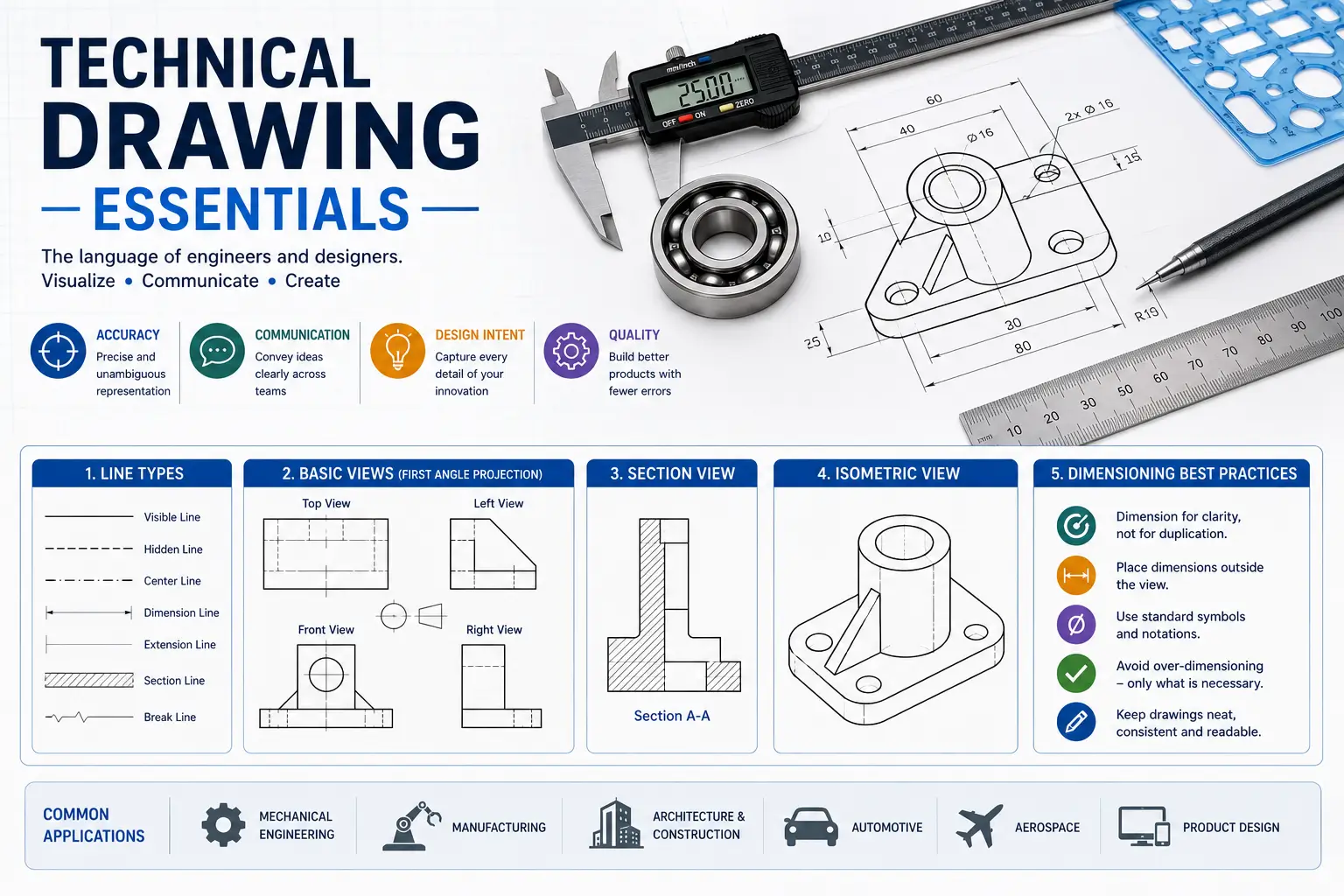
Introduction
The Technical Drawing Essentials Course is a foundational training program designed to help learners develop the knowledge and skills required to understand and create accurate technical drawings used in engineering, manufacturing, construction, and product design. Technical drawing is considered the backbone of engineering communication because it translates complex ideas into precise visual representations that can be universally understood by engineers, designers, technicians, and manufacturers.
In engineering and industrial environments, technical drawings serve as the primary reference for designing, manufacturing, assembling, inspecting, and maintaining products and structures. Therefore, understanding technical drawing principles is essential for anyone involved in engineering or technical fields.
This course provides learners with practical knowledge of technical drawing by combining drafting fundamentals, geometric construction, projection techniques, dimensioning methods, drawing standards, interpretation skills, and basic CAD concepts. Whether you are an engineering student, technician, draftsman, designer, or aspiring engineer, this course provides essential knowledge that supports technical communication and professional development.
Course Overview
Technical drawing plays a critical role in transforming engineering ideas into physical products and structures. It ensures accuracy, consistency, and clarity in communication between design and manufacturing teams.
First, learners explore the importance of technical drawing in engineering, architecture, manufacturing, and industrial design. Next, they understand how drawings act as a universal communication tool that eliminates ambiguity in design interpretation.
Additionally, the course explains drawing instruments, line types, scales, geometric construction, orthographic projection, isometric projection, section views, and dimensioning techniques. Learners also gain knowledge of engineering symbols, tolerances, drawing standards, and basic CAD drawing principles.
Furthermore, the curriculum combines theoretical drafting concepts with practical interpretation techniques, helping learners confidently read and create technical drawings used in real-world engineering applications.
What You Will Learn
The Technical Drawing Essentials Course covers a wide range of topics related to engineering drawing and technical representation.
First, learners study the fundamentals of technical drawing and understand its role in engineering communication, design, and manufacturing. They also explore the importance of accuracy, precision, and standardization in technical drawings.
Next, participants learn about drawing instruments and tools. They understand the use of scales, compasses, set squares, protractors, drafting machines, and CAD tools for creating precise engineering drawings.
Additionally, the course introduces line types and drawing conventions. Learners discover how different line styles represent visible edges, hidden details, center lines, and construction guides in technical drawings.
Furthermore, participants study geometric construction techniques. They learn how to construct basic shapes, angles, circles, arcs, tangents, and patterns used in engineering design.
The course also explains orthographic projection. Learners understand how 3D objects are represented in 2D views, including front view, top view, and side view projections.
Moreover, learners gain knowledge of isometric drawing. They learn how to create 3D representations of objects using isometric angles and scaling techniques for visualization.
In addition, the curriculum covers section views and auxiliary views. Participants understand how internal features of components are represented clearly using sectional drawing techniques.
The course also introduces dimensioning techniques. Learners explore how measurements, tolerances, annotations, and notes are added to technical drawings to ensure manufacturing accuracy.
Additionally, learners study engineering symbols, drafting standards, and conventions used in mechanical and industrial drawings.
Furthermore, the curriculum explains how to read and interpret engineering drawings used in manufacturing and construction environments.
Finally, learners are introduced to basic CAD concepts, digital drafting tools, and modern engineering drawing practices used in industry.
Skills You Will Gain
Upon successful completion of the course, learners will develop valuable professional skills, including:
- Technical drawing fundamentals
- Engineering drawing interpretation
- Orthographic projection
- Isometric drawing
- Geometric construction
- Dimensioning techniques
- Section and auxiliary views
- Drafting standards
- Engineering symbols understanding
- Basic CAD awareness
- Drawing accuracy
- Technical communication
- Visual representation skills
- Industrial drafting knowledge
- Problem-solving through drawings
These skills are highly valued across engineering, manufacturing, architecture, construction, automotive, aerospace, product design, and industrial production industries.
Benefits of the Course
The Technical Drawing Essentials Course provides learners with practical drafting knowledge that supports engineering communication and design accuracy.
First, the course helps learners understand how technical drawings communicate complex engineering ideas clearly and precisely.
Additionally, participants strengthen their ability to interpret engineering drawings, understand dimensions, and visualize 3D objects from 2D representations.
Furthermore, learners develop practical skills in geometric construction, projection techniques, dimensioning, and drafting standards.
The course also enhances spatial thinking, attention to detail, analytical thinking, and technical communication skills.
As industries continue to rely on accurate design documentation and digital drafting, professionals with technical drawing skills remain highly valuable.
Finally, learners gain the confidence to read, interpret, and create engineering drawings used in real-world applications.
Who Should Enroll?
This course is ideal for:
- Engineering students
- Mechanical engineering beginners
- Draftsmen
- CAD beginners
- Technicians
- Product designers
- Construction workers
- Manufacturing professionals
- Architecture students
- Industrial trainees
- Technical assistants
- Anyone interested in engineering drawing
No prior drafting experience is required. Therefore, beginners can easily learn and build a strong foundation in technical drawing.
Career Opportunities
After completing the course, learners may pursue opportunities such as:
- CAD Draftsman
- Junior Design Engineer
- Mechanical Drafter
- Engineering Technician
- CAD Operator
- Technical Assistant
- Product Design Assistant
- Manufacturing Drafting Support
- Construction Drafting Assistant
- Design Support Engineer
- Industrial Drafter
- Engineering Intern
- Technical Drawing Specialist
- Production Drawing Assistant
- AutoCAD Beginner Specialist
Additionally, learners can apply these skills across engineering design firms, manufacturing industries, construction companies, automotive companies, aerospace industries, architecture firms, and product development organizations.
Certification
Upon successful completion of the Technical Drawing Essentials Course, participants receive a certification recognizing their understanding of engineering drawing fundamentals, orthographic projection, isometric drawing, dimensioning techniques, drafting standards, and technical interpretation skills. This certification strengthens professional credibility and supports entry-level career opportunities in engineering, design, manufacturing, and drafting fields.
Why Choose This Course?
The Technical Drawing Essentials Course combines foundational drafting principles with practical engineering applications to provide a strong learning experience.
First, learners develop a clear understanding of how technical drawings communicate engineering ideas effectively.
Additionally, the curriculum focuses on orthographic projection, isometric drawing, geometric construction, dimensioning, and interpretation of engineering drawings.
Furthermore, participants gain industry-relevant knowledge that supports career development in engineering, manufacturing, construction, architecture, and product design.
Whether your goal is to become a CAD designer, draftsman, engineering technician, or product design assistant, this course provides the knowledge, skills, and confidence needed to succeed.
Enroll today and build a strong foundation in technical drawing, engineering visualization, and industrial drafting.
FAQ Section
1. What is the Technical Drawing Essentials Course?
The course teaches the fundamentals of engineering drawing, including orthographic projection, isometric drawing, dimensioning, and technical representation.
2. Is this course suitable for beginners?
Yes. The course is designed for beginners with no prior drafting experience.
3. What topics are covered?
Topics include drawing instruments, line types, geometric construction, orthographic projection, isometric drawing, section views, dimensioning, and drafting standards.
4. Will I receive a certificate?
Yes. Participants receive a certificate upon successful completion of the course.
5. Do I need prior CAD knowledge?
No. The course introduces basic drafting concepts and CAD awareness in a beginner-friendly format.
6. Who should enroll in this course?
Engineering students, technicians, draftsmen, designers, architecture students, and beginners in CAD and drafting can benefit from this course.
7. Is the course fully online?
Yes. The course offers flexible online learning.
8. What skills will I gain?
You will gain skills in technical drawing, orthographic projection, isometric drawing, dimensioning, geometric construction, and engineering interpretation.
9. Can this course help my career?
Yes. Technical drawing skills are essential for careers in engineering, manufacturing, architecture, construction, and product design.
10. Why is technical drawing important?
Technical drawing ensures clear, accurate, and standardized communication of engineering designs, enabling proper manufacturing and construction.





Reviews
There are no reviews yet.