
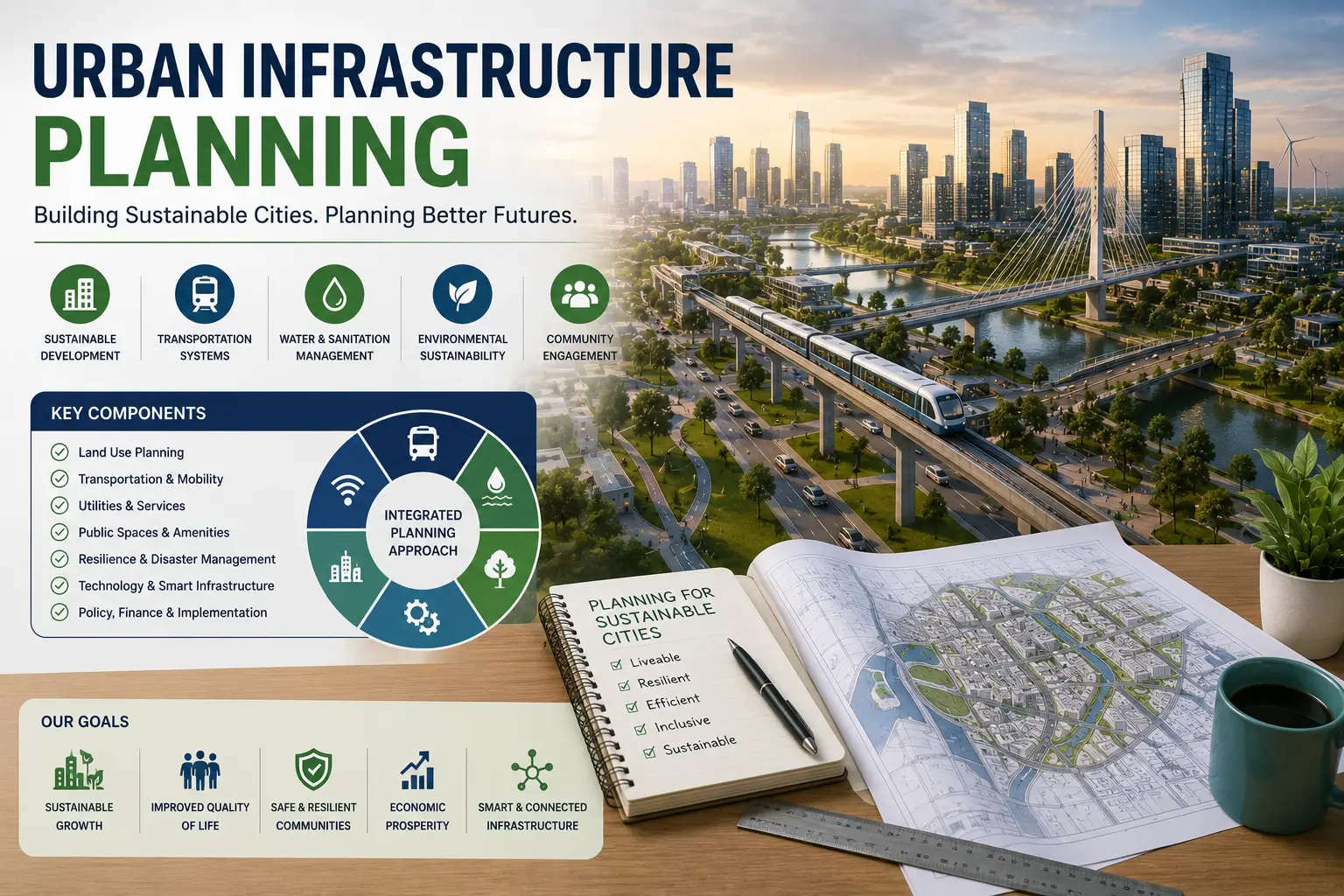
Urban Infrastructure Planning Course
The Urban Infrastructure Planning Course is designed to help learners understand how cities develop, manage resources, and create sustainable infrastructure systems. Moreover, the course provides practical knowledge of urban planning, transportation networks, public utilities, smart city initiatives, and infrastructure development. As a result, learners gain the skills required to contribute to modern urban growth and sustainable city management.
Urban Infrastructure Planning Course Overview
Urban infrastructure plays a crucial role in supporting economic growth, public services, and community well-being. Therefore, effective planning is essential for developing resilient and sustainable cities. This Urban Infrastructure Planning Course provides a comprehensive understanding of infrastructure systems and urban development strategies.
In addition, learners explore transportation planning, utility management, environmental sustainability, and smart city technologies. Furthermore, they gain practical insights into addressing urban challenges and improving city infrastructure.
Fundamentals of Urban Planning
The course begins with the fundamentals of urban planning. Therefore, students learn about land use planning, urban design principles, zoning regulations, and community development. Moreover, they understand how planning supports balanced urban growth and efficient resource allocation.
These foundations help learners build strong urban planning skills.
Infrastructure Design and Development
Infrastructure is the backbone of every city. Consequently, learners study the planning and development of roads, bridges, utilities, public facilities, and communication systems. In addition, they explore methods for designing infrastructure that meets current and future needs.
As a result, students gain practical infrastructure development expertise.
Transportation and Mobility Planning
Transportation systems are essential for urban connectivity. Therefore, the course covers public transportation planning, traffic management, mobility solutions, and transportation infrastructure development. Furthermore, learners understand how efficient transportation improves urban accessibility and economic productivity.
These skills support effective city planning initiatives.
Sustainable Urban Development
Sustainability is a key focus of modern urban planning. Consequently, students learn environmental management strategies, green infrastructure concepts, renewable energy integration, and sustainable development practices. In addition, they explore methods for reducing environmental impacts while supporting urban growth.
These concepts strengthen sustainable planning capabilities.
Smart Cities and Digital Infrastructure
Technology is transforming urban environments worldwide. Therefore, learners study smart city concepts, digital infrastructure systems, Internet of Things (IoT) applications, and data-driven urban management. Moreover, they understand how technology improves public services and operational efficiency.
As a result, students gain valuable smart city planning knowledge.
Public Utilities and Resource Management
Cities rely on efficient utility systems to serve residents and businesses. Consequently, the course introduces water management, waste management, energy distribution, and public utility planning. In addition, learners explore strategies for ensuring reliable and sustainable services.
These skills support effective infrastructure management.
Urban Policy and Governance
Successful infrastructure planning requires strong governance and policy frameworks. Therefore, students learn urban policy development, municipal governance, regulatory compliance, and stakeholder engagement strategies. Furthermore, they understand how public institutions support infrastructure projects.
These concepts improve planning and decision-making abilities.
Practical Learning and Case Studies
The Urban Infrastructure Planning Course includes practical projects, planning exercises, and real-world case studies. Moreover, learners analyze successful urban development projects and apply planning concepts to realistic scenarios.
As a result, students gain hands-on experience and industry-relevant knowledge.
Learning Outcomes
By the end of this course, learners will be able to:
- Understand urban infrastructure planning principles.
- Develop sustainable infrastructure strategies.
- Apply transportation and mobility planning techniques.
- Support smart city development initiatives.
- Manage public utility and resource planning projects.
- Analyze urban development challenges and solutions.
- Contribute to sustainable and resilient city growth.
Who Should Enroll?
This course is ideal for urban planners, architects, civil engineers, infrastructure professionals, government officials, students, and development professionals. Moreover, it benefits anyone interested in city planning and sustainable urban development.
Conclusion
The Urban Infrastructure Planning Course provides comprehensive training in urban planning, infrastructure development, transportation systems, sustainability, and smart city technologies. Furthermore, it combines theoretical concepts with practical applications. As a result, learners gain the expertise needed to support modern city development and infrastructure management.
9. FAQ SECTION
What is an Urban Infrastructure Planning Course?
An Urban Infrastructure Planning Course teaches city planning, infrastructure development, transportation systems, and sustainable urban growth strategies.
Who can enroll in this course?
Students, urban planners, engineers, architects, government professionals, and beginners can enroll.
Do I need prior experience?
No, beginners can join and learn urban planning fundamentals.
What skills will I learn?
You will learn urban planning, infrastructure design, transportation planning, sustainability, and smart city management.
Is practical training included?
Yes, the course includes projects, planning exercises, and case studies.
Will I receive a certificate?
Yes, learners receive a course completion certificate.
Does the course cover smart city development?
Yes, smart cities and digital infrastructure are important parts of the curriculum.
What career opportunities are available?
Career options include Urban Planner, Infrastructure Analyst, Development Consultant, Smart City Specialist, and Municipal Planning Officer.
Can government professionals benefit from this course?
Yes, it supports better planning and management of public infrastructure projects.
Why should I study Urban Infrastructure Planning?
The course helps develop skills needed for sustainable urban development and modern city management.



Reviews
There are no reviews yet.