
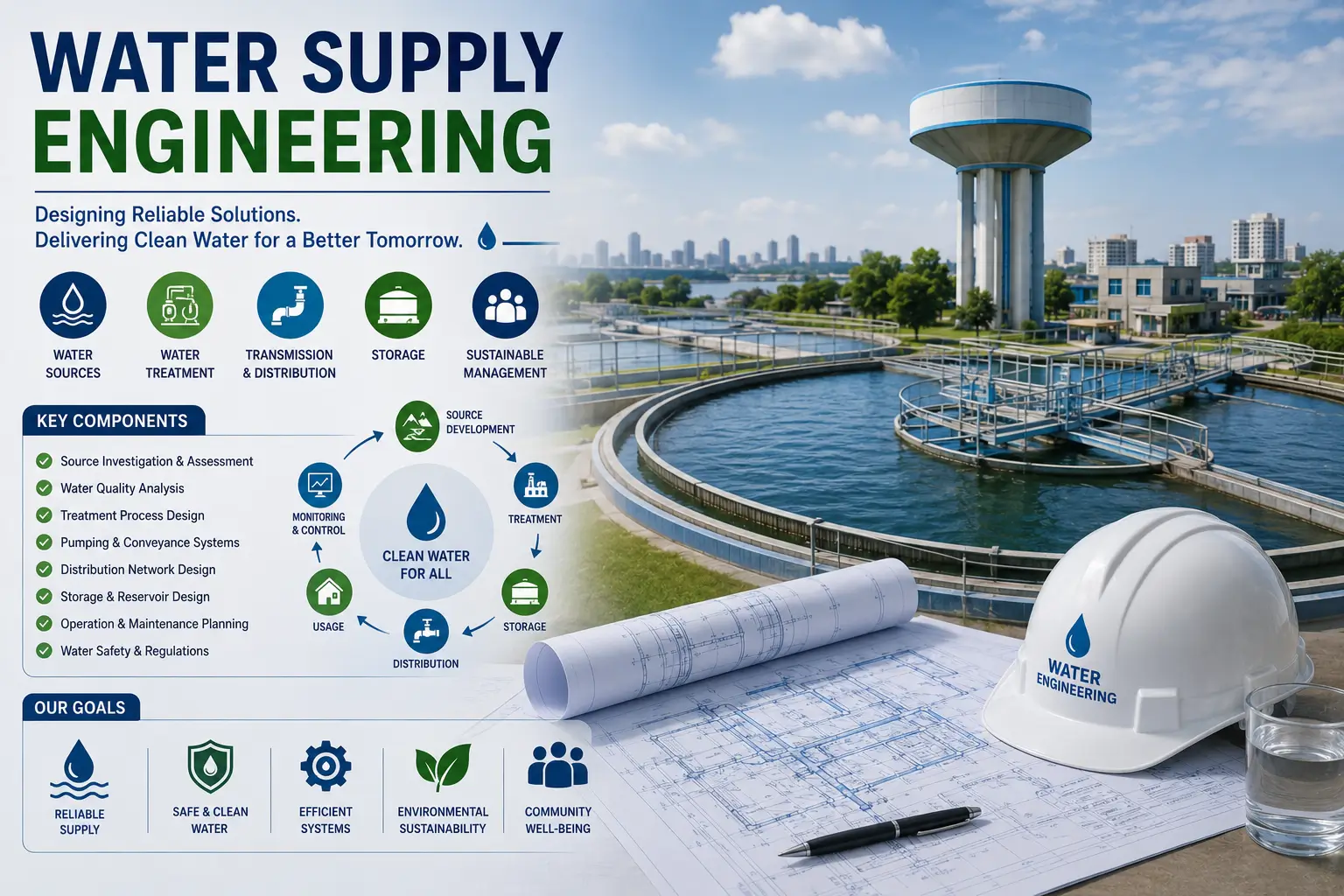
Water Supply Engineering Course
The Water Supply Engineering Course is designed to help learners understand the planning, design, operation, and management of water supply systems. Moreover, the course provides practical knowledge of water sources, treatment processes, distribution networks, hydraulic principles, and sustainable water management. As a result, learners develop the skills required to support safe and efficient water supply infrastructure.
Water Supply Engineering Course Overview
Water is one of the most essential resources for human life and economic development. Therefore, effective water supply systems are critical for public health, industrial growth, and environmental sustainability. This Water Supply Engineering Course provides a comprehensive understanding of modern water supply infrastructure and engineering practices.
In addition, learners explore water treatment technologies, distribution systems, and water quality management techniques. Furthermore, they gain practical insights into addressing challenges related to water availability and resource management.
Fundamentals of Water Supply Engineering
The course begins with the fundamentals of water supply engineering. Therefore, students learn the principles of water collection, treatment, storage, and distribution. Moreover, they understand the role of engineering in ensuring reliable access to clean and safe water.
These foundations help learners build strong water engineering skills.
Water Sources and Resource Management
Identifying and managing water resources is a key aspect of water supply engineering. Consequently, learners study surface water, groundwater, reservoirs, and water conservation methods. In addition, they explore strategies for sustainable water resource utilization.
As a result, students gain valuable resource management expertise.
Water Treatment Processes
Water treatment ensures the safety and quality of drinking water. Therefore, the course covers sedimentation, filtration, disinfection, purification methods, and treatment plant operations. Furthermore, learners understand how treatment processes remove contaminants and improve water quality.
These skills support effective water management systems.
Water Distribution Systems
Water distribution networks deliver treated water to communities and industries. Consequently, students learn the design and operation of pipelines, pumping stations, storage facilities, and distribution systems. In addition, they explore methods for maintaining efficiency and reducing water losses.
These concepts strengthen infrastructure planning capabilities.
Hydraulic Principles and Pipeline Design
Hydraulic engineering is essential for water movement and distribution. Therefore, learners study fluid mechanics, flow calculations, pressure management, and pipeline design principles. Moreover, they understand how hydraulic systems support reliable water supply operations.
As a result, students develop practical engineering knowledge.
Water Quality Monitoring
Maintaining water quality is a critical responsibility of water engineers. Consequently, the course introduces water testing methods, quality standards, contamination control, and monitoring systems. In addition, learners explore regulatory requirements and public health considerations.
These skills support safe water delivery.
Sustainable Water Management
Sustainability is an important focus of modern water engineering. Therefore, students learn water conservation strategies, wastewater reuse, rainwater harvesting, and environmental protection practices. Furthermore, they understand how sustainable approaches improve long-term water security.
These concepts strengthen environmental management capabilities.
Practical Learning and Case Studies
The Water Supply Engineering Course includes practical assignments, design exercises, and real-world case studies. Moreover, learners analyze successful water infrastructure projects and apply engineering concepts to realistic scenarios.
As a result, students gain hands-on experience and industry-relevant knowledge.
Learning Outcomes
By the end of this course, learners will be able to:
- Understand water supply engineering principles and systems.
- Design and manage water distribution networks.
- Apply water treatment and purification techniques.
- Monitor and maintain water quality standards.
- Use hydraulic principles in water infrastructure planning.
- Support sustainable water management initiatives.
- Contribute to safe and efficient water supply projects.
Who Should Enroll?
This course is ideal for civil engineers, environmental engineers, infrastructure professionals, government officials, students, and individuals interested in water resource management. Moreover, it benefits anyone seeking knowledge of water supply systems and engineering practices.
Conclusion
The Water Supply Engineering Course provides comprehensive training in water treatment, distribution systems, hydraulic engineering, and sustainable resource management. Furthermore, it combines theoretical concepts with practical applications. As a result, learners gain the expertise needed to support reliable and efficient water supply infrastructure.
9. FAQ SECTION
What is a Water Supply Engineering Course?
A Water Supply Engineering Course teaches water treatment, distribution systems, hydraulic principles, and water resource management.
Who can enroll in this course?
Students, engineers, infrastructure professionals, and beginners can enroll.
Do I need prior engineering experience?
No, beginners can learn the fundamentals, although engineering knowledge can be beneficial.
What skills will I learn?
You will learn water treatment, distribution system design, hydraulic calculations, and water quality management.
Is practical training included?
Yes, the course includes projects, case studies, and engineering exercises.
Will I receive a certificate?
Yes, learners receive a course completion certificate.
Does the course cover water treatment plants?
Yes, water treatment plant operations are an important part of the curriculum.
What career opportunities are available?
Career options include Water Supply Engineer, Environmental Engineer, Infrastructure Planner, Water Resource Specialist, and Utility Manager.
Is sustainable water management covered?
Yes, the course includes water conservation and sustainable management practices.
Why should I study Water Supply Engineering?
The course helps develop technical skills needed for water infrastructure development and resource management.



Reviews
There are no reviews yet.