
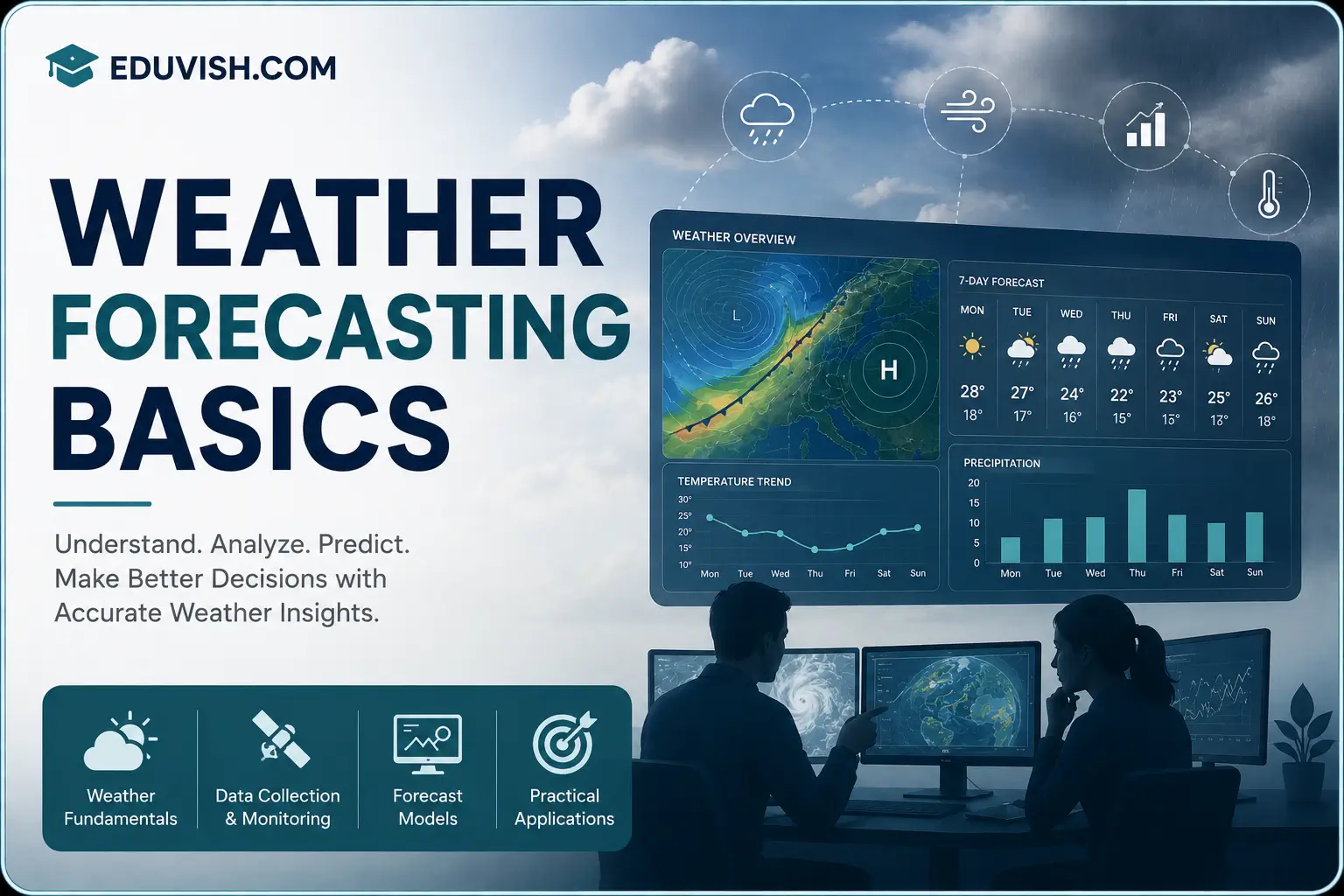
Weather Forecasting Basics is a foundational course designed to introduce learners to the science and techniques behind predicting weather patterns. This program covers the fundamentals of meteorology, atmospheric processes, climate systems, and the tools used in modern forecasting.
Students will gain insights into cloud formation, wind patterns, precipitation, and temperature variations, while also learning how to interpret weather maps, satellite data, and radar imagery. The course emphasizes both theoretical knowledge and practical applications, preparing learners to understand and communicate weather forecasts effectively.
By the end of this course, participants will be able to:
- Understand the principles of meteorology and atmospheric science.
- Analyze weather elements such as temperature, humidity, and pressure.
- Interpret weather maps, satellite images, and radar data.
- Explore forecasting models and prediction techniques.
- Evaluate the impact of climate systems on local and global weather.
- Apply forecasting skills to agriculture, aviation, and disaster management.
- Communicate weather information clearly for public and professional use.
This course is ideal for students, environmentalists, aviation professionals, and anyone interested in understanding how weather forecasts are made. With case studies, practical assignments, and real-world applications, you’ll gain the confidence to interpret weather data and predict atmospheric changes.
FAQ SECTION
1. What is weather forecasting?
Weather forecasting is the scientific process of predicting future atmospheric conditions based on weather observations and data analysis.
2. Is this course suitable for beginners?
Yes. The course is designed for beginners and requires no prior meteorology experience.
3. What topics are covered?
Topics include meteorology, weather systems, forecasting methods, weather maps, climate concepts, and atmospheric science.
4. Will I learn how meteorologists predict weather?
Yes. The course explains forecasting techniques, data collection methods, and weather analysis processes.
5. Do I need a science background?
No. The course introduces concepts in an easy-to-understand manner for all learners.
6. What is the difference between weather and climate?
Weather refers to short-term atmospheric conditions, while climate describes long-term weather patterns.
7. Are weather maps included in the course?
Yes. Learners will understand weather charts, symbols, pressure systems, and forecasting maps.
8. Is certification provided?
Yes. Learners receive a certificate after successfully completing the course.
9. Who should enroll in this course?
Students, teachers, environmental enthusiasts, researchers, and professionals interested in weather science.
10. Can this course help with environmental careers?
Yes. Weather and climate knowledge are valuable in environmental science, agriculture, disaster management, and research roles.




Reviews
There are no reviews yet.