
Introduction
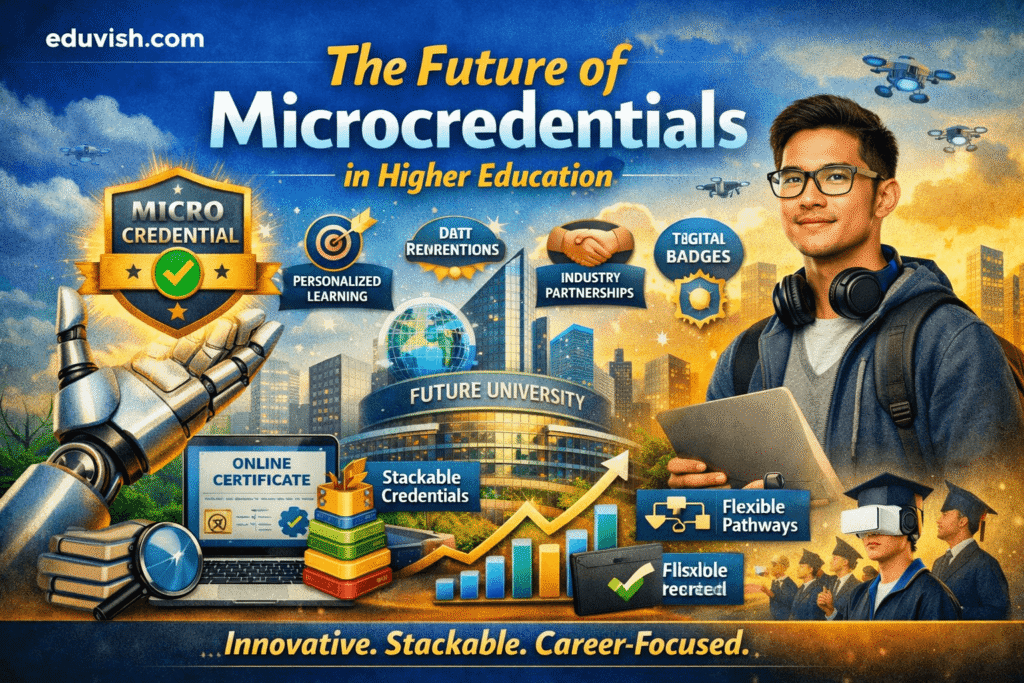
Education is evolving faster than ever. Traditional degrees are no longer the only measure of knowledge or skill. Enter microcredentials — short, focused certifications that validate specific competencies. As universities adapt to the digital age, microcredentials are reshaping the landscape of higher education, offering flexibility, relevance, and lifelong learning opportunities
Understanding Micro credentials
- Definition: Microcredentials are compact, skill‑based certifications that demonstrate mastery in a particular area.
- Purpose: They bridge the gap between academic learning and industry needs.
- Format: Delivered online, self‑paced, and often stackable toward larger qualifications.
The Rise of Micro credentials in Higher Education
Universities worldwide are embracing microcredentials to meet the demands of modern learners.
- Global adoption: Institutions like MIT, Harvard, and the University of Melbourne offer microcredential programs.
- Industry collaboration: Courses are co‑created with companies to ensure real‑world relevance.
- Digital transformation: Technology enables personalized learning experiences.
Why Microcredentials Are the Future
a. Flexibility
Learners can study anytime, anywhere, balancing education with work and life.
b. Affordability
Microcredentials cost less than traditional degrees, making education accessible to all.
c. Relevance
They focus on current industry skills — from data analytics to digital marketing.
d. Stackability
Learners can combine multiple microcredentials to build toward diplomas or degrees.
Benefits for Students
- Career advancement: Gain job‑ready skills faster.
- Personalized learning: Choose courses that match career goals.
- Global recognition: Digital badges are accepted by employers worldwide.
- Continuous growth: Lifelong learning becomes achievable.
Benefits for Universities
- Innovation in curriculum: Universities can update programs quickly.
- Expanded reach: Online delivery attracts global learners.
- Industry partnerships: Collaboration enhances credibility.
- Revenue diversification: New income streams through short courses.
Benefits for Employers
- Skill verification: Employers can easily assess candidate competencies.
- Upskilling workforce: Employees stay updated with emerging technologies.
- Reduced training costs: Targeted learning saves time and resources.
Challenges and Solutions
| Challenge | Solution |
|---|---|
| Lack of awareness | Promote through university‑industry campaigns |
| Quality assurance | Accreditation and standardized frameworks |
| Integration with degrees | Stackable pathways and credit recognition |
| Employer acceptance | Collaboration with HR and recruitment platforms |
The Role of Technology
- AI and analytics personalize learning paths.
- Blockchain secures credential verification.
- Virtual reality enhances experiential learning.
- Learning management systems streamline course delivery.
Global Trends Shaping the Future
- Hybrid education models combining degrees and microcredentials.
- Government support through funding and policy frameworks.
- Employer‑driven learning aligning education with workforce needs.
- International collaboration for global recognition.
Predictions for the Next Decade
- Microcredentials will become mainstream in higher education.
- Universities will offer stackable learning pathways.
- Employers will prioritize skills over degrees.
- Digital badges will serve as universal proof of competence.
Conclusion
The future of higher education is flexible, digital, and skill‑focused. Microcredentials empower learners to take control of their education, universities to innovate, and employers to find qualified talent. As technology and collaboration continue to evolve, microcredentials will redefine what it means to learn, teach, and succeed.

