
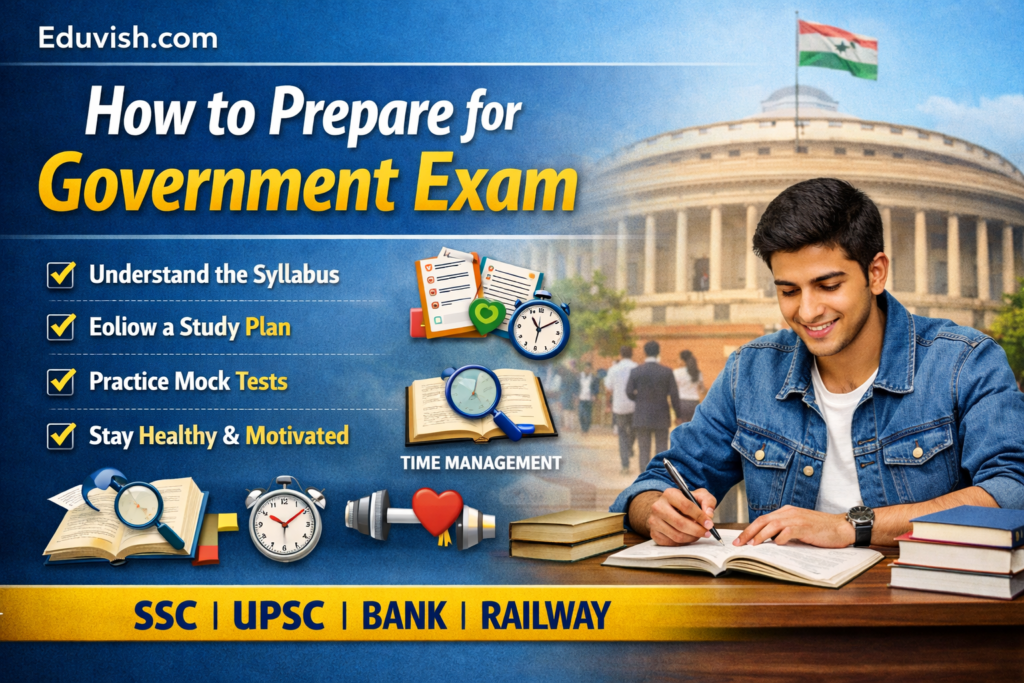
Introduction
Preparing for a government exam is one of the most rewarding yet challenging journeys for students and job seekers in India. With thousands of aspirants competing for limited seats, success requires smart strategy, discipline, and consistency. This guide will help you master the art of preparation for exams like UPSC, SSC, Banking, Railways, and State PSCs — step by step.
Understanding Government Exams
Government exams test your knowledge, aptitude, and decision‑making skills. They are designed to select candidates for various administrative, technical, and clerical roles.
Why Choose a Government Job?
- Job Security: Lifetime stability and pension benefits.
- Respect & Prestige: Government employees hold high social status.
- Work‑Life Balance: Fixed hours and paid leaves.
- Financial Benefits: Regular increments and allowances.
Popular Government Exams
| Exam | Conducting Body | Key Focus |
|---|---|---|
| UPSC | Union Public Service Commission | Civil Services (IAS, IPS, IFS) |
| SSC | Staff Selection Commission | CGL, CHSL, MTS, GD |
| Banking | IBPS, SBI, RBI | PO, Clerk, Assistant |
| Railways | RRB | NTPC, Group D |
| Defense | CAPF, CDS, NDA | Armed Forces |
| State PSCs | State Commissions | Administrative Services |
Step‑by‑Step Preparation Strategy
To crack any government exam, follow these proven steps:
1. Understand the Syllabus and Pattern
- Read the official syllabus carefully.
- Identify core subjects and weightage areas.
- Analyze previous year papers to understand question trends.
- Focus on General Studies, Quantitative Aptitude, Reasoning, and English.
2. Create a Study Plan
- Divide your syllabus into daily, weekly, and monthly goals.
- Allocate more time to difficult subjects.
- Include revision slots and mock tests.
- Stick to your timetable religiously.
3. Gather Quality Study Material
- Use NCERT books for basics.
- Refer to standard guides like Lucent GK, RS Aggarwal Quantitative Aptitude, Word Power Made Easy.
- Follow trusted online platforms for current affairs and quizzes.
4. Strengthen Your Basics
Before jumping into advanced topics, ensure your fundamentals are clear.
- Practice arithmetic and grammar daily.
- Build conceptual clarity in reasoning and general awareness.
- Watch educational YouTube channels for visual learning.
5. Practice Mock Tests & Previous Papers
- Attempt weekly mock tests to simulate exam conditions.
- Analyze your mistakes and improve accuracy.
- Solve previous year papers to understand difficulty levels.
6. Revise Regularly
- Prepare short notes for quick revision.
- Use flashcards for formulas and GK facts.
- Revise at least once every week.
7. Stay Healthy & Motivated
- Maintain a balanced diet and proper sleep.
- Exercise or meditate to reduce stress.
- Stay positive — consistency beats talent.
Advanced Preparation Tips
Focus on Weak Areas
Identify subjects where you score less and dedicate extra time to them.
Improve Speed & Accuracy
- Practice under timed conditions.
- Learn shortcuts for quantitative problems.
- Avoid guesswork — accuracy matters more than attempts.
Stay Updated with Current Affairs
- Read newspapers like The Hindu or Indian Express.
- Follow monthly magazines like Pratiyogita Darpan.
- Watch daily news summaries or GK capsules online.
Join Coaching or Online Courses
If self‑study feels overwhelming, enroll in a reputed coaching institute or online course for structured guidance.
Group Study & Peer Learning
Discuss topics with friends or join online study groups. Sharing knowledge helps reinforce learning.
Common Mistakes to Avoid
- Ignoring the syllabus and studying irrelevant topics.
- Neglecting current affairs.
- Overloading yourself with too many books.
- Skipping revision.
- Losing motivation midway.

