
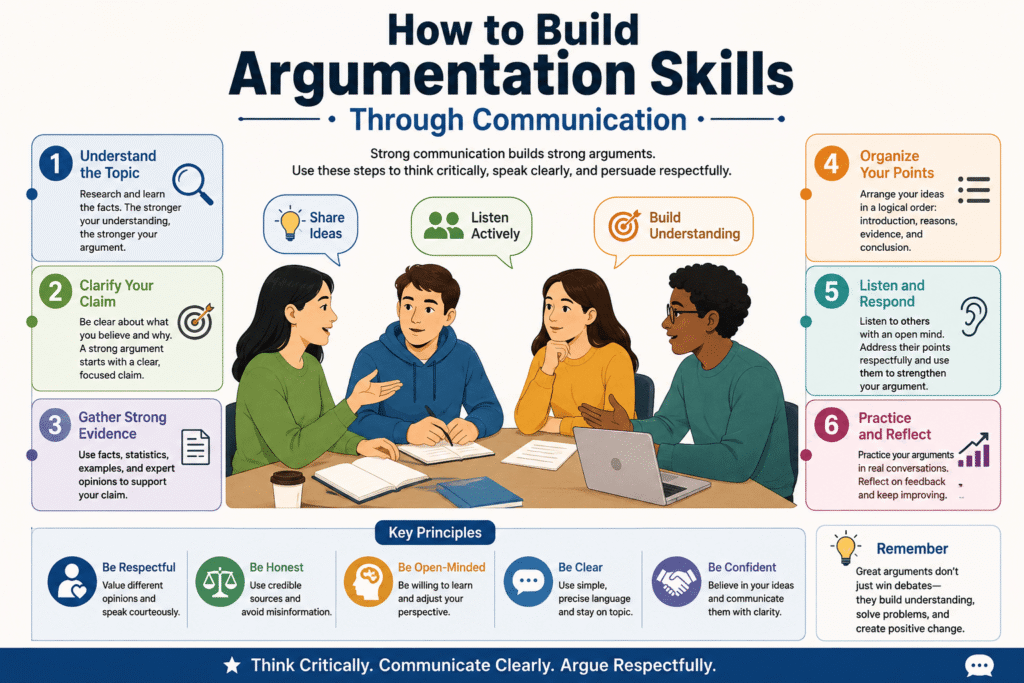
Introducation
Effective communication is more than just speaking—it’s about expressing ideas logically, persuasively, and respectfully. One of the most valuable communication abilities students can develop is argumentation skills. These skills help you present your thoughts clearly, defend your opinions with evidence, and engage in meaningful discussions.
In this article, we’ll explore how communication helps build argumentation skills, why they matter, and practical ways to strengthen them for academic and personal success.
1. What Are Argumentation Skills?
Argumentation skills involve presenting ideas logically and supporting them with evidence. They help you analyze, reason, and persuade others effectively.
Key Components:
- Clarity: Expressing ideas in a structured way.
- Evidence: Supporting claims with facts or examples.
- Logic: Connecting ideas coherently.
- Respect: Listening and responding thoughtfully.
SEO Keywords: argumentation skills for students, communication and critical thinking, how to build persuasive communication
2. The Connection Between Communication and Argumentation
Communication is the foundation of argumentation. Without clear communication, even strong arguments lose impact.
How They Work Together:
- Communication conveys your reasoning effectively.
- Argumentation strengthens your ability to discuss and debate.
- Both help in academic writing, presentations, and teamwork.
Result: You become a confident speaker and thinker.
3. Why Argumentation Skills Matter for Students
Strong argumentation skills help students:
- Express opinions confidently.
- Participate actively in discussions.
- Write persuasive essays and reports.
- Develop critical thinking and problem-solving abilities.
SEO Keywords: importance of argumentation in education, student communication skills, critical thinking through debate
4. Elements of a Strong Argument
Every effective argument has three essential parts:
| Element | Description | Example |
|---|---|---|
| Claim | The main point or statement. | “Group projects improve teamwork skills.” |
| Evidence | Facts or examples supporting the claim. | “Studies show students learn better through collaboration.” |
| Reasoning | Explains how evidence supports the claim. | “Working together helps students share diverse perspectives.” |
Result: A well-structured argument is logical, persuasive, and credible.
5. Developing Argumentation Through Communication
Communication helps refine argumentation by encouraging dialogue and feedback.
Tips:
- Discuss ideas openly with peers.
- Ask questions to understand different viewpoints.
- Practice explaining your reasoning clearly.
SEO Keywords: communication techniques for argumentation, how to improve debate skills, effective student communication
6. Active Listening: The Secret to Better Arguments
Listening is as important as speaking. Active listening helps you understand others’ perspectives and respond thoughtfully.
Tips:
- Focus on the speaker without interrupting.
- Summarize their points before replying.
- Ask clarifying questions.
Result: You’ll build empathy and stronger counterarguments.
7. Using Evidence and Logic
Strong arguments rely on facts, not emotions.
Tips:
- Use credible sources like research papers or statistics.
- Avoid assumptions or generalizations.
- Connect evidence logically to your main point.
SEO Keywords: logical reasoning for students, evidence-based communication, academic argumentation skills
8. Respectful Communication in Argumentation
Respectful communication ensures healthy discussions.
Tips:
- Avoid personal attacks or harsh language.
- Use phrases like “I understand your point, but…”
- Focus on ideas, not individuals.
Result: You’ll gain respect and credibility in debates.
9. Building Confidence in Argumentation
Confidence helps you present arguments effectively.
Tips:
- Prepare your points in advance.
- Practice speaking in front of a mirror or group.
- Maintain positive body language.
SEO Keywords: confidence in communication, public speaking for students, argumentation practice tips
10. Body Language and Tone
Non-verbal communication strengthens your arguments.
Tips:
- Maintain eye contact.
- Use gestures naturally.
- Speak clearly and calmly.
Result: Your message becomes more persuasive and engaging.
11. Argumentation in Academic Writing
Writing is another form of communication where argumentation shines.
Tips:
- Start with a clear thesis statement.
- Support each paragraph with evidence.
- Conclude by summarizing your argument.
SEO Keywords: academic writing skills, essay argumentation techniques, student writing improvement
12. Debate and Discussion Practice
Participating in debates helps sharpen argumentation skills.
Tips:
- Research both sides of a topic.
- Anticipate counterarguments.
- Practice responding calmly under pressure.
Result: You’ll learn to think critically and communicate persuasively.
13. Common Mistakes to Avoid
- Relying on emotions instead of facts.
- Ignoring opposing viewpoints.
- Using unclear or vague statements.
- Speaking aggressively or defensively.
Solution: Focus on logic, clarity, and respect.
14. Role of Feedback in Building Argumentation Skills
Feedback helps refine your communication and reasoning.
Tips:
- Ask teachers or peers for constructive criticism.
- Reflect on areas for improvement.
- Apply feedback in future discussions.
SEO Keywords: feedback for communication improvement, student learning through reflection 15. Real-Life Applications of Argumentation Skills
Argumentation isn’t limited to academics—it’s useful everywhere.
Examples:
- Negotiating in group projects.
- Presenting ideas in meetings.
- Making decisions in daily life.
Result: You’ll become a confident communicator and problem solver.
16. How Communication Builds Critical Thinking
Communication encourages questioning, reasoning, and analysis.
Tips:
- Engage in discussions regularly.
- Challenge assumptions respectfully.
- Reflect on different perspectives.
SEO Keywords: critical thinking through communication, student reasoning skills, academic success strategies
17. Steps to Improve Argumentation Skills
- Read and research regularly.
- Practice debates and discussions.
- Listen actively and observe others.
- Write essays or blogs to organize thoughts.
- Seek feedback and keep improving.
Result: Consistent practice leads to mastery.
Conclusion
Building argumentation skills through communication helps students think critically, express ideas clearly, and engage respectfully. By combining logic, evidence, and empathy, you can become a persuasive communicator and a confident leader.
Remember: Strong arguments don’t win by volume—they win by clarity, respect, and reason.

