
Introduction
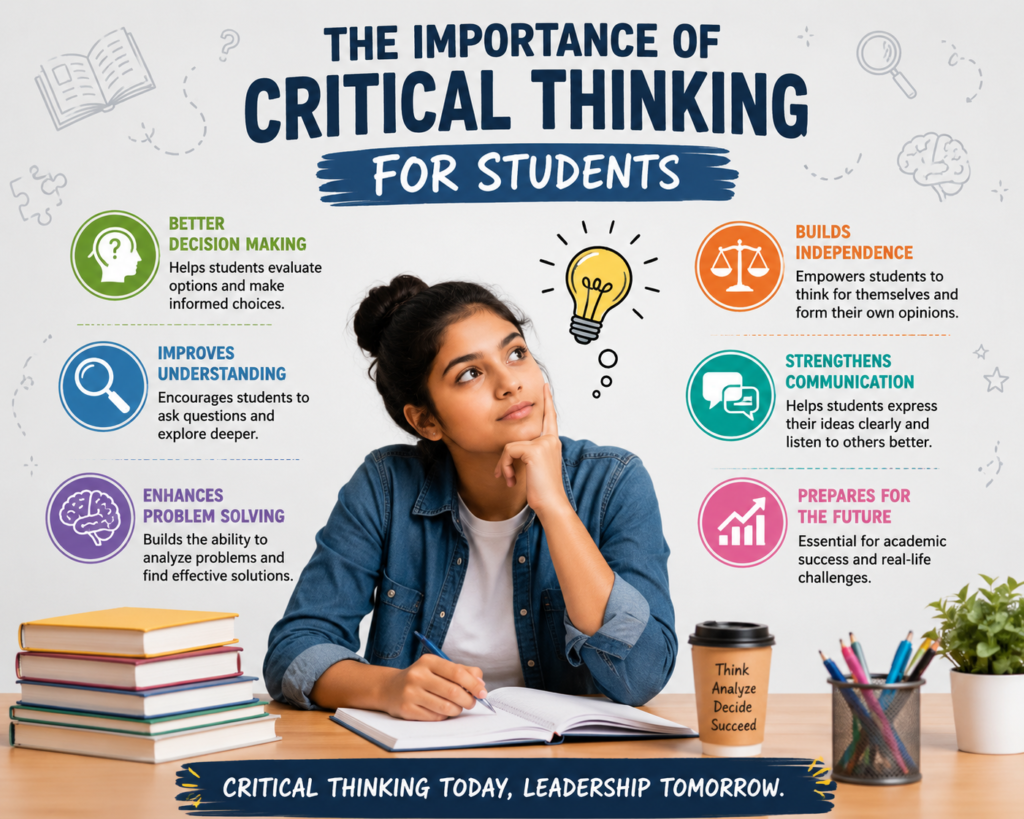
The importance of critical thinking for students cannot be overstated in today’s rapidly changing world. Critical thinking helps students analyze information, evaluate evidence, solve complex problems, and make informed decisions. Understanding the importance of critical thinking for students is essential for academic achievement, career readiness, and lifelong learning..
What is Critical Thinking?
Critical thinking is the process of actively and skillfully conceptualizing, analyzing, synthesizing, and evaluating information to reach a conclusion. It goes beyond memorization and encourages students to question assumptions, identify biases, and explore multiple perspectives.
Why Critical Thinking Matters for Students
- Academic success: Enhances comprehension, research, and writing skills.
- Problem-solving: Helps students tackle complex challenges with logical reasoning.
- Decision-making: Enables informed choices in academics, careers, and personal life.
- Creativity: Encourages innovative ideas by questioning conventional approaches.
- Communication: Improves clarity in expressing thoughts and arguments.
Role of Critical Thinking in Education
- Classroom learning: Encourages active participation and deeper understanding.
- Research skills: Helps students evaluate sources and avoid misinformation.
- Collaborative projects: Promotes teamwork by respecting diverse perspectives.
- Exams and assessments: Strengthens analytical writing and problem‑solving in tests.
Real-Life Applications
- Career readiness: Employers value critical thinkers for leadership and innovation.
- Digital literacy: Helps students identify fake news and online misinformation.
- Social awareness: Encourages empathy and responsible citizenship.
Strategies to Develop Critical Thinking
- Ask questions: Cultivate curiosity by challenging assumptions.
- Analyze case studies: Apply theoretical knowledge to real scenarios.
- Debates and discussions: Encourage students to defend viewpoints logically.
- Problem-based learning: Engage students in solving real-world issues.
- Reflective journaling: Helps students evaluate their own thought processes.
Benefits of Critical Thinking for Students
| Benefit | Impact on Students |
|---|---|
| Improved learning | Better comprehension and retention |
| Confidence | Stronger decision-making abilities |
| Adaptability | Ability to handle new challenges |
| Leadership | Inspires teamwork and innovation |
| Lifelong skill | Valuable beyond academics |

