
Introduction
Economic reforms are not just about numbers, policies, or financial systems — they are deeply influenced by politics. Political ideologies, leadership decisions, and governance structures shape how reforms are designed, implemented, and sustained. Understanding the role of politics in economic reforms helps us see why some nations succeed in transforming their economies while others struggle.
🗳️ What Are Economic Reforms?
Economic reforms are changes in policies and regulations aimed at improving a country’s economy. They often involve:
- Liberalization: Opening markets to competition.
- Privatization: Shifting ownership from public to private hands.
- Globalization: Integrating with the world economy.
- Fiscal reforms: Adjusting taxation and government spending.
- Monetary reforms: Managing inflation and interest rates.
🏛️ Role of Politics in Economic Reforms
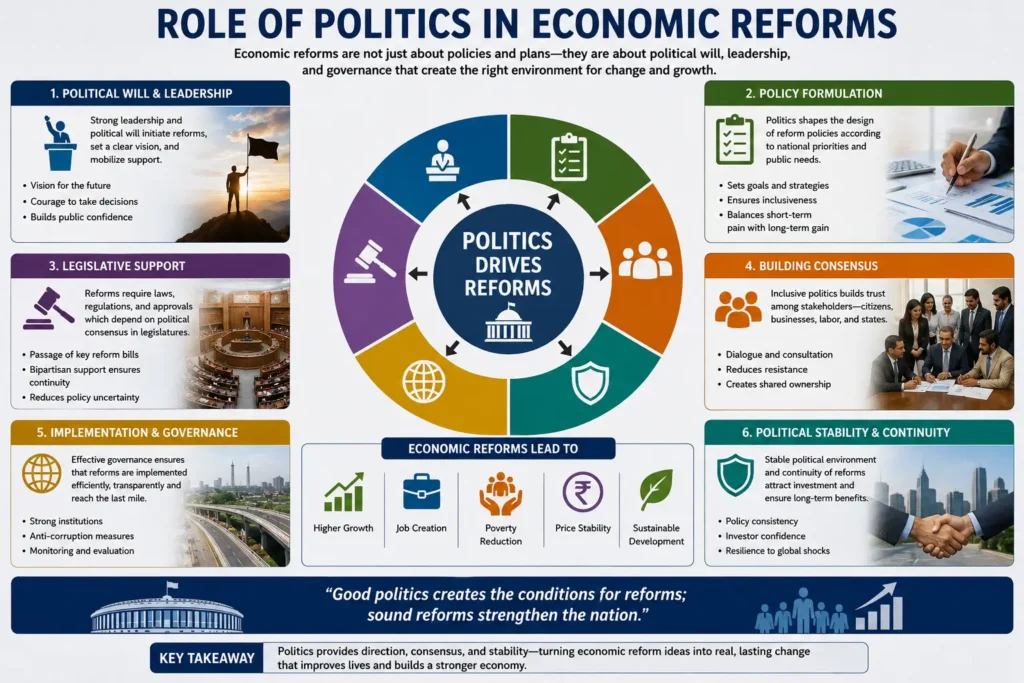
Politics determines the direction, speed, and success of reforms.
Key Political Influences
- Leadership vision: Strong leaders drive bold reforms.
- Political ideology: Left‑leaning governments may focus on welfare, while right‑leaning ones emphasize free markets.
- Public opinion: Politicians balance reforms with voter expectations.
- International relations: Global alliances influence trade and investment policies.
- Institutional strength: Parliaments, courts, and bureaucracies ensure reforms are implemented fairly.
📜 Historical Examples
1. India’s 1991 Economic Reforms
Political will during a financial crisis led to liberalization, privatization, and globalization.
2. China’s Open Door Policy
Political leadership under Deng Xiaoping transformed China into a global economic powerhouse.
3. Eastern Europe Post‑Cold War
Political transitions from communism to democracy enabled market reforms.
⚖️ Politics vs Economics
While economists design reforms, politicians decide whether they are feasible.
- Economists may recommend subsidy cuts, but politicians weigh voter backlash.
- Trade liberalization may boost GDP, but political leaders consider national security.
🌱 Politics and Sustainable Development
Modern reforms are shaped by political commitments to sustainability.
- Green policies encourage renewable energy.
- Social equity ensures reforms benefit all citizens.
- Global agreements like the Paris Accord influence national policies.
🚨 Challenges in Political Influence
- Populism: Short‑term political gains may hinder long‑term reforms.
- Corruption: Weak governance undermines reform success.
- Political instability: Frequent government changes delay reforms.
- Global pressures: International politics may force unwanted reforms.
✅ Conclusion
Politics is the engine behind economic reforms. Without political will, reforms remain on paper. Successful reforms require visionary leadership, strong institutions, and public trust.
By understanding the role of politics in economic reforms, we can appreciate how nations balance growth, equity, and stability in a complex global environment

