
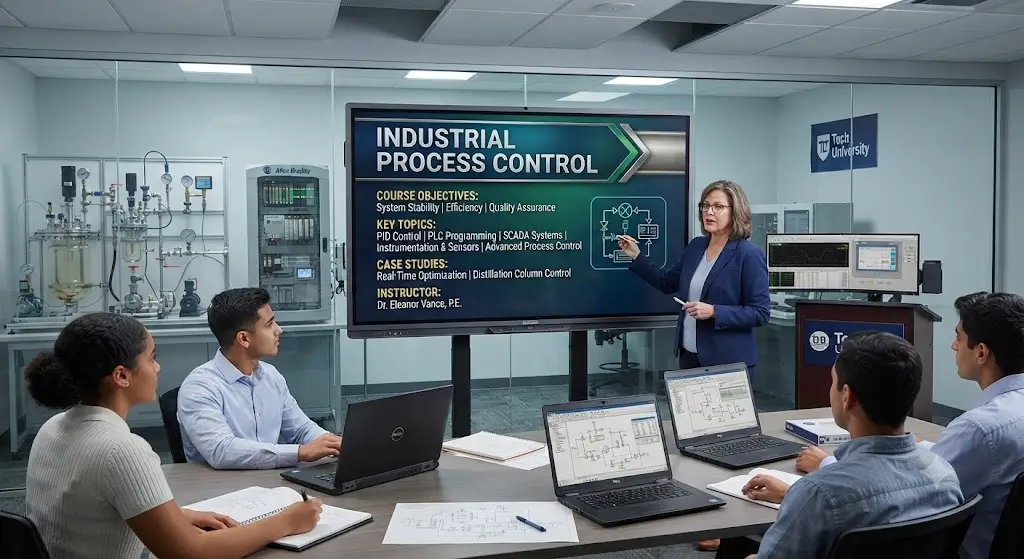
Industrial Process Control Course
The Industrial Process Control Course is designed to help engineers, technicians, automation professionals, maintenance personnel, production supervisors, plant operators, manufacturing professionals, engineering students, and aspiring industrial specialists develop the knowledge and practical skills required to monitor, control, and optimize industrial processes. Process control systems play a vital role in improving productivity, ensuring product quality, reducing operational risks, and maintaining safe industrial operations.
This course introduces the core concepts of industrial process control, including process variables, industrial instrumentation, sensors, transmitters, controllers, PID control, PLC fundamentals, SCADA systems, industrial automation, process monitoring, troubleshooting, safety standards, and control system optimization. Learners will gain practical knowledge of controlling industrial operations efficiently using modern automation technologies.
Whether you work in manufacturing, oil and gas, power generation, pharmaceuticals, food processing, chemicals, water treatment, mining, or other industrial sectors, this course provides a comprehensive foundation in industrial process control.
Course Overview
The course explores the principles of monitoring and controlling industrial processes using instrumentation and automation systems. Learners will understand how process control improves operational efficiency, minimizes process variation, enhances safety, and supports continuous production.
The curriculum combines engineering theory with practical examples, industrial case studies, automation concepts, and industry best practices to prepare learners for careers in industrial automation and process engineering.
What You Will Learn
By completing this course, you will be able to:
- Understand industrial process control fundamentals.
- Identify process variables.
- Understand industrial instrumentation.
- Work with sensors and transmitters.
- Explain control loop operation.
- Understand PID control principles.
- Learn PLC fundamentals.
- Understand SCADA systems.
- Monitor industrial processes.
- Improve process efficiency.
- Support industrial automation.
- Apply safety practices.
- Troubleshoot control systems.
- Improve operational reliability.
- Build automation knowledge.
Course Curriculum
The curriculum begins with process control fundamentals before progressing through instrumentation, sensors, process variables, controllers, PID control, PLC basics, SCADA systems, industrial automation, troubleshooting, safety, case studies, and Industry 4.0 concepts.
Practical learning activities help learners understand how industrial control systems operate in real manufacturing and processing environments.
Skills You Will Gain
After completing the course, you will develop skills in:
- Industrial Process Control
- Industrial Instrumentation
- Process Monitoring
- PLC Fundamentals
- SCADA Systems
- PID Control
- Control Loop Analysis
- Automation Systems
- Sensor Technology
- Process Optimization
- Industrial Troubleshooting
- Operational Safety
- Data Monitoring
- Manufacturing Automation
- Engineering Problem-Solving
Benefits of the Course
This course helps learners improve industrial process efficiency, strengthen automation knowledge, enhance production quality, reduce operational downtime, improve workplace safety, and support digital transformation initiatives. Strong process control skills contribute to reliable production systems and sustainable industrial growth.
These competencies are highly valued across manufacturing plants, oil and gas companies, power generation facilities, pharmaceutical manufacturers, food processing industries, chemical plants, water treatment facilities, mining operations, engineering firms, and automation companies.
Who Should Enroll
This course is ideal for:
- Industrial Engineers
- Automation Engineers
- Mechanical Engineers
- Electrical Engineers
- Instrumentation Engineers
- Maintenance Technicians
- Plant Operators
- Production Supervisors
- Manufacturing Professionals
- Engineering Students
- PLC Technicians
- Process Engineers
- Industrial Technicians
- Plant Managers
- Anyone interested in industrial automation
Career Opportunities
After completing the Industrial Process Control Course, learners may strengthen their qualifications for roles such as:
- Process Control Engineer
- Automation Engineer
- Instrumentation Engineer
- PLC Programmer (Entry Level)
- SCADA Operator
- Process Engineer
- Manufacturing Engineer
- Plant Operator
- Industrial Automation Technician
- Maintenance Engineer
These skills are valuable across manufacturing, oil and gas, power generation, pharmaceuticals, food processing, chemical industries, water treatment, mining, engineering consulting, and industrial automation companies.
Certification Details
Upon successful completion, learners receive a Certificate of Completion recognizing their expertise in Industrial Process Control and automation fundamentals. This certification enhances your professional profile and supports career advancement in industrial automation, manufacturing, engineering, instrumentation, maintenance, process engineering, and plant operations.
If you want to understand industrial automation, improve process efficiency, and build expertise in process control systems, the Industrial Process Control Course provides practical, industry-relevant knowledge for today’s industrial environments.
FAQ SECTION
1. What is the Industrial Process Control Course?
It teaches the principles of industrial process control, including instrumentation, sensors, PLC basics, SCADA systems, PID control, automation, and process monitoring.
2. Is this course suitable for beginners?
Yes. The course starts with process control fundamentals and is suitable for beginners, engineering students, technicians, and industry professionals.
3. What topics are covered?
Industrial instrumentation, sensors, transmitters, control loops, PID control, PLC fundamentals, SCADA systems, automation, process monitoring, troubleshooting, and industrial safety.
4. Do I need previous engineering experience?
No. The course is designed for beginners, students, technicians, engineers, maintenance personnel, and anyone interested in industrial automation.
5. Is the course online?
Yes. The course is fully online and self-paced.
6. Will I receive a certificate?
Yes. A certificate is awarded after successfully completing the course.
7. Who should enroll?
Industrial engineers, automation engineers, instrumentation professionals, technicians, plant operators, production supervisors, engineering students, and manufacturing professionals.
8. What skills will I gain?
Industrial automation, process monitoring, PLC basics, SCADA fundamentals, PID control, instrumentation, troubleshooting, process optimization, operational safety, and engineering problem-solving.
9. Can this course help my career?
Yes. Industrial process control skills are highly valued across manufacturing, oil and gas, pharmaceuticals, power generation, food processing, chemical industries, mining, engineering consulting, and automation companies.
10. Why is Industrial Process Control important?
Industrial Process Control helps organizations maintain consistent production, improve product quality, reduce operational costs, enhance workplace safety, optimize process performance, minimize downtime, and support smart manufacturing and Industry 4.0 initiatives.



Reviews
There are no reviews yet.