
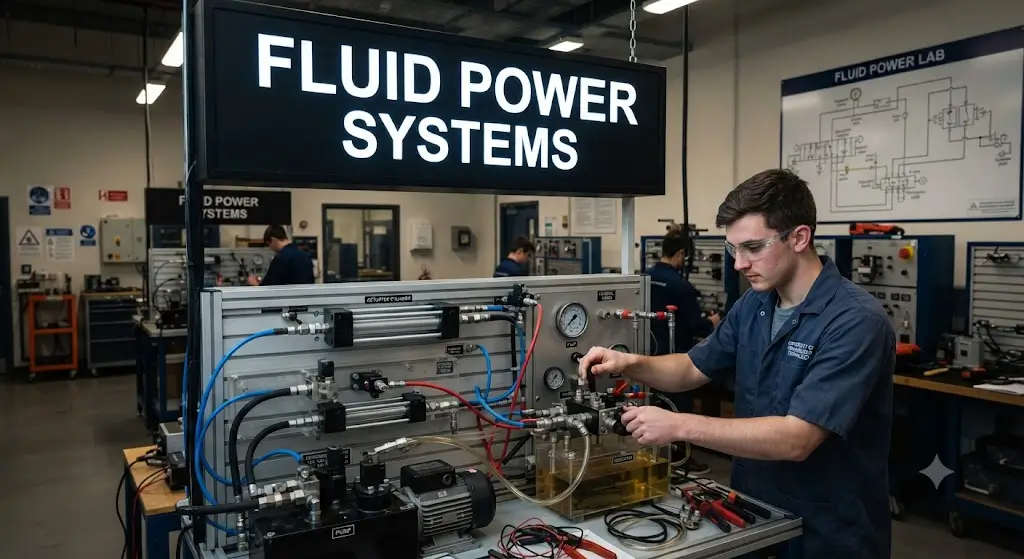
Introduction to Fluid Power Systems
The Fluid Power Systems Course is a professional training program designed to help learners understand how hydraulic and pneumatic technologies are used to transmit power and control machinery. Fluid power systems are widely used in manufacturing, construction, aerospace, automotive, agriculture, and industrial automation.
Fluid power systems utilize pressurized liquids or gases to generate force and motion. Hydraulic systems provide high power and precision, while pneumatic systems offer speed, cleanliness, and cost-effective automation. Professionals in this field design, operate, maintain, and troubleshoot these systems to ensure reliable performance.
This course combines fluid mechanics, hydraulic engineering, pneumatic technology, system design, and industrial maintenance to provide practical knowledge applicable across various engineering industries.
Why Fluid Power Systems Matter
Fluid power systems play a vital role in powering machinery and industrial equipment. Properly designed systems improve efficiency, reduce downtime, enhance safety, and increase productivity.
Understanding hydraulic and pneumatic systems enables engineers and technicians to optimize machine performance, minimize maintenance costs, and support automation initiatives. These skills are essential for modern industrial operations.
The Fluid Power Systems Course enables learners to develop practical expertise in designing, analyzing, and maintaining fluid-powered equipment.
Course Overview
The Fluid Power Systems Course introduces learners to the principles, components, and applications of hydraulic and pneumatic systems.
Participants begin by studying fluid mechanics fundamentals and power transmission concepts. The course explores pumps, compressors, valves, cylinders, motors, and control systems.
Learners also study hydraulic and pneumatic circuit design, troubleshooting techniques, preventive maintenance, and industrial safety standards.
Practical case studies demonstrate how fluid power systems are implemented across manufacturing plants, heavy equipment, and automated production facilities.
Topics Covered
Throughout the Fluid Power Systems Course, learners will study:
Fluid Power Fundamentals
Understand the principles of hydraulic and pneumatic power transmission.
Hydraulic Systems
Learn the operation of hydraulic pumps, cylinders, motors, and valves.
Pneumatic Systems
Study compressed air systems and pneumatic actuators.
Fluid Mechanics Basics
Understand pressure, flow, force, and energy relationships.
Hydraulic and Pneumatic Circuits
Design and interpret industrial fluid power circuits.
Control Valves
Learn pressure, flow, and directional control techniques.
System Components
Study reservoirs, filters, compressors, accumulators, and actuators.
Maintenance and Troubleshooting
Diagnose faults and improve system reliability.
Industrial Automation Applications
Integrate fluid power with automated manufacturing systems.
Safety and Energy Efficiency
Apply best practices for safe and efficient system operation.
Skills You Will Gain
After completing the Fluid Power Systems Course, learners will develop valuable professional skills including:
- Hydraulic system design and analysis
- Pneumatic system operation
- Fluid mechanics fundamentals
- Hydraulic circuit interpretation
- Pneumatic circuit design
- Industrial maintenance techniques
- System troubleshooting
- Preventive maintenance planning
- Industrial automation integration
- Technical problem-solving
- Engineering analysis
- Equipment reliability improvement
- Safety compliance
- Technical documentation
- Performance optimization
These competencies are valuable across manufacturing, automotive, aerospace, construction, mining, agriculture, and industrial automation sectors.
Benefits of the Course
The Fluid Power Systems Course provides practical knowledge for designing, operating, and maintaining hydraulic and pneumatic systems.
Participants gain confidence in diagnosing system faults, improving operational efficiency, and supporting industrial automation projects. The course also strengthens engineering analysis, maintenance planning, and technical decision-making skills.
As industries increasingly rely on automated and high-performance machinery, professionals with fluid power expertise remain in strong demand.
Who Should Enroll?
This course is suitable for:
- Mechanical engineers
- Industrial engineers
- Maintenance engineers
- Automation engineers
- Hydraulic technicians
- Pneumatic system technicians
- Manufacturing professionals
- Engineering students
- Plant maintenance personnel
- Technical supervisors
Basic engineering knowledge is recommended.
Career Opportunities
After completing the Fluid Power Systems Course, learners may pursue careers such as:
- Hydraulic Engineer
- Pneumatic Systems Engineer
- Mechanical Design Engineer
- Maintenance Engineer
- Industrial Automation Engineer
- Manufacturing Engineer
- Field Service Engineer
- Plant Maintenance Supervisor
- Fluid Power Technician
- Reliability Engineer
- Industrial Equipment Engineer
- Process Engineer
- Automation Technician
- Engineering Consultant
- Chief Maintenance Engineer (future path)
Certification
Upon successful completion of the Fluid Power Systems Course, learners receive a professional certificate recognizing their expertise in hydraulic systems, pneumatic systems, fluid power design, maintenance, and industrial automation. This certification supports career advancement across manufacturing, engineering, automation, and maintenance industries.
Frequently Asked Questions (FAQs)
1. What is the Fluid Power Systems Course?
It teaches the principles, design, operation, and maintenance of hydraulic and pneumatic systems.
2. Who should enroll in this course?
Mechanical engineers, technicians, maintenance professionals, and engineering students can benefit.
3. Do I need prior experience?
Basic engineering knowledge is recommended, but the course is structured for both beginners and working professionals.
4. What topics are covered?
Hydraulics, pneumatics, fluid mechanics, circuit design, maintenance, troubleshooting, and industrial automation.
5. Is this course practical?
Yes. It includes practical concepts, industrial applications, and real-world case studies.
6. Will I learn hydraulic and pneumatic circuit design?
Yes. Circuit design and analysis are key components of the course.
7. How does this help my career?
It develops industry-relevant skills for engineering, manufacturing, automation, and maintenance roles.
8. Does it include maintenance and troubleshooting?
Yes. Preventive maintenance and fault diagnosis techniques are covered.
9. Can this improve my job opportunities?
Yes. Fluid power expertise is highly valued across multiple engineering industries.
10. What industries use fluid power systems?
Manufacturing, automotive, aerospace, construction, mining, agriculture, and industrial automation.





Reviews
There are no reviews yet.