
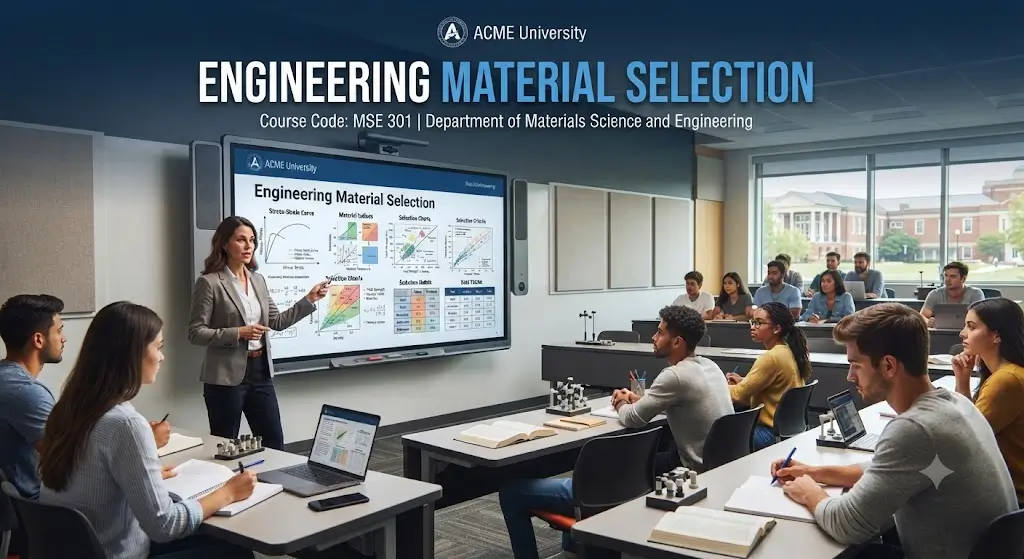
Introduction to Engineering Material Selection
The Engineering Material Selection Course is a professional training program designed to help learners understand the principles and processes involved in selecting engineering materials for different applications. Material selection plays a critical role in ensuring product performance, reliability, safety, and cost-effectiveness.
Engineering material selection involves evaluating the physical, mechanical, thermal, chemical, and environmental properties of materials while considering manufacturing processes, service conditions, and economic factors. Engineers use systematic selection methods to balance performance requirements with practical constraints.
This course combines materials science, mechanical engineering, manufacturing principles, and design methodologies to provide practical knowledge applicable across automotive, aerospace, construction, energy, biomedical, electronics, and industrial manufacturing sectors.
Why Engineering Material Selection Matters
Selecting the right material directly impacts product quality, structural integrity, durability, and manufacturing efficiency. Poor material selection can lead to premature failures, increased maintenance costs, and reduced operational performance.
Understanding material selection enables engineers to improve product reliability, reduce production costs, support sustainability, and meet regulatory requirements. These skills are essential in modern engineering design and manufacturing.
The Engineering Material Selection Course enables learners to build expertise in evaluating and selecting materials for diverse engineering applications.
Course Overview
The Engineering Material Selection Course introduces learners to material classification, selection criteria, and engineering decision-making processes.
Participants begin by studying the properties and behavior of engineering materials. The course explores metals, polymers, ceramics, composites, and advanced materials.
Learners also study material testing, corrosion resistance, fatigue, wear, thermal properties, manufacturing compatibility, lifecycle assessment, and sustainability.
Practical case studies demonstrate how engineers select materials for products, machinery, structures, and industrial systems.
Topics Covered
Throughout the Engineering Material Selection Course, learners will study:
Engineering Material Fundamentals
Understand the classification and characteristics of engineering materials.
Metals and Alloys
Study ferrous and non-ferrous materials used in engineering.
Polymers and Plastics
Learn about polymer properties and industrial applications.
Ceramics and Composites
Explore advanced materials for high-performance applications.
Mechanical Properties
Evaluate strength, hardness, toughness, ductility, and fatigue resistance.
Thermal and Chemical Properties
Understand heat resistance, conductivity, and corrosion behavior.
Material Testing
Perform and interpret material testing techniques.
Material Selection Methods
Apply systematic approaches to selecting engineering materials.
Sustainability and Lifecycle Assessment
Evaluate environmental impacts and material lifecycle performance.
Engineering Applications
Select materials for mechanical, structural, and manufacturing systems.
Skills You Will Gain
After completing the Engineering Material Selection Course, learners will develop valuable professional skills including:
- Engineering material selection
- Materials science fundamentals
- Mechanical property evaluation
- Material testing interpretation
- Corrosion and wear analysis
- Manufacturing process compatibility
- Failure analysis
- Sustainability assessment
- Engineering design support
- Technical decision-making
- Cost-performance optimization
- Product development support
- Material specification
- Engineering problem-solving
- Quality improvement techniques
These competencies are valuable across automotive, aerospace, manufacturing, construction, biomedical engineering, electronics, energy, and industrial design sectors.
Benefits of the Course
The Engineering Material Selection Course provides practical knowledge for selecting materials that improve product performance, safety, and cost efficiency.
Participants gain confidence in evaluating engineering materials, comparing alternatives, supporting product design, and optimizing manufacturing processes. The course also strengthens analytical thinking and engineering decision-making.
As industries continue to develop advanced products and sustainable solutions, professionals with expertise in material selection remain in high demand.
Who Should Enroll?
This course is suitable for:
- Mechanical engineers
- Materials engineers
- Manufacturing engineers
- Product design engineers
- Industrial engineers
- Quality engineers
- R&D professionals
- Engineering students
- Technical consultants
- Production engineers
Basic engineering knowledge is recommended.
Career Opportunities
After completing the Engineering Material Selection Course, learners may pursue careers such as:
- Materials Engineer
- Mechanical Design Engineer
- Product Development Engineer
- Manufacturing Engineer
- Quality Engineer
- Materials Testing Engineer
- R&D Engineer
- Industrial Engineer
- Product Design Engineer
- Failure Analysis Engineer
- Process Engineer
- Technical Consultant
- Engineering Specialist
- Production Engineer
- Chief Materials Engineer (future path)
Certification
Upon successful completion of the Engineering Material Selection Course, learners receive a professional certificate recognizing their expertise in engineering materials, material selection methodologies, testing techniques, failure analysis, and sustainable engineering practices. This certification supports career advancement across engineering, manufacturing, product development, and materials science.
Frequently Asked Questions (FAQs)
1. What is the Engineering Material Selection Course?
It teaches how to evaluate and select suitable engineering materials for different applications.
2. Who should enroll in this course?
Mechanical engineers, materials engineers, product designers, manufacturing professionals, and engineering students can benefit.
3. Do I need prior experience?
Basic engineering knowledge is recommended, but the course is suitable for beginners and professionals.
4. What topics are covered?
Metals, polymers, ceramics, composites, material properties, testing, corrosion, sustainability, and material selection methods.
5. Is this course practical?
Yes. It includes real-world engineering examples, case studies, and material selection methodologies.
6. Will I learn about different engineering materials?
Yes. The course covers metals, polymers, ceramics, composites, and advanced materials.
7. How does this help my career?
It develops essential skills for engineering design, manufacturing, product development, and materials engineering.
8. Does it include material testing and failure analysis?
Yes. Material testing techniques and failure analysis are important parts of the course.
9. Can this improve my job opportunities?
Yes. Material selection expertise is highly valued across engineering and manufacturing industries.
10. What industries use engineering material selection?
Automotive, aerospace, construction, manufacturing, biomedical engineering, electronics, energy, consumer products, and industrial engineering.




Reviews
There are no reviews yet.