
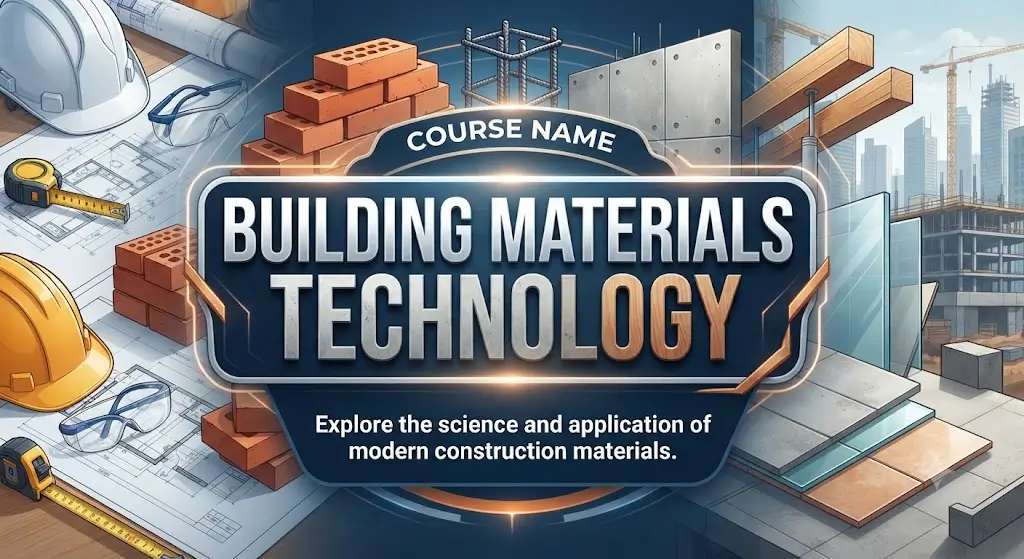
Introduction to Building Materials Technology
The Building Materials Technology Course is a professional training program designed to help learners understand the characteristics, performance, and applications of building materials used in modern construction. Building materials are fundamental to the strength, durability, safety, and sustainability of residential, commercial, and infrastructure projects.
Building materials technology involves studying the physical, mechanical, chemical, and environmental properties of construction materials. Engineers and construction professionals use this knowledge to select suitable materials based on structural requirements, environmental conditions, project budgets, and regulatory standards.
This course combines civil engineering, materials science, construction technology, and quality management to provide practical knowledge applicable across building construction, infrastructure development, industrial facilities, and architectural projects.
Why Building Materials Technology Matters
Selecting the right building materials directly impacts construction quality, structural integrity, energy efficiency, and long-term maintenance costs. Modern construction increasingly requires sustainable, durable, and high-performance materials that meet evolving industry standards.
Understanding building materials technology enables professionals to improve project quality, reduce construction risks, optimize costs, and support environmentally responsible construction practices.
The Building Materials Technology Course enables learners to build expertise in construction material selection, testing, and application.
Course Overview
The Building Materials Technology Course introduces learners to the principles and applications of modern construction materials.
Participants begin by studying the classification and properties of building materials. The course explores cement, concrete, steel, timber, bricks, aggregates, glass, ceramics, polymers, composites, and insulation materials.
Learners also study material testing methods, quality control procedures, sustainability concepts, construction standards, and material performance evaluation.
Practical case studies demonstrate how different materials are selected and applied in residential, commercial, industrial, and infrastructure projects.
Topics Covered
Throughout the Building Materials Technology Course, learners will study:
Building Material Fundamentals
Understand the classification and properties of construction materials.
Cement and Concrete
Study cement types, concrete production, and performance.
Steel and Reinforcement
Learn structural steel applications and reinforcement systems.
Bricks and Masonry Materials
Evaluate masonry materials and construction methods.
Timber and Wood Products
Understand timber properties and building applications.
Aggregates and Composite Materials
Study aggregates, composites, and advanced construction materials.
Glass and Insulation Materials
Explore energy-efficient building materials and insulation systems.
Material Testing and Quality Control
Perform material testing and quality assurance procedures.
Sustainable Building Materials
Apply environmentally friendly material selection practices.
Construction Applications
Understand material selection for different building systems.
Skills You Will Gain
After completing the Building Materials Technology Course, learners will develop valuable professional skills including:
- Building material selection
- Material property evaluation
- Construction material testing
- Concrete technology
- Steel and masonry applications
- Quality control techniques
- Sustainable construction practices
- Material performance analysis
- Technical reporting
- Engineering calculations
- Building standards compliance
- Construction planning
- Cost-effective material selection
- Problem-solving
- Engineering decision-making
These competencies are valuable across construction companies, civil engineering consultancies, architecture firms, infrastructure projects, manufacturing organizations, and government agencies.
Benefits of the Course
The Building Materials Technology Course provides practical knowledge for selecting, testing, and applying construction materials effectively.
Participants gain confidence in evaluating material performance, ensuring construction quality, supporting sustainable building practices, and meeting engineering standards. The course also strengthens analytical thinking and technical expertise.
As construction technologies continue to evolve, professionals with knowledge of building materials remain in high demand.
Who Should Enroll?
This course is suitable for:
- Civil engineers
- Architects
- Construction engineers
- Material engineers
- Site engineers
- Quality control engineers
- Infrastructure professionals
- Engineering consultants
- Engineering students
- Construction supervisors
Basic knowledge of construction or civil engineering is recommended.
Career Opportunities
After completing the Building Materials Technology Course, learners may pursue careers such as:
- Materials Engineer
- Civil Engineer
- Construction Engineer
- Quality Control Engineer
- Building Materials Specialist
- Site Engineer
- Project Engineer
- Construction Consultant
- Materials Testing Engineer
- Infrastructure Engineer
- Product Development Engineer
- Technical Consultant
- Building Inspector
- Technical Manager
- Chief Materials Engineer (future path)
Certification
Upon successful completion of the Building Materials Technology Course, learners receive a professional certificate recognizing their expertise in building materials, construction technology, material testing, quality control, and sustainable construction practices. This certification supports career advancement across civil engineering, construction, architecture, and infrastructure industries.
Frequently Asked Questions (FAQs)
1. What is the Building Materials Technology Course?
It teaches the properties, selection, testing, and applications of modern construction materials.
2. Who should enroll in this course?
Civil engineers, architects, construction professionals, material engineers, and engineering students can benefit.
3. Do I need prior experience?
Basic knowledge of construction or civil engineering is recommended.
4. What topics are covered?
Cement, concrete, steel, timber, bricks, composites, material testing, quality control, and sustainable building materials.
5. Is this course practical?
Yes. It includes real-world construction applications, material testing concepts, and industry case studies.
6. Will I learn about modern construction materials?
Yes. The course covers both traditional and advanced building materials.
7. How does this help my career?
It develops practical skills for construction, civil engineering, architecture, and materials engineering roles.
8. Does it include material testing and quality control?
Yes. Material testing methods and quality assurance are key topics.
9. Can this improve my job opportunities?
Yes. Building materials expertise is highly valued across construction and infrastructure industries.
10. What industries use building materials technology?
Construction, civil engineering, architecture, infrastructure development, manufacturing, real estate, consulting, and government engineering organizations.




Reviews
There are no reviews yet.