
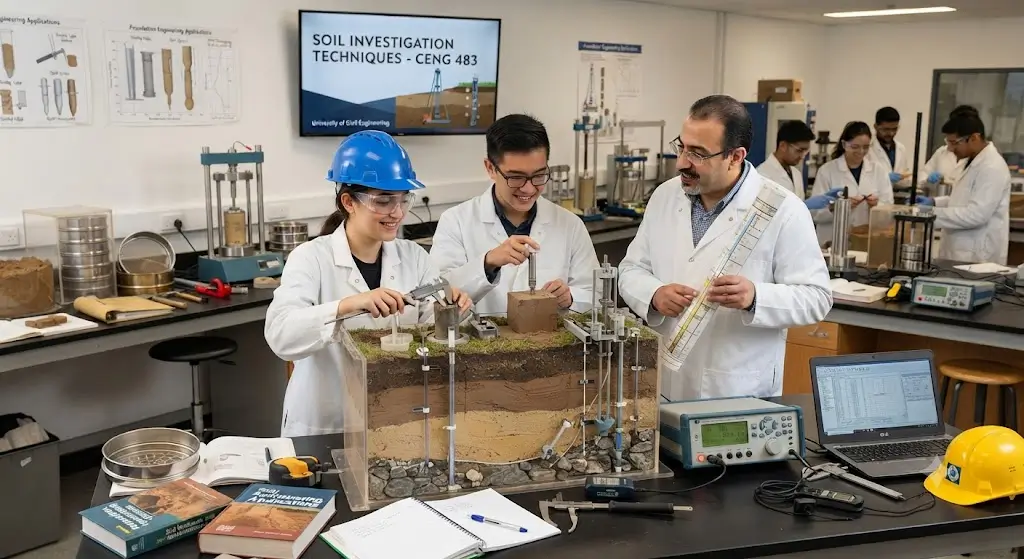
Introduction to Soil Investigation Techniques
The Soil Investigation Techniques Course is a professional training program designed to help learners understand the methods and procedures used to evaluate soil conditions before construction and infrastructure development. Soil investigation is a critical step in geotechnical engineering, providing essential information for designing safe and durable foundations.
Soil investigation involves field exploration, soil sampling, laboratory testing, groundwater evaluation, and data analysis to determine the engineering properties of the ground. Engineers use these findings to assess soil strength, stability, bearing capacity, and settlement characteristics.
This course combines geotechnical engineering principles, field investigation techniques, laboratory analysis, and engineering reporting to provide practical knowledge applicable across construction, transportation, mining, infrastructure, and environmental engineering projects.
Why Soil Investigation Techniques Matter
Accurate soil investigation helps engineers design stable foundations, minimize construction risks, reduce project costs, and improve long-term structural performance. Poor site investigation can lead to foundation failures, excessive settlement, and costly project delays.
Understanding soil investigation techniques enables professionals to make informed engineering decisions, ensure regulatory compliance, and improve construction safety. These skills are fundamental in civil and geotechnical engineering.
The Soil Investigation Techniques Course enables learners to develop expertise in site investigation and geotechnical analysis.
Course Overview
The Soil Investigation Techniques Course introduces learners to modern methods used for geotechnical site investigation and soil evaluation.
Participants begin by studying soil properties, site investigation planning, and exploration methods. The course explores borehole drilling, sampling procedures, field tests, laboratory testing, and groundwater assessment.
Learners also study soil classification, bearing capacity evaluation, foundation recommendations, quality control, and geotechnical reporting.
Practical case studies demonstrate how soil investigations support construction, infrastructure, and land development projects.
Topics Covered
Throughout the Soil Investigation Techniques Course, learners will study:
Soil Investigation Fundamentals
Understand the objectives and importance of soil investigations.
Site Exploration Methods
Learn borehole drilling and trial pit techniques.
Soil Sampling
Study disturbed and undisturbed sampling methods.
Standard Penetration Test (SPT)
Evaluate soil strength using SPT procedures.
Cone Penetration Test (CPT)
Analyze subsurface soil conditions with CPT.
Laboratory Soil Testing
Determine engineering properties through laboratory analysis.
Soil Classification
Classify soils based on engineering standards.
Groundwater Investigation
Assess groundwater levels and site conditions.
Geotechnical Reporting
Prepare professional soil investigation reports.
Foundation Recommendations
Interpret investigation results for foundation design.
Skills You Will Gain
After completing the Soil Investigation Techniques Course, learners will develop valuable professional skills including:
- Soil investigation planning
- Site exploration techniques
- Borehole logging
- Soil sampling methods
- SPT and CPT interpretation
- Laboratory soil testing
- Soil classification
- Geotechnical data analysis
- Groundwater assessment
- Foundation evaluation
- Technical reporting
- Quality control
- Engineering problem-solving
- Construction site assessment
- Geotechnical decision-making
These competencies are valuable across civil engineering firms, geotechnical consultancies, construction companies, infrastructure projects, mining operations, and government agencies.
Benefits of the Course
The Soil Investigation Techniques Course provides practical knowledge for evaluating soil conditions and supporting safe engineering design.
Participants gain confidence in conducting site investigations, interpreting soil data, preparing geotechnical reports, and recommending foundation solutions. The course also strengthens technical analysis and field investigation skills.
As infrastructure and construction projects continue to expand, professionals with expertise in soil investigation remain highly sought after.
Who Should Enroll?
This course is suitable for:
- Civil engineers
- Geotechnical engineers
- Site engineers
- Construction professionals
- Surveyors
- Infrastructure engineers
- Engineering consultants
- Laboratory technicians
- Engineering students
- Project engineers
Basic knowledge of civil engineering is recommended.
Career Opportunities
After completing the Soil Investigation Techniques Course, learners may pursue careers such as:
- Geotechnical Engineer
- Site Investigation Engineer
- Soil Testing Engineer
- Civil Engineer
- Foundation Engineer
- Geotechnical Consultant
- Construction Engineer
- Infrastructure Engineer
- Survey Engineer
- Laboratory Engineer
- Quality Control Engineer
- Field Engineer
- Engineering Consultant
- Project Engineer
- Chief Geotechnical Engineer (future path)
Certification
Upon successful completion of the Soil Investigation Techniques Course, learners receive a professional certificate recognizing their expertise in soil exploration, field testing, laboratory analysis, geotechnical reporting, and foundation assessment. This certification supports career advancement across civil engineering, geotechnical engineering, construction, and infrastructure sectors.
Frequently Asked Questions (FAQs)
1. What is the Soil Investigation Techniques Course?
It teaches methods for investigating and analyzing soil conditions for engineering projects.
2. Who should enroll in this course?
Civil engineers, geotechnical engineers, surveyors, construction professionals, and engineering students can benefit.
3. Do I need prior experience?
Basic knowledge of civil engineering is recommended.
4. What topics are covered?
Site exploration, boreholes, soil sampling, SPT, CPT, laboratory testing, groundwater assessment, and geotechnical reporting.
5. Is this course practical?
Yes. It includes field investigation methods, testing procedures, and real-world engineering applications.
6. Will I learn SPT and CPT testing?
Yes. Standard Penetration Test (SPT) and Cone Penetration Test (CPT) are key topics.
7. How does this help my career?
It develops essential geotechnical engineering and site investigation skills.
8. Does it include laboratory soil testing?
Yes. Laboratory testing and soil property evaluation are covered.
9. Can this improve my job opportunities?
Yes. Soil investigation expertise is highly valued in civil engineering and construction industries.
10. What industries use soil investigation techniques?
Construction, infrastructure, transportation, mining, environmental engineering, geotechnical consulting, and government engineering projects.




Reviews
There are no reviews yet.