
Introduction
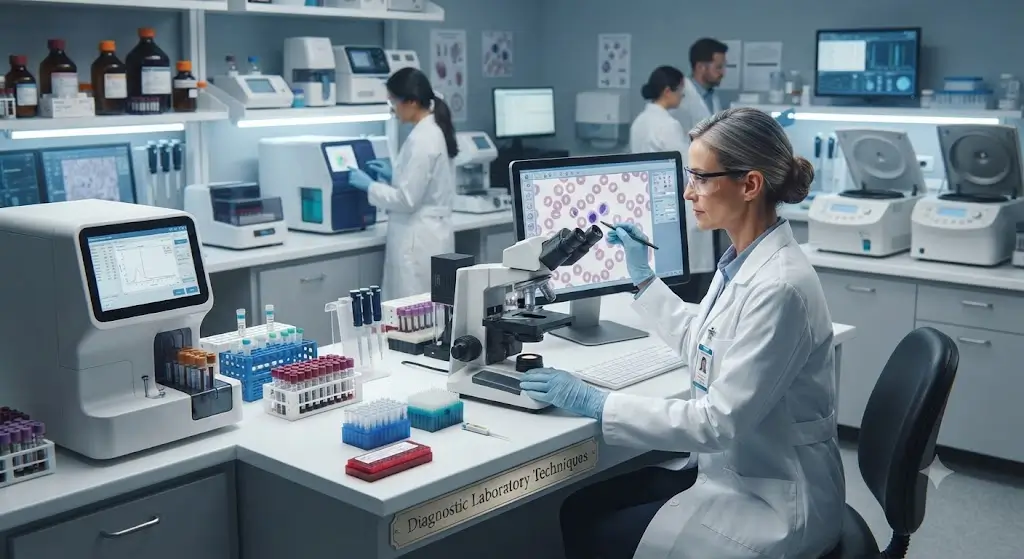
The Diagnostic Laboratory Techniques Course is a comprehensive training program designed to help learners develop the knowledge and practical skills required for modern diagnostic laboratory environments. Diagnostic laboratories play a crucial role in healthcare by performing laboratory tests that assist in disease detection, patient monitoring, treatment planning, and preventive healthcare. Accurate laboratory results support physicians in making informed clinical decisions and contribute significantly to improved patient outcomes.
This course introduces learners to specimen collection, laboratory testing procedures, clinical laboratory instruments, sample processing, quality assurance, laboratory safety, infection prevention, diagnostic reporting, and laboratory documentation. Participants also gain practical knowledge of standard laboratory workflows, quality control procedures, and professional laboratory practices used across healthcare facilities.
Whether you are a medical laboratory student, laboratory technician, healthcare professional, biomedical science graduate, pathology laboratory employee, or someone interested in diagnostic laboratory sciences, this course provides industry-relevant knowledge and practical skills that support career growth and professional development.
Course Overview
Diagnostic laboratory techniques involve the collection, processing, examination, and analysis of patient samples to detect diseases and evaluate health conditions. Modern laboratories use standardized procedures and advanced equipment to ensure reliable and accurate diagnostic results while maintaining patient safety and regulatory compliance.
Throughout this course, learners explore laboratory operations, specimen handling, clinical testing methods, microscopy, laboratory instrumentation, quality assurance systems, biosafety practices, diagnostic reporting, and documentation standards. The curriculum combines theoretical knowledge with practical laboratory applications to prepare learners for professional diagnostic laboratory settings.
What You Will Learn
During this course, learners will study:
- Fundamentals of diagnostic laboratory techniques
- Laboratory organization and workflow
- Specimen collection and transportation
- Sample preparation and processing
- Clinical laboratory instrumentation
- Basic microscopy techniques
- Hematology and clinical chemistry basics
- Microbiology laboratory fundamentals
- Laboratory quality control
- Quality assurance systems
- Laboratory safety and biosafety practices
- Infection prevention and control
- Laboratory documentation and reporting
- Ethical laboratory practices
- Continuous quality improvement
Skills You Will Gain
Upon successful completion of the course, learners will develop valuable skills including:
- Specimen collection and handling
- Laboratory testing procedures
- Sample preparation
- Laboratory documentation
- Diagnostic reporting
- Laboratory quality assurance
- Laboratory safety compliance
- Scientific observation
- Analytical thinking
- Professional communication
These skills are highly valued across hospitals, diagnostic laboratories, pathology laboratories, research centers, biotechnology companies, pharmaceutical organizations, and healthcare institutions.
Benefits of the Course
This course provides learners with a strong understanding of diagnostic laboratory procedures and professional laboratory practices. Participants gain practical knowledge of specimen management, laboratory operations, quality assurance, biosafety, and diagnostic reporting while strengthening technical competence and professional confidence.
The program also enhances scientific observation, documentation accuracy, analytical thinking, teamwork, and problem-solving abilities. As healthcare systems continue to rely on laboratory diagnostics for accurate disease detection, qualified laboratory professionals remain in high demand across the healthcare industry.
Who Should Enroll?
This course is ideal for:
- Medical laboratory students
- Laboratory technicians
- Medical laboratory technologists
- Healthcare professionals
- Biomedical science graduates
- Pathology laboratory staff
- Diagnostic laboratory employees
- Research laboratory assistants
- Biotechnology professionals
- Individuals interested in laboratory sciences
No previous diagnostic laboratory experience is required, making this course suitable for beginners as well as experienced professionals.
Career Opportunities
After completing this course, learners may pursue opportunities such as:
- Diagnostic Laboratory Technician
- Medical Laboratory Technologist
- Clinical Laboratory Assistant
- Pathology Laboratory Technician
- Laboratory Quality Control Associate
- Biomedical Laboratory Executive
- Research Laboratory Assistant
- Laboratory Documentation Specialist
- Healthcare Laboratory Coordinator
- Diagnostic Laboratory Executive
The knowledge gained through this course can be applied across hospitals, diagnostic laboratories, pathology centers, research institutions, biotechnology companies, pharmaceutical organizations, blood banks, and healthcare facilities.
Certification
Upon successful completion of the course, participants receive a professional certification recognizing their understanding of diagnostic laboratory techniques, specimen handling, laboratory testing, quality assurance, laboratory safety, diagnostic reporting, and professional laboratory procedures. This certification enhances professional credibility and supports career advancement within laboratory sciences and healthcare.
Why Choose This Course?
This course combines laboratory science fundamentals with practical diagnostic applications to provide learners with a comprehensive educational experience. The curriculum focuses on specimen processing, laboratory testing, microscopy, laboratory instrumentation, quality management, biosafety, documentation, infection prevention, and diagnostic reporting.
Learners gain practical knowledge that prepares them to contribute effectively to diagnostic laboratory operations while supporting accurate disease diagnosis and quality patient care. Whether your goal is to begin a laboratory career or strengthen your expertise in diagnostic laboratory sciences, this course provides the essential knowledge and confidence needed for long-term professional success.
Start Your Learning Journey
Diagnostic laboratory techniques are essential for disease diagnosis, patient monitoring, and quality healthcare delivery. By completing this course, learners develop practical laboratory knowledge, technical skills, and professional confidence that prepare them for rewarding careers in hospitals, diagnostic laboratories, pathology centers, research organizations, biotechnology companies, and healthcare institutions.
FAQ Section
1. What are diagnostic laboratory techniques?
Diagnostic laboratory techniques are procedures used to collect, process, analyze, and report patient samples to help diagnose diseases and monitor health conditions.
2. Is this course suitable for beginners?
Yes. The course is designed for beginners, medical laboratory students, healthcare professionals, and anyone interested in laboratory sciences.
3. What topics are covered?
The course covers specimen collection, laboratory testing, sample processing, microscopy, laboratory instrumentation, hematology basics, clinical chemistry, microbiology fundamentals, quality assurance, laboratory safety, infection control, and documentation.
4. Will I receive a certificate?
Yes. Participants receive a certificate after successfully completing the course.
5. Do I need prior laboratory experience?
No. The course introduces diagnostic laboratory concepts and techniques in a beginner-friendly manner.
6. Who should enroll in this course?
Medical laboratory students, laboratory technicians, biomedical science graduates, healthcare professionals, pathology staff, research assistants, and individuals interested in diagnostic laboratory careers.
7. Is the course available online?
Yes. The course is delivered online with flexible learning that allows participants to study according to their own schedule.
8. What skills will I gain?
You will develop skills in specimen handling, laboratory testing, documentation, microscopy, quality assurance, laboratory safety, diagnostic reporting, and laboratory workflow management.
9. Can this course improve my career opportunities?
Yes. Diagnostic laboratory skills are highly valued across hospitals, pathology laboratories, diagnostic centers, biotechnology companies, pharmaceutical organizations, and healthcare institutions.
10. Why are diagnostic laboratory techniques important?
Diagnostic laboratory techniques support accurate disease diagnosis, treatment planning, patient monitoring, infection detection, and high-quality healthcare services.



Reviews
There are no reviews yet.