
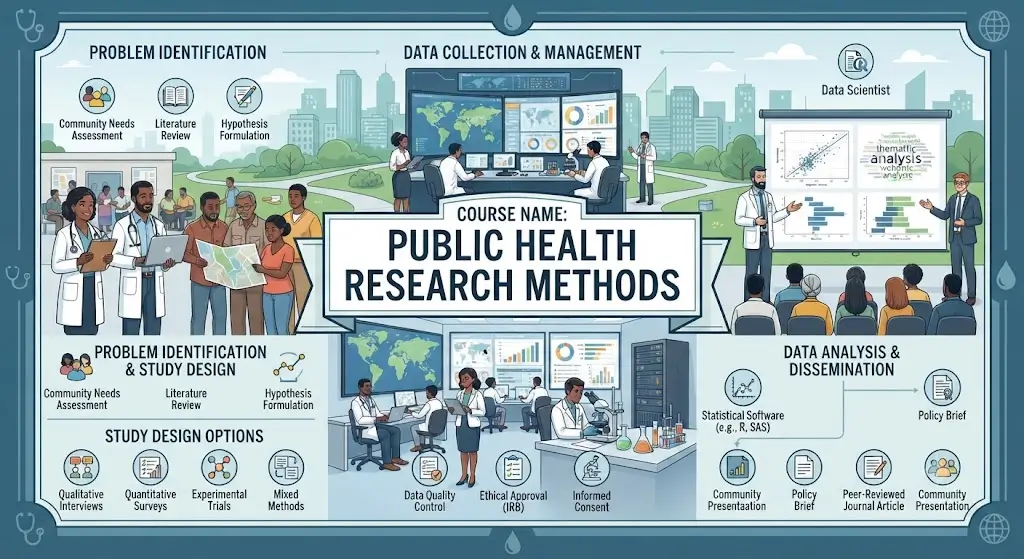
Public Health Research Methods Course
The Public Health Research Methods Course is designed to help public health professionals, healthcare workers, researchers, epidemiologists, medical practitioners, students, policy analysts, non-governmental organization (NGO) professionals, and individuals interested in population health develop the knowledge and practical skills required to conduct high-quality public health research. Effective research methods are essential for understanding health challenges, evaluating interventions, supporting evidence-based decision-making, and improving population health outcomes.
This course introduces the core principles of public health research, including research methodology, epidemiology, study design, quantitative and qualitative research methods, sampling techniques, survey design, biostatistics, health data collection, statistical analysis, research ethics, program evaluation, scientific writing, and evidence-based public health practices. Learners will gain practical knowledge of planning, conducting, analyzing, and reporting research that informs healthcare policies and public health programs.
Whether you work in healthcare, academia, government, research institutions, NGOs, or international health organizations, this course provides a comprehensive foundation in public health research methods.
Course Overview
The course explores the complete public health research process, from identifying research questions and designing studies to collecting data, analyzing findings, evaluating public health programs, and communicating research results. Learners will understand how robust research methods support disease prevention, health promotion, policy development, and improved healthcare delivery.
The curriculum combines research methodology with practical exercises, case studies, health data analysis, and evidence-based practices to prepare learners for careers in public health research and program evaluation.
What You Will Learn
By completing this course, you will be able to:
- Understand public health research principles.
- Design public health research studies.
- Select appropriate research methodologies.
- Apply quantitative and qualitative research methods.
- Develop effective sampling strategies.
- Design health surveys and questionnaires.
- Collect and manage health data.
- Apply basic biostatistics techniques.
- Analyze and interpret research findings.
- Follow research ethics and informed consent procedures.
- Evaluate public health programs.
- Prepare scientific reports and research papers.
- Support evidence-based healthcare decisions.
- Improve research quality and accuracy.
- Strengthen public health policy development.
Course Curriculum
The curriculum begins with public health research fundamentals before progressing through epidemiology, research design, quantitative and qualitative methods, sampling, biostatistics, data analysis, ethics, program evaluation, scientific writing, case studies, and future trends in health research.
Practical assignments help learners apply research methods using real-world public health scenarios.
Skills You Will Gain
After completing the course, you will develop skills in:
- Public Health Research
- Research Methodology
- Epidemiology
- Study Design
- Quantitative Research
- Qualitative Research
- Biostatistics
- Health Data Collection
- Statistical Analysis
- Research Ethics
- Program Evaluation
- Scientific Writing
- Evidence-Based Public Health
- Health Policy Research
- Critical Data Interpretation
Benefits of the Course
This course helps learners strengthen research capabilities, improve health data analysis, support evidence-based healthcare, evaluate public health interventions, and contribute to informed policy decisions. Strong public health research skills enable professionals to address health challenges, improve healthcare systems, and promote healthier communities.
These skills are highly valuable across government health departments, hospitals, universities, research institutions, NGOs, international organizations, public health agencies, pharmaceutical companies, consulting firms, and healthcare policy organizations.
Who Should Enroll
This course is ideal for:
- Public Health Professionals
- Healthcare Workers
- Epidemiologists
- Medical Practitioners
- Researchers
- Public Health Students
- Nursing Professionals
- NGO Professionals
- Health Program Managers
- Policy Analysts
- Academic Researchers
- Clinical Research Professionals
- Healthcare Administrators
- Data Analysts
- Anyone interested in public health research
Career Opportunities
After completing the Public Health Research Methods Course, learners may strengthen their qualifications for roles such as:
- Public Health Researcher
- Epidemiologist
- Health Data Analyst
- Research Associate
- Public Health Program Officer
- Monitoring and Evaluation Specialist
- Health Policy Analyst
- Clinical Research Coordinator
- Research Consultant
- Public Health Project Manager
These skills are valuable across public health agencies, hospitals, universities, research institutes, NGOs, government organizations, healthcare consulting firms, pharmaceutical companies, international health organizations, and policy research centers.
Certification Details
Upon successful completion, learners receive a Certificate of Completion recognizing their expertise in Public Health Research Methods and evidence-based research practices. This certification enhances your professional profile and supports career advancement in public health, healthcare research, epidemiology, policy analysis, program evaluation, and academic research.
If you want to conduct high-quality public health research, analyze health data effectively, and contribute to evidence-based healthcare solutions, the Public Health Research Methods Course provides practical, industry-relevant knowledge for today’s public health sector.
FAQ SECTION
1. What is the Public Health Research Methods Course?
It teaches the principles and techniques used to design, conduct, analyze, and report public health research that supports evidence-based healthcare and policy decisions.
2. Is this course suitable for beginners?
Yes. The course begins with research fundamentals and is suitable for beginners as well as healthcare and public health professionals.
3. What topics are covered?
Research methodology, epidemiology, study design, quantitative and qualitative research, biostatistics, health data collection, statistical analysis, research ethics, program evaluation, and scientific writing.
4. Do I need previous research experience?
No. The course is designed for beginners, students, healthcare professionals, researchers, and anyone interested in public health research.
5. Is the course online?
Yes. The course is fully online and self-paced.
6. Will I receive a certificate?
Yes. A certificate is awarded after successfully completing the course.
7. Who should enroll?
Public health professionals, healthcare workers, epidemiologists, researchers, students, NGO professionals, health program managers, policy analysts, and anyone interested in health research.
8. What skills will I gain?
Research design, epidemiology, biostatistics, data collection, statistical analysis, research ethics, program evaluation, scientific writing, and evidence-based decision-making.
9. Can this course help my career?
Yes. Public health research skills are highly valued across government health departments, hospitals, universities, NGOs, research institutions, healthcare consulting firms, pharmaceutical companies, and international health organizations.
10. Why are Public Health Research Methods important?
Public Health Research Methods help identify health challenges, evaluate interventions, improve healthcare programs, support evidence-based policies, strengthen disease prevention strategies, optimize resource allocation, improve population health outcomes, and advance scientific knowledge in public health.




Reviews
There are no reviews yet.