
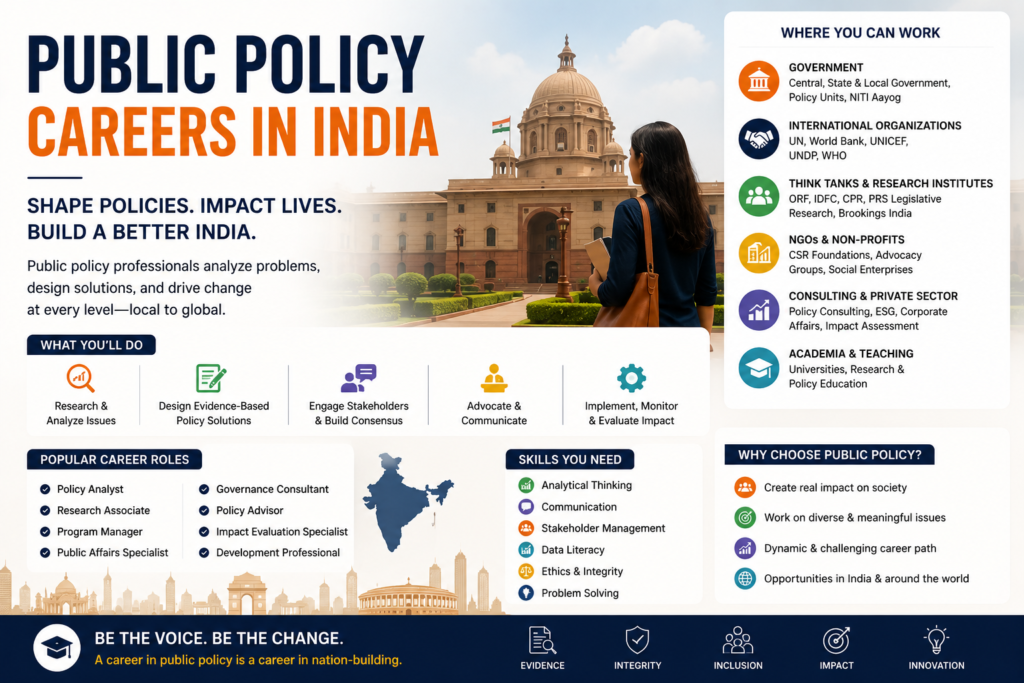
Introduction
Public policy is the backbone of governance. It determines how governments address social, economic, and environmental challenges. In India, public policy careers are gaining immense popularity among young professionals who want to make a meaningful impact. This article explores the scope, opportunities, skills, and pathways to build a successful career in public policy.
What Is Public Policy?
Public policy refers to the principles and actions adopted by governments to solve public issues. It involves research, analysis, and implementation of strategies that influence society.
Key aspects include:
- Policy formulation – Designing solutions for social and economic problems.
- Implementation – Executing policies through government programs.
- Evaluation – Measuring the effectiveness of policies.
Why Choose a Career in Public Policy?
Public policy offers a unique blend of intellectual challenge and social contribution.
Benefits of a Public Policy Career
- Social impact – Contribute to education, healthcare, and sustainability.
- Diverse opportunities – Work with government, NGOs, think tanks, or private firms.
- Policy innovation – Develop creative solutions for national issues.
- Career stability – Growing demand for policy professionals in India.
Skills Required for Public Policy Professionals
To succeed in this field, you need a mix of analytical, communication, and leadership skills.
| Skill | Description | Example |
|---|---|---|
| Research and analysis | Collect and interpret data | Policy impact studies |
| Critical thinking | Evaluate multiple perspectives | Assessing pros and cons of reforms |
| Communication | Present ideas clearly | Writing policy briefs |
| Leadership | Drive initiatives and teams | Managing social projects |
| Networking | Build connections with stakeholders | Collaborating with ministries and NGOs |
Educational Pathways for Public Policy Careers
1. Undergraduate Courses
Start with degrees in economics, political science, sociology, or law.
2. Postgraduate Programs
Enroll in specialized programs like Master’s in Public Policy (MPP) or Master’s in Public Administration (MPA).
3. Professional Certifications
Short‑term courses in data analysis, governance, or development studies enhance employability.
Top Institutes Offering Public Policy Programs in India
| Institute | Program Offered | Location |
|---|---|---|
| Indian Institute of Management (IIM) | Public Policy and Management | Bangalore, Ahmedabad |
| National Law School of India University (NLSIU) | Master’s in Public Policy | Bengaluru |
| Ashoka University | M.A. in Public Policy and Governance | Haryana |
| Tata Institute of Social Sciences (TISS) | M.A. in Development Studies | Mumbai |
| OP Jindal Global University | M.A. in Public Policy | Sonipat |
Career Opportunities in Public Policy
Public policy professionals work across multiple sectors.
1. Government Sector
Join ministries, planning commissions, or advisory bodies.
2. Non‑Governmental Organizations (NGOs)
Work on social development, education, and healthcare projects.
3. Think Tanks
Conduct research and provide policy recommendations.
4. Corporate Sector
Advise companies on regulatory compliance and social responsibility.
5. International Organizations
Collaborate with institutions like the UN, World Bank, or WHO.
Emerging Fields in Public Policy
- Climate policy – Addressing environmental challenges.
- Digital governance – Using technology for transparency.
- Health policy – Improving public healthcare systems.
- Education policy – Reforming learning and skill development.
Salary and Growth Prospects
Public policy professionals earn competitive salaries depending on experience and sector.
| Role | Average Salary (INR) | Experience Level |
|---|---|---|
| Policy Analyst | 6–10 LPA | Entry‑level |
| Research Associate | 8–12 LPA | Mid‑level |
| Program Manager | 10–15 LPA | Senior |
| Policy Advisor | 15–25 LPA | Expert |
How to Build a Successful Career in Public Policy
- Stay informed – Follow news, reports, and government updates.
- Network actively – Attend seminars and conferences.
- Gain practical experience – Intern with think tanks or NGOs.
- Develop soft skills – Communication and leadership are key.
- Pursue higher education – Advanced degrees open global opportunities.
Real‑Life Examples of Public Policy Professionals
- Dr. Bibek Debroy – Economist and member of NITI Aayog.
- Rukmini S – Data journalist influencing policy through research.
- Yamini Aiyar – President of Centre for Policy Research, shaping governance studies.
The Future of Public Policy Careers in India
With India’s growing focus on sustainable development, digital transformation, and inclusive growth, the demand for skilled policy professionals will continue to rise. The next decade will see more collaboration between government, academia, and private sectors to design impactful policies.
Conclusion
Public policy careers in India offer a chance to influence change, shape governance, and contribute to national progress. Whether you work in government, research, or advocacy, your role in public policy can help build a more equitable and sustainable future.
FAQ Section
Is public policy a good career in India?
Yes, public policy is an emerging field in India with opportunities in government agencies, think tanks, NGOs, consulting firms, and international organizations.
What qualifications are needed for public policy jobs?
Most employers prefer degrees in public policy, economics, political science, law, public administration, or related fields.
What is the salary of a public policy professional in India?
Entry-level professionals may earn ₹4–8 LPA, while experienced policy analysts and consultants can earn significantly higher depending on the organization.
Which organizations hire public policy professionals?
Government departments, policy think tanks, NGOs, consulting firms, research institutions, and international organizations frequently hire public policy experts.

