
Introduction
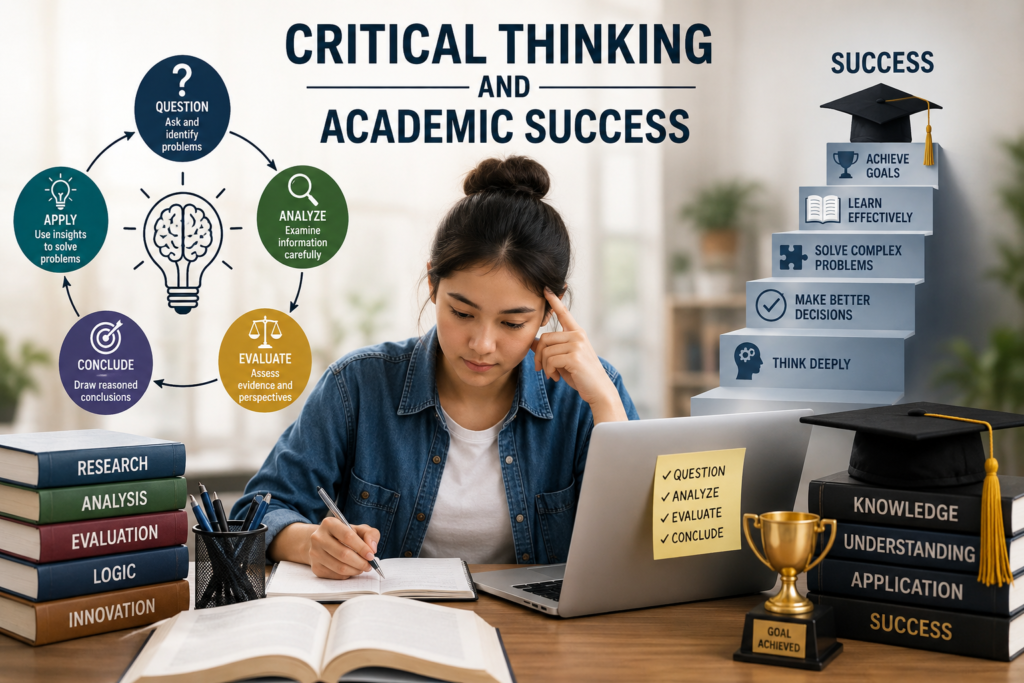
In today’s competitive academic environment, students need more than just the ability to memorize facts. Critical thinking equips learners with the skills to evaluate information, question assumptions, and apply knowledge effectively. This skill is directly linked to academic success, as it fosters deeper understanding, creativity, and problem-solving abilities
What is Critical Thinking?
Critical thinking is the ability to analyze, evaluate, and synthesize information to form reasoned judgments. It involves:
- Questioning assumptions
- Evaluating evidence
- Making logical decision
Connection Between Critical Thinking and Academic Success
- Enhanced comprehension: Students understand concepts deeply rather than superficially.
- Improved problem-solving: Helps in tackling complex assignments and exams.
- Better research skills: Students can identify credible sources and avoid misinformation.
- Effective communication: Clearer arguments in essays, debates, and presentations.
- Higher grades: Critical thinkers perform better in assessments
Role in Education
- Classroom learning: Encourages active participation.
- Exams: Strengthens analytical writing and logical reasoning.
- Group projects: Promotes collaboration and respect for diverse perspectives.
Strategies to Develop Critical Thinking
- Ask questions
- Engage in debates
- Analyze case studies
- Reflective journaling
Benefits for Academic Success
| Benefit | Impact on Students |
|---|---|
| Deeper learning | Better comprehension and retention |
| Confidence | Stronger decision-making abilities |
| Adaptability | Ability to handle new challenges |
| Leadership | Inspires teamwork and innovation |
| Lifelong skill | Valuable beyond academics |

