
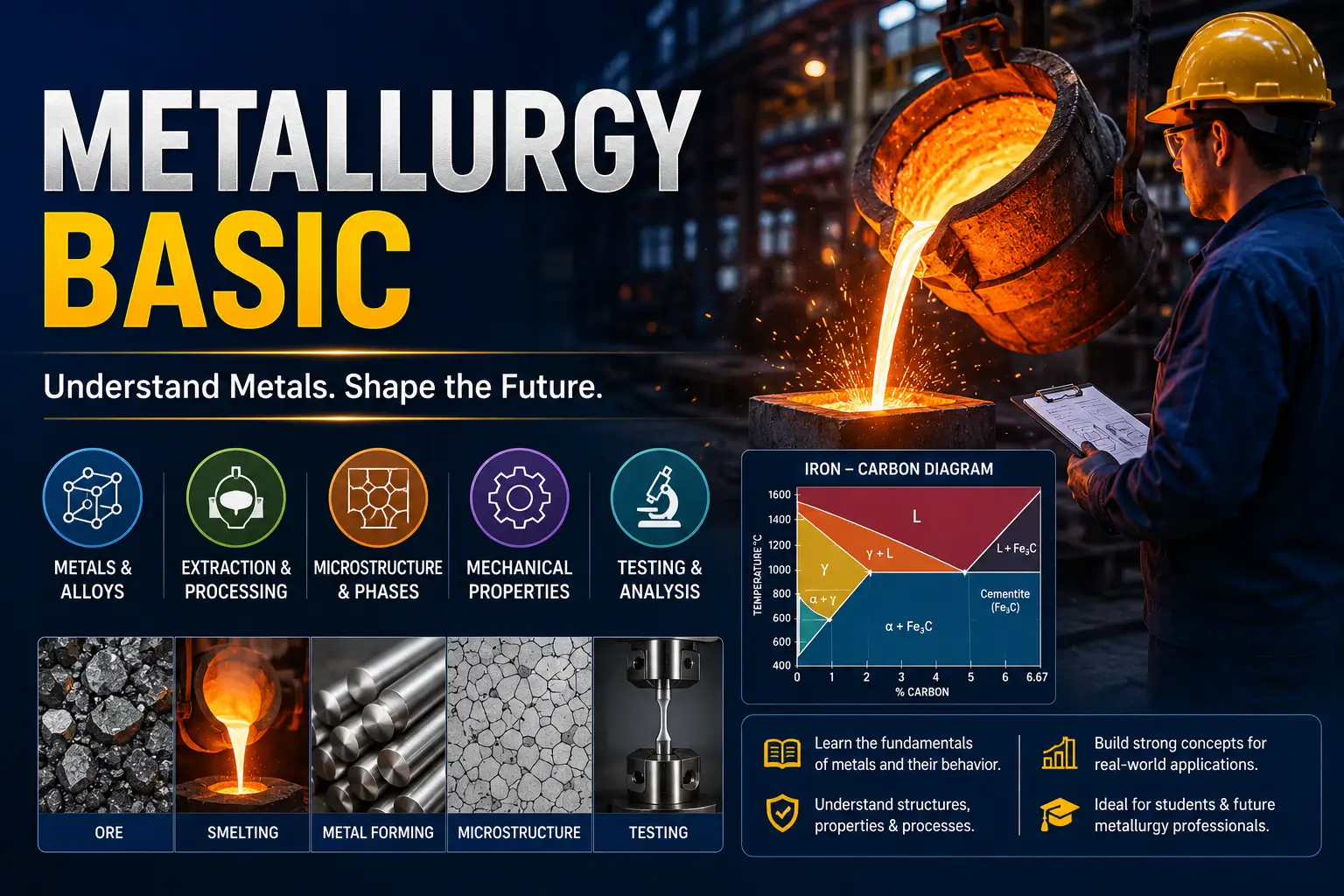
Metallurgy Basic is a foundational course designed to introduce learners to the science and technology of metals. This program covers the principles of metal extraction, refining, alloy formation, and the physical and chemical properties of metals. Learners will explore how metallurgy contributes to industries such as construction, manufacturing, aerospace, and automotive engineering.
Students will gain insights into mineral processing, smelting, casting, and heat treatment techniques, while also learning about corrosion prevention, material testing, and the role of metallurgy in modern engineering. The course emphasizes both theoretical knowledge and practical applications, preparing learners for careers in materials science and industrial engineering.
By the end of this course, participants will be able to:
- Understand the fundamentals of metallurgy and its industrial importance.
- Explore metal extraction, refining, and alloy formation processes.
- Apply heat treatment and casting techniques to improve material properties.
- Analyze corrosion mechanisms and prevention methods.
- Conduct basic material testing and quality control.
- Evaluate the role of metallurgy in engineering and manufacturing industries.
This course is ideal for students, engineers, and professionals interested in materials science, mechanical engineering, and industrial applications. With case studies, practical assignments, and industry-focused training, you’ll gain the confidence to work with metals and contribute to technological innovation.
FAQ SECTION
1. What is metallurgy?
Metallurgy is the science and technology of extracting, processing, testing, and using metals and alloys.
2. Who should enroll in this course?
Students, engineers, technicians, manufacturing professionals, and anyone interested in materials science and metal processing.
3. Do I need prior engineering knowledge?
No. The course is designed for beginners and introduces metallurgy concepts in an easy-to-understand manner.
4. What skills will I learn?
You will learn metal classification, extraction processes, heat treatment, material properties, quality control, and industrial applications.
5. Does the course cover ferrous and non-ferrous metals?
Yes. Both categories are covered along with their properties and applications.
6. Will I learn about heat treatment?
Yes. The course explains major heat treatment processes and their effects on metal performance.
7. Is certification provided?
Yes. Participants receive a certificate upon successful completion.
8. Can this course help with engineering careers?
Yes. It provides foundational knowledge valuable for engineering, manufacturing, mining, and materials science careers.
9. Does the course include quality control concepts?
Yes. Metallurgical testing and quality assurance procedures are included.
10. What career opportunities can benefit from this course?
Metallurgical Technician, Materials Testing Assistant, Manufacturing Technician, Quality Control Inspector, Production Supervisor, Mining Technician, and Engineering Support Roles.





Reviews
There are no reviews yet.