
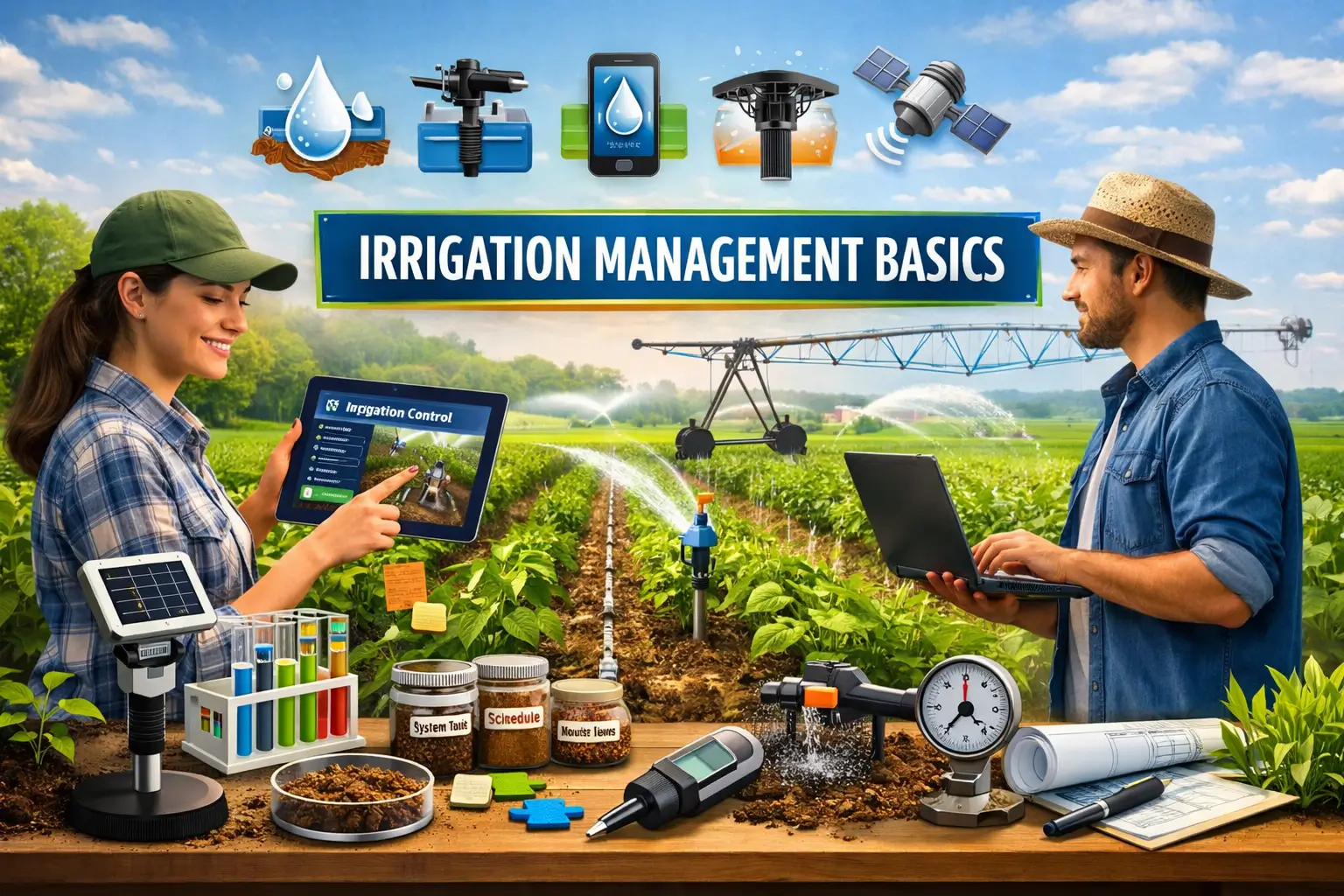
INTRODUCTION
The Irrigation Management Basics Course is a structured beginner-level agricultural training program designed to help learners understand how water is supplied, managed, and optimized for agricultural crop production. Water is one of the most critical natural resources in farming, and proper irrigation management directly impacts crop yield, soil health, and farm profitability.
In many regions, agriculture depends heavily on irrigation due to unpredictable rainfall patterns. Therefore, understanding irrigation systems is essential for farmers, agricultural students, and rural entrepreneurs who want to improve productivity and ensure sustainable farming practices.
This course focuses on practical irrigation knowledge that helps learners make informed decisions about water usage, irrigation scheduling, and system selection. It also introduces modern irrigation technologies that improve water efficiency and reduce waste.
By the end of this course, learners will understand how irrigation systems work and how to manage water resources effectively for different crops and soil types.
WHAT IS IRRIGATION MANAGEMENT?
Irrigation management refers to the planning, scheduling, and control of water application to crops in a way that ensures optimal growth and maximum productivity.
It includes determining how much water is needed, when it is needed, and how it should be delivered to the crops.
Proper irrigation management ensures that crops do not suffer from water stress or waterlogging.
It also helps in maintaining soil fertility and preventing erosion.
Additionally, irrigation management plays a key role in sustainable agriculture by conserving water resources.
IMPORTANCE OF IRRIGATION IN AGRICULTURE
Irrigation is essential because natural rainfall alone is often not sufficient for crop production.
Proper irrigation ensures consistent crop growth throughout the year.
It increases agricultural productivity and allows multiple cropping cycles.
Moreover, irrigation helps farmers grow crops in dry and semi-arid regions.
It also reduces dependency on seasonal rainfall.
Efficient irrigation systems contribute to food security and rural economic development.
TYPES OF IRRIGATION SYSTEMS
1. Surface Irrigation
Surface irrigation is one of the oldest methods where water flows over the soil surface.
It is simple and cost-effective but less efficient in water usage.
2. Drip Irrigation
Drip irrigation delivers water directly to the plant roots in small quantities.
It is highly efficient and reduces water wastage.
This system is widely used in horticulture and vegetable farming.
3. Sprinkler Irrigation
Sprinkler systems distribute water like rainfall through sprinklers.
They are suitable for uneven land and various crop types.
4. Subsurface Irrigation
This method supplies water below the soil surface.
It minimizes evaporation loss and improves efficiency.
SOIL AND WATER RELATIONSHIP
Soil plays a major role in irrigation management.
Different soil types have different water-holding capacities.
Sandy soils drain quickly while clay soils retain more water.
Understanding soil texture helps determine irrigation frequency.
Soil moisture monitoring ensures that crops receive the right amount of water.
IRRIGATION SCHEDULING
Irrigation scheduling refers to deciding when and how much water should be applied to crops.
It depends on crop type, soil condition, climate, and growth stage.
Proper scheduling avoids over-irrigation and under-irrigation.
It improves water efficiency and crop productivity.
Modern systems use sensors and data tools for precise scheduling.
WATER SOURCES FOR IRRIGATION
Water for irrigation comes from various sources such as:
Rivers
Canals
Wells
Tube wells
Rainwater harvesting systems
Reservoirs
Each source has different availability and usage conditions.
Proper management of these sources is essential for sustainable agriculture.
MODERN IRRIGATION TECHNOLOGIES
Modern agriculture uses advanced irrigation technologies to improve efficiency.
Drip systems reduce water usage significantly.
Sprinkler systems provide uniform water distribution.
Automated irrigation systems use sensors and timers.
Smart irrigation systems use weather data for decision-making.
These technologies help farmers save water and increase yield.
WATER CONSERVATION IN AGRICULTURE
Water conservation is a key part of irrigation management.
Efficient irrigation reduces water waste and environmental impact.
Techniques include mulching, drip irrigation, and rainwater harvesting.
Proper scheduling also helps conserve water resources.
Sustainable irrigation ensures long-term agricultural productivity.
COMMON IRRIGATION PROBLEMS
Farmers often face challenges such as:
Water scarcity
Uneven water distribution
Soil erosion
Salinity issues
High water costs
Understanding these problems helps in selecting better irrigation methods.
SOLUTIONS IN IRRIGATION MANAGEMENT
Solutions include:
Using drip irrigation systems
Improving soil structure
Scheduling irrigation properly
Using sensors for monitoring
Harvesting rainwater
These solutions improve efficiency and crop performance.
REAL-LIFE APPLICATIONS
Irrigation management is used in:
Crop farming
Horticulture
Greenhouse farming
Landscape irrigation
Large-scale agriculture projects
It is also used in government water management systems and rural development projects.
SKILLS YOU WILL GAIN
After completing this course, learners will develop:
Irrigation system knowledge
Water management skills
Soil moisture analysis
Crop water requirement understanding
Scheduling techniques
Sustainable farming knowledge
Problem-solving skills
Agricultural planning skills
Modern irrigation technology awareness
Farm efficiency optimization
BENEFITS OF THE COURSE
The Irrigation Management Basics Course helps learners understand efficient water usage in agriculture.
It improves crop yield and reduces water wastage.
Additionally, it supports sustainable farming practices.
Benefits include:
Better crop productivity
Efficient water usage
Cost reduction in farming
Improved soil health
Sustainable agriculture practices
Modern farming knowledge
Higher agricultural efficiency
Climate-resilient farming systems
WHO SHOULD ENROLL
This course is suitable for:
Farmers
Agriculture students
Rural entrepreneurs
Horticulture learners
Civil/agricultural engineering students
Government job aspirants
Farm technicians
Greenhouse farmers
Agriculture consultants (beginners)
Anyone interested in farming systems
CAREER OPPORTUNITIES
After completing this course, learners may pursue roles such as:
Irrigation Technician Assistant
Agriculture Field Assistant
Farm Water Management Assistant
Agricultural Technician Trainee
Irrigation System Operator
Horticulture Support Staff
Farm Planning Assistant
Water Resource Assistant
Agriculture Project Helper
Sustainable Farming Assistant
CERTIFICATION DETAILS
Upon successful completion of the Irrigation Management Basics Course, learners receive a certification recognizing their skills in irrigation systems, water management, and agricultural efficiency practices.
CONCLUSION
The Irrigation Management Basics Course provides a strong foundation in agricultural water management, irrigation systems, and sustainable farming practices. It helps learners understand how to efficiently use water resources for maximum crop productivity.
Therefore, mastering irrigation management is essential for modern agriculture, food security, and sustainable farming development.
FAQ SECTION
1. What is Irrigation Management Basics Course?
It is a beginner-level course that teaches irrigation systems and water management.
2. Who should take this course?
This course is suitable for farmers, students, and agriculture learners.
3. Do I need experience?
No, it is beginner-friendly.
4. What will I learn in this course?
You will learn irrigation systems, scheduling, and water management.
5. Is this useful for farming?
Yes, it improves crop productivity and water efficiency.
6. Will I learn drip irrigation?
Yes, drip and sprinkler systems are included.
7. Is water conservation included?
Yes, sustainable water use is covered.
8. Will I get a certificate?
Yes, a completion certificate is provided.
9. Is this useful for agriculture jobs?
Yes, it supports irrigation and farm management roles.
10. Is this useful for career growth?
Yes, it helps in agriculture and water management careers.


Reviews
There are no reviews yet.